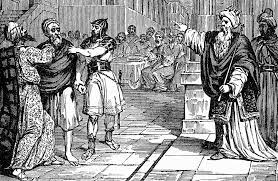
The theme of the last few weekend’s readings on the vineyard of the Lord being the House of Israel is continued this weekend. This time, the kingdom of God is not drawn as a vineyard with workers or as a vineyard with the management being changed, but as a royal wedding feast. And the feast, as given by the prophet Isaiah in the first reading, is not for a particular people or nation – not only for Israel – but emphatically for all peoples.
“A time is coming when the Lord of hosts will prepare a banquet on this mountain of ours; no meat so tender, no wine so mellow, meat that drips with fat, wine well strained. Gone the chains in which He has bound the peoples, the veil that covered the nations hitherto; on the mountain-side, all these will be engulfed; death, too, shall be engulfed for ever.”
Isaias, 25: 6-8 [link]
The location of the Holy Mountain is obviously Mount Zion or Jerusalem, and the wedding feast is a Jewish wedding feast; the gospel reading demonstrates that the first invitation of guests was the Hebrew nation of Israel, the descendants of Israel. But Isaiah speaks of the veil being lifted off the eyes of non-Jewish people, so that they come running to find the God of Israel. But the message of Christ was primarily for a Jewish audience, and He is clear here that the Hebrew nation, as represented by the chief priests and the elders of the people, had not itself responded to the invitation. As the parable continues, we discover that the king who was making the invitations had sent out servants to pursue the invitations and bring the invited in, but they were employed with secular activities – literally, the things of this world.
“…he sent other servants with a fresh summons, bidding them tell those who had been invited, By this, I have prepared my feast, the oxen have been killed, and the fatlings, all is ready now; come to the wedding. But still they paid no heed, and went off on other errands, one to his farm in the country, and another to his trading; and the rest laid hands upon his servants, and insulted and killed them. The king fell into a rage when he heard of it, and sent out his troops to put those murderers to death, and burn their city….”
Gospel of S. Matthew, 22: 4-7 [link]
These servants were the prophets who had been sent for centuries, most lately S. John the Baptist. They had all been badly-treated and somehow silenced. Here again, Christ foretells the destruction of Jerusalem and the Temple (forty years later), when He says that the king in his anger dispatched soldiers to have the murderers killed and their town burnt down. The next prophecy is of the Apostolic Church, for the new servants – the Apostles and missionaries – are now sent out to invite everybody they could find with a mind to come, even non-Jews and non-Hebrews. What a great message for all of us who are not Jews, that we should be able to enter the family of God. Our song of joy is given by Isaiah in the first reading:
“…men will be saying, He is here, the God to whom we looked for help, the Lord for whom we waited so patiently; ours to rejoice, ours to triumph in the victory he has sent us.
Isaias, 25: 9 [link]
And yet, the Lord ends the parable with a warning: there is a man invited to the wedding who had no wedding garment on, and was at once condemned to be tossed without again. Long ago, in our baptisms, we were given a literal white garment and were told by the priest baptist (whether or not we could understand, if we were baptised as infants) that we were to bring that white garment unstained before the Lord at the end of our lives. It is not easy to keep the white garment unstained, for sadly we are most of us sinners, but worse yet there are many we know (even our friends and family) who have given up their wedding garments through apostasy and denial of Christ. The response of the king in the parable, who generously invites all to the feast, is terrifying: ‘throw him without, where there is weeping and grinding of teeth.’ So, today, let us pray for the return to the practice of the faith of lapsed Christians and Catholics. For, as the Lord says…
“Bind him hand and foot, and cast him out into the darkness, where there shall be weeping, and gnashing of teeth. Many are called, but few are chosen.”
Gospel of S. Matthew, 22: 13-14 [link]
 Catholic Louth and Mablethorpe