Our religion is one of resurrection, and if we look down the history of the people of God, first in Scripture and then in Church history, we find that with every great destruction of the people a small remnant survives in faith and devotion and becomes prosperous again. We’ve heard of the proverb that history repeats itself, and the initial devotion of the remnant survives generally for a time, before being increasingly watered down and dying. I say generally, because as the general devotion of a community dies a new small remnant remains faithful and continues to hold up the torch.
“All the chief priests, too, and the common folk did heinous wrong by following the detestable ways of the heathen; desecrated that sanctuary the Lord had set apart for Himself at Jerusalem. He, the God of their fathers, sent messengers to warn them; never a day dawned but He was already pleading with them, so well He loved His people and His dwelling-place. And they? They mocked the Lord’s own messengers, made light of His warnings, derided His prophets, until at last the Lord’s anger was roused against His people, past all assuaging. Then it was that He embroiled them with the king of Babylon, who came and put their young men to the sword in the sanctuary itself, pitying neither young man nor maid, old man nor cripple; none might escape His attack. All the furniture of the Lord’s house, great and small, all the treasures of temple and king and princes, must be carried off to Babylon. Enemy hands set fire to the Lord’s house, pulled down Jerusalem’s walls, burnt its towers to the ground, destroyed all that was of price. Those who escaped massacre were carried off to Babylon, where they must live as slaves to the king and his heirs until their empire should pass to the king of Persia…”
Second book of the Paralipomena (Chronicles), 36: 14-20 [link]
In this first reading this weekend, we hear of the calamitous destruction of Jerusalem and her Temple in 587BC. This was Solomon’s Temple; the great tragedy of its destruction is mirrored by the psalm sandwiched between the readings – that Boney M classic (psalm 136(137)). This second book of the chronicles of the kings began with the construction of this wonderful building and the establishment of its liturgical ritual according to the plan of the shepherd-king David. The priestly chronicler gives a theological justification for God’s permitting the destruction of His Temple: infidelity upon infidelity on the part of the people. Infidelity to God, because they had ignored His commandments, they had ignored the Law of charity. Failing in their charity to God, they had fallen into idolatry and syncretism, which is the worship of multiple gods, the Holy One becoming one of this pantheon. From idolatry, they had naturally fallen into moral depravity, abusing each other in various ways. God had sent them prophets to guide them, but this had had no effect. Thus came the scourge of the Babylonian king, who razed Jerusalem to the ground and carried away most of the people into exile.
After a great snip-snip, the reading tells us about a remnant of this people in Babylon who were permitted by the Persian king Cyrus to return to Jerusalem and rebuild. We should look at this story as similar to the story of the flood and Noah in the book of Genesis, who knows how long before this event in the Chronicles. In the Noah story, a sinful humanity was washed away, and a remnant of it – Noah and his family, with some animals – survived to rebuild. Within a few decades, Jerusalem would be remade, the walls built by the governor Nehemiah, the liturgical rites of a restored temple being offered by priests like Ezra. And within a few centuries, Christ would be on the streets of Jerusalem calling for the people to repent and return to Him, their ancient God, or calamity would strike again. And they crucified Him, as before they had rejected and mistreated the prophets. And within a few decades, in AD70 the Romans would raze Jerusalem to the ground. And a remnant of the people would remain in the surviving Jews and especially in the Church of Christ. O let my tongue cleave to my mouth, if I remember you not, o Jerusalem… Jerusalem stands for the earthly glory of the Chosen People. In so far as we rest upon that earthly glory and ignore the glory of the Holy One Who lives within the Temple, we have built our houses on sand and can be blown away by the turbulence of this world. The Church too has an earthly glory, but our gaze must be set upon the glory of the Holy One Who lives within our hearts as He did within His Temple of old, in Jerusalem. Our sinful behaviour attaches us to this earth and forces Him out of the temples that are our hearts.
“How rich God is in mercy, with what an excess of love He loved us! Our sins had made dead men of us, and hHe, in giving life to Christ, gave life to us too; it is His grace that has saved you; raised us up too, enthroned us too above the heavens, in Christ Jesus. He would have all future ages see, in that clemency which He shewed us in Christ Jesus, the surpassing richness of His grace. Yes, it was grace that saved you, with faith for its instrument; it did not come from yourselves, it was God’s gift, not from any action of yours, or there would be room for pride.”
Letter of S. Paul to the Ephesians, 2: 4-9 [link]
That grace S. Paul speaks of in the second reading, that divine gift which comes to us principally through the sacraments of the Church, will lift our gaze from this earth and fix them upon the God Who redeems us. It is the argument of the Church that even in the great tragedies of our history, such as the destruction of the Jerusalem Temples, there is a great mercy. For with such protracted physical and mental suffering comes a purification of the heart of the people: as they are stripped of the externals of religion and the securities of walls and armies, they rediscover the heart of their ancient faith and are drawn back to the God Who awaits them.
“And this Son of Man must be lifted up, as the serpent was lifted up by Moses in the wilderness; so that those who believe in Him may not perish, but have eternal life. God so loved the world, that He gave up His only-begotten Son, so that those who believe in Him may not perish, but have eternal life. When God sent His Son into the world, it was not to reject the world, but so that the world might find salvation through Him. For the man who believes in Him, there is no rejection; the man who does not believe is already rejected; He has not found faith in the name of God’s only-begotten Son. Rejection lies in this, that when the light came into the world men preferred darkness to light; preferred it, because their doings were evil. Anyone who acts shamefully hates the light, will not come into the light, for fear that His doings will be found out. Whereas the man whose life is true comes to the light, so that His deeds may be seen for what they are, deeds done in God.”
Gospel of S. John, 3: 14-21 [link]
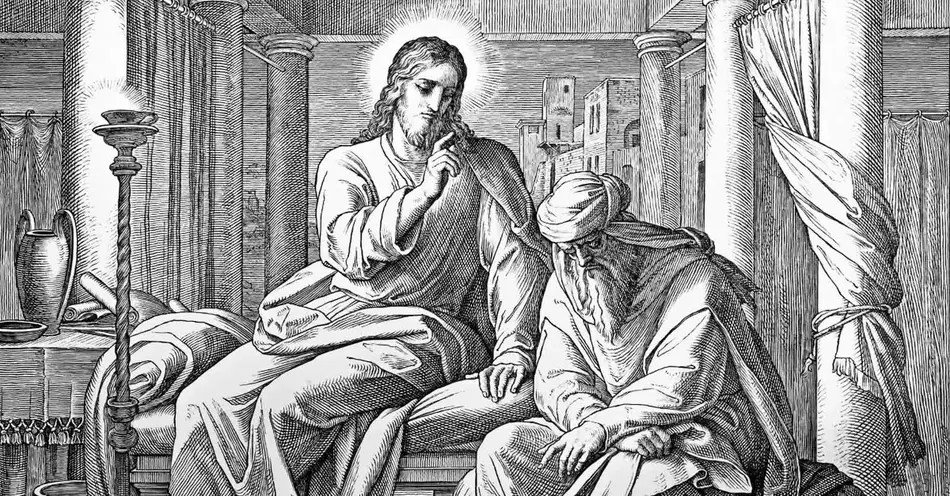
Our gospel reading from the Gospel of S. John is a discourse between Christ and the pharisee S. Nicodemus on baptism – one of the seven sacraments. Baptism is tied inextricably with faith, either the faith of the adult convert or the faith of the parents of the infant catechumen. This faith and belief, the gospel reading associates with light – a theme that is distinctively one of S. John’s, seen in both his Gospel and in his first letter. So Christ declares that they who do not believe – that is, they who prefer the darkness to the light – are condemned by their very choice.
There will come a time, at the end of all things, when, just as with Noah and with the destruction of Jerusalem, everything will pass away. But there will be a remnant, as there always is, to populate a new heaven and a new earth. That remnant is associated with belief in Christ, as He has said multiple times, and so is associated with baptism, by which men and women have embraced the light of Christ, Who called Himself the Way, the Truth and the Life, the only gate of access to the union with God which is the true fulfilment of human existence.
 Catholic Louth and Mablethorpe