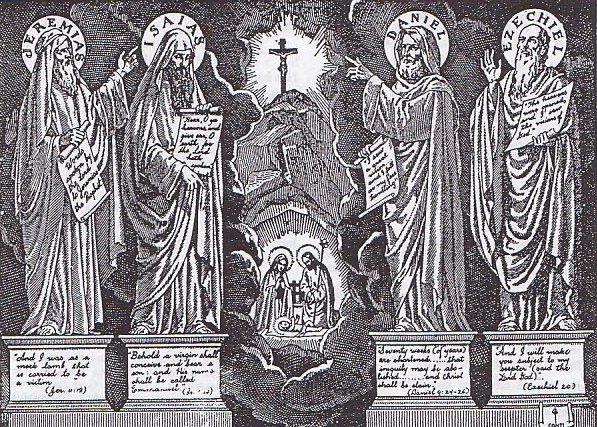
We had a sentiment of prophecy in our readings last weekend, when it seemed evident that prophets are always sent, whether or not people listen to them. The directions of the Creator for right human living arrive in every time, whether or not the worlds receives them well. In our readings this weekend, we discover the humble origins of the prophets of Holy Scripture, and then we must think to ourselves where the prophets of today are to come from. In our first reading, we find the prophet Amos, one of the first (chronologically speaking) of the prophets whose records we have in our Old Testaments.
“…a message came to Jeroboam, king of Israel, from Amasias that was priest at Bethel. ‘Here is Amos,’ said he, ‘raising revolt against thee in the realm of Israel; there is no room in all the land for such talk as his; Jeroboam to die at the sword’s point, Israel to be banished from its native country!’ And this was his counsel to Amos, ‘Sir prophet, get thee gone; in Juda take refuge if thou wilt, and there earn thy living by prophecy. Prophesy here in Bethel thou mayst not, where the king’s chapel is, and the king’s court.’ ‘What,’ said Amos, ‘I a prophet? Nay, not that, nor a prophet’s son neither; I am one that minds cattle, one that nips the sycamore-trees; I was but tending sheep when the Lord took me into His service. It was the Lord bade me go and prophesy to His people of Israel. He has a message for thee: Thou wilt have no prophesying against Israel, no word dropped against Bethaven? Here, then, is the divine doom pronounced on thee: Wife of thine, here in the city streets, shall be dishonoured; sons and daughters of thine shall die at the sword’s point; lands of thine shall feel the measuring-rope. And for thyself, on unhallowed soil death awaits thee, when Israel is banished, as banished it needs must be, from the land of its birth.'”
Prophecy of Amos, 7: 10-17 [link]
In Amos’ time, the united kingdom of David and Solomon had been knifed down the middle and the more prosperous half – the northern kingdom, called Israel – had immediately fallen into idolatry and syncretism. Amos was sent by the Holy One from the southern kingdom of Judah, where the Temple still shone like a beacon in Jerusalem, to draw the people of the northern kingdom back to the religion of their ancestors. Or else, death and destruction awaited the people, as above. But in our reading today, the priest Amazyah (Amasias in the Greek) of the new religion in the Bethel attempts to evict Amos and send him home. Amazyah was probably a professional prophet and yes-man, one of those who told the northern king – here Jeroboam – what he wanted to hear. Amos replies, to say that he is himself not a professional, rather he is a shepherd and a sycamore-dresser, and it was through an ordinary worker of the land that the Holy One wished to speak.
There is a similar message in the gospel story we have today. The Twelve were a particular group of men chosen to draw the people to Christ, the Holy One now standing among them in the flesh. We know the professions of many of these Twelve – the leaders were almost all fishermen, and at least one of them was a former tax-collector, and the Lord Himself was a carpenter. Even if the profession of tax-collector was greatly despised, these were all ordinary Jews, and working people. They were not residents of Jerusalem, who had the ear of the Roman procurator, or the regional rulers, or even of the Temple priests. But here, Christ sends them out with the authority of the God of Israel, to the point of their being able to chase out devils that were tormenting poor souls.
“And now He called the Twelve to Him, and began sending them out, two and two, giving them authority over the unclean spirits. And He gave them instructions to take a staff for their journey and nothing more; no wallet, no bread, no money for their purses; to be shod with sandals, and not to wear a second coat. ‘You are to lodge,’ He told them, ‘in the house you first enter, until you leave the place. And wherever they give you no welcome and no hearing, shake off the dust from beneath your feet in witness against them.’ So they went out and preached, bidding men repent; they cast out many devils, and many who were sick they anointed with oil, and healed them.”
Gospel of S. Mark, 6: 7-13 [link]
That staff or walking stick sounds a little like a symbol of authority. Now here’s an interesting detail: He tells them not to take provisions for their preaching journeys: no bread, no haversack, etc. Just as He had once sent Amos out with nothing, He now sends these Twelve out with no product of their own work. How shall we read that?
Consider that at the very beginning, in Adam and Eve, we were properly dependent upon the Holy One. Then came pride, disobedience, and humanity seizing after independence from God. We thought we could be gods, too, and that was the original temptation of the serpent in the garden. In men like Noah and Abraham, God found a humanity that accepted the reality of human existence and was willing to submit to Him again, to live in dependence upon divine providence. ‘Go where I tell you,’ said God to Abraham, and Abraham said, ‘Very well, lead the way, my fate is in Your hands.’ Every prophet in later times also gave his or her life to God, and the prophet of God lives by the providence of God. We know from the stories of the Old Testament that men like Elijah were often destitute and fugitives, but they were brought food by birds and animals, and they found water by striking rocks in the desert by the divine command. The very origin story of Israel is a story of God drawing His chosen people out of prosperity in Egypt and into a wilderness, where their entire existence was entirely dependent upon Him.
The Twelve would also find the means of survival through the hospitality God would find them, or otherwise through divine providence. And if they didn’t receive the hospitality that heaven demanded, and were treated as Amos was, they would give the Jewish ultimatum of shaking the dust off their feet. In our own times, the message of the gospel is not welcome and we are not always received well. Ask a street preacher, and you will learn how many people are willing to even stop. And neither are the priests of Christ always welcome, and there must be a lot of shaking of dust off feet in some places. But, by the grace of God, we are not without support and sustenance, thanks to the generosity of the people of our parishes. Just as the Twelve were not permitted to carry sustenance, we too are forbidden by the Church authority to pursue any trade and support ourselves thereby, although most of us are well capable of doing so, as S. Paul once did in order to not trouble his young churches with donations to his mission.
And, speaking of S. Paul, let’s have a look at our rather long second reading this weekend, in which that early Christian prophet sings about the blessing that Christ has brought upon His Church, about the election of Christians to be holy and spotless and children of God by adoption, about the forgiveness we have received as a gift through the Blood of Christ, which makes us God’s own, stamped with the seal of the Holy Spirit…
“Blessed be that God,
Letter of S. Paul to the Ephesians, 1: 3-14 [link]
that Father of our Lord Jesus Christ,
Who has blessed us, in Christ,
with every spiritual blessing, higher than heaven itself.
He has chosen us out, in Christ,
before the foundation of the world,
to be saints, to be blameless in His sight, for love of Him;
marking us out beforehand (so His will decreed)
to be His adopted children through Jesus Christ.
Thus He would manifest the splendour of that grace
by which He has taken us into His favour
in the person of His beloved Son.
It is in Him and through His blood
that we enjoy redemption, the forgiveness of our sins.
So rich is God’s grace, that has overflowed upon us
in a full stream of wisdom and discernment,
to make known to us the hidden purpose of His will.
It was His loving design, centred in Christ,
to give history its fulfilment
by resuming everything in Him,
all that is in heaven, all that is on earth,
summed up in Him.
In Him it was our lot to be called,
singled out beforehand to suit His purpose
(for it is He who is at work everywhere,
carrying out the designs of His will);
we were to manifest His glory,
we who were the first to set our hope in Christ;
in Him you too were called,
when you listened to the preaching of the truth,
that gospel which is your salvation.
In Him you too learned to believe,
and had the seal set on your faith
by the promised gift of the Holy Spirit;
a pledge of the inheritance which is ours,
to redeem it for us and bring us into possession of it,
and so manifest God’s glory.”
 Catholic Louth and Mablethorpe