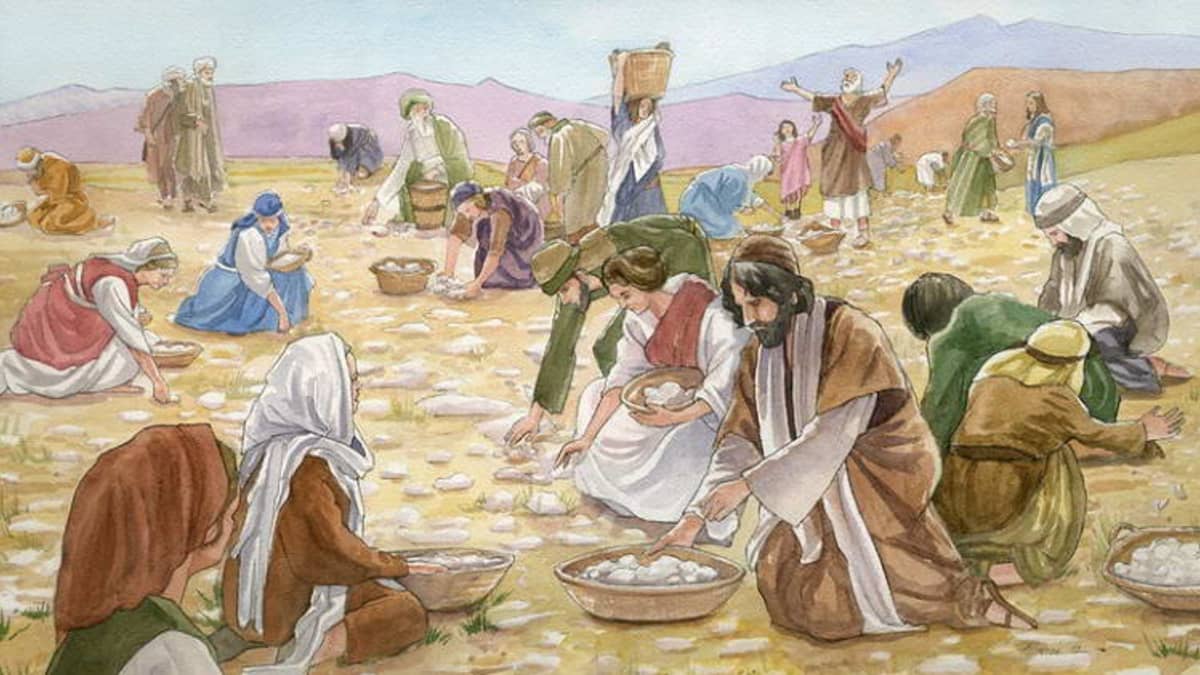
“After this, Jesus retired across the sea of Galilee, or Tiberias, and there was a great multitude following Him; they had seen the miracles He performed over the sick. So Jesus went up on to the hill-side, and there sat down with His disciples. It was nearly the time of the Jews’ great feast, the paschal feast. And now, lifting up His eyes and seeing that a great multitude had gathered round Him, Jesus said to Philip, ‘Whence are we to buy bread for these folk to eat?’ In saying this, He was putting him to the test; He Himself knew well enough what He meant to do. Philip answered Him, ‘Two hundred silver pieces would not buy enough bread for them, even to give each a little.’ One of His disciples (it was Andrew, Simon Peter’s brother) said to Him, ‘There is a boy here, who has five barley loaves and two fishes; but what is that among so many?‘ Then Jesus said, ‘Make the men sit down.’ There was no lack of grass where they were; so the men sat down, about five thousand in number. And Jesus took the loaves, and gave thanks, and distributed them to the company, and a share of the fishes too, as much as they had a mind for. Then, when they had all had enough, He told His disciples, ‘Gather up the broken pieces that are left over, so that nothing may be wasted.’ And when they gathered them up, they filled twelve baskets with the broken pieces left over by those who had eaten. When they saw the miracle Jesus had done, these men began to say, ‘Beyond doubt, this is the Prophet who is to come into the world.’ Knowing, then, that they meant to come and carry Him off, so as to make a king of Him, Jesus once again withdrew on to the hill-side all alone.”
Gospel of S. John, 6: 1-15 [link]
It’s good, every now and then, to be brought back around to the greatest gift that the Church has possessed from the very beginning: the divine sustenance, the true bread from heaven, the most Holy Eucharist. To make all the necessary connections this weekend, I shall once more return to the garden of Eden, and the origins of the race of men. In the beginning, as demonstrated by the book of Genesis, mankind lived in perfect harmony with the mind of God, in perfect dependence upon the divine providence. This was ruptured by the sin of our first parents, a sin of pride and disobedience which basically told God that we could live independently of Him, that we could do it on our own, that we could be gods like Him. When the Christian Church began to lift her head in the midst of the Roman Empire, one of the first of the criminal charges levelled against her was impiety – impiety towards the general idea of human religions. The Church had dared to say that she relied not upon human beings like Caesar (for he was no god, as no secular authority can be) and human societies like the Roman society (sufficiency built on collaboration among people). Rather, the Church would place all her hopes upon the God Who loves her.
The Church thus rejected the temptation of the serpent in the garden, and rejects it constantly, and so places her many hearts within the Sacred Heart, reliant entirely upon Him. This devout attitude was foreshadowed in the work of the great men and women of both the Old Testament period and the New, whom we call Saints. We see one of these Saints, the prophet Elisha (here Eliseus), also multiplying bread in the first reading today.
“Once, too, a man came from Baal-Salisa, bringing with him twenty barley loaves, his first-fruit offering, and nothing besides except some fresh grain in his wallet. Eliseus would have a meal set before the company, and when his servant asked how this would suffice for a hundred mouths, he said again, ‘Set it before the company for their meal; they shall eat, the Lord says, and leave some over.’ And when he set it before them, eat they did and leave they did; so the Lord’s promise was fulfilled.”
The fourth (or second) book of Kings, 4: 42-44 [link]
All these miracles of feeding multitudes of people in the desert are meant to call to the general mind of the people the miraculous feeding of the Israelites with manna when they had emerged from slavery in Egypt. I should again mention (as I often do) the general principle that the biblical processions into the desert imply: the drawing of the people from the sufficiency of the cities and towns and into the scarcity of the desert, the drawing of the people from the security of human provision to the insecurity of dependence upon God. Note again that slavery in Egypt was more comfortable than life in the desert; this is obvious from the multiple time Moses had to prevent the Israelites from running back to Egypt for reasons of discomfort.
We are meant to learn a lesson from these stories. None of us would think it prudent today to walk for any amount of time into, say, the Sahara desert and expect to be fed miraculously. But the Church has her own means of leading her children into the desert, and has in the past commanded very severe seasonal fasts, such as the present Lenten sacrifices but more tedious, and also several more. Our Latin church has softened considerably since the middle of the twentieth century, but other Eastern churches still have rigorous rules of fasting and abstinence. It is the constant advice of the Saints we honour that it is by giving up the comforts of this world and our dependence upon them that we find divine sustenance, that we find the Union with God that is the goal of our Christian existence.
This is why most of the Saints in the history of the Church (who were not martyred for the Faith) have come from the numerous Religious Orders, which have codified into their statutes and codes the rules of fasting and abstinence that have led men and women into the desert with Christ, where He has fed them miraculously. We could also suggest that it is partly because of the laxity in religious practice of the Church in the last several decades that the Church has been increasingly secularised, and that the Religious Orders have lost thousands of members and are many of these Orders are dying.
Basically, it could be said that we are as a community now back in Egypt, enslaved with the passions of the world of our time, waiting for another Moses to call us to travel three days in the desert to find God again. We must find a measure of detachment from the things of this world, so that we may soar heavenward. This is truly a martyrdom: to deny ourselves physical and material comforts so that our only true possession becomes God Himself. The great martyrs of the Church took this shedding of possessions to its logical extreme, giving even their very lives. Not all of us will find that strength of mind, that strength of devotion. But we must nevertheless move forward into the desert again, as a community, as a church, guided by the Successor of S. Peter.
The second reading speaks of this unity of Christians in our procession of faith, a unity that is characterised by mutual charity (our love for each other), generosity of heart, with one and the same hope, united in love to the Holy One, God our Lord, Who is Father of all, and to Whom be glory for endless ages.
“Here, then, is one who wears chains in the Lord’s service, pleading with you to live as befits men called to such a vocation as yours. You must be always humble, always gentle; patient, too, in bearing with one another’s faults, as charity bids; eager to preserve that unity the Spirit gives you, whose bond is peace. You are one body, with a single Spirit; each of you, when he was called, called in the same hope; with the same Lord, the same faith, the same baptism; with the same God, the same Father, all of us, who is above all beings, pervades all things, and lives in all of us.”
Letter of S. Paul to the Ephesians, 4: 1-6 [link]
 Catholic Louth and Mablethorpe