This book is a history of the original settlement of the Holy Land by the Israelites, and is interesting in the similarities it has to the more recent settlement of the Holy Land by the Jews, followed by the establishment of the Zionist State of Israel. If today we hear loud cries of ‘Colonialism!’ and ‘Genocide!’ and ‘Settlers!,’ well, what must the Canaanites of old have thought when the Israelites arrived in their hundreds of thousands from Egypt, followed by extraordinary stories of the God of heaven working miracles on their behalf? The difference in approach is clear: Joshua had arrived from the great power of Egypt with a formidable number of men, arranged as a proper army, and must have struck fear into the hearts of the settled peoples; whereas the modern State of Israel did begin with small and peaceful colonies of Jews who had to unite together and create a military guard when surrounding tribes of Arabs began to grow in envy of their prosperity.
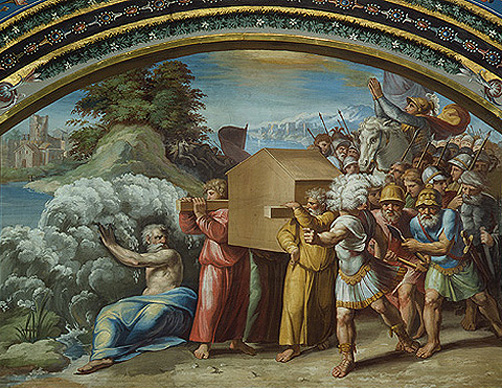
Following on from the Book of Deuteronomy, Joshua (a contraction of Yehoshua, which also contracts in the Greek to Yesous, anglicised as Jesus) was the new captain of the people, inheriting the job from Moses, who had died on the wrong side of the Jordan river, in the hills of Moab. Joshua began by planning the overthrow and destruction of the ancient city of Jericho from the camp in Setim in Moab, sending out spies, who were assisted by the treachery of the prostitute Rachab, who hid them in her home while they were being searched for and later signalled for the beginning of the Hebrew attack. Now, Joshua acquired the respect of the people by repeating on a smaller scale the great miracle of Egypt – the crossing of the Red Sea. Here, Joshua led the people through the river Jordan on a dry bank, as the waters piled up to the north (image above). There was already a lot of formal ritual in this passage of the river, for the priests carrying the Ark of the Covenant were to stand in mid-stream until after the people had passed over, the hundreds of thousands of them. Representatives from every tribe were to witness the majesty of this miracle and, in a further ritual element, new representatives from each tribe were to collect twelve large rocks from where the priests stood in the river, one each, to commemorate the crossing.
The crossing took place just before the Passover celebration that year, and the Israelites camped at Galgal, not far from Jericho, where the Abrahamic commitment to the physical circumcision of the men was renewed (it had fallen into general neglect during the wandering in the wilderness). After the Pasch, began the great ritual attack on Jericho. For six days, trumpets would sound and the army once circled the city, which was now in a state of siege. On the seventh day, they went around seven times and, with a great trumpeting and a shouting of the people, the walls of the city came down.
The rest of the conquest narrative covers a series of bloodbaths, as several Canaanite towns apparently had their populations removed and slaughtered. We must keep in mind that this book is more of a Jewish hagiography of Joshua than a proper history, and although it demonstrates apparent genocides, later narratives show the presence of tribes of Canaanites living in harmony with the Israelites, and periodically causing them to descend into paganism and idolatry.
Long ago, in the book of Numbers, more than forty years before in the timeline, Moses had sent scouts into the Holy Land from Seir in the south, among other things to measure the strength of the people living there. They had come back with a discouraging message:
“Forty days had passed before they returned from their survey, after traversing the whole country, to find Moses and Aaron and all the people of Israel still in the desert of Pharan, by Cades. To these and to the whole multitude they made their report, and shewed them what fruit the land yielded. And this was the story they told: ‘When we reached the land where our errand lay, we found it indeed a land all milk and honey, as this fruit will prove to you; but it is a powerful race that dwells in it, with strong walled cities; such were the sons of Enac, whom we saw there. The south is occupied by Amelec, the mountain parts by Hethites, Jebusites and Amorrhites; by the sea, and round the Jordan river, the Chanaanites are in possession.'”
Numbers, 13: 26-30
The result of this had been the great sedition against Moses that had ended with the curse of God on the people, that they should not see the Holy Land, but should die in the wilderness, only their children entering in. Hence, they wandered for forty years. Moses and Joshua, receiving the command of God, had obviously realised that the Holy Land was already well-populated and that the residents would have to be dispossessed, in an almost complete replacement. To prevent recurring wars as that people attempted to recover the land, these people would have to be exterminated. Hence the series of horrendous bloodbaths, as cities were taken and entire populations destroyed with their belongings. Only one of the local tribes, the Gabaonites, was shrewd enough to negotiate peace with Joshua. The other Canaanite kings formed alliances against him. From the ruins of Jericho, and their camp at Galgal, there were new attacks on a series of cities: starting at Hai (near Bethel), which was burnt to the ground, a rescue of the Gabaonites led to the conquest of Jerusalem, Hebron, Jerimoth, Lachis and Eglon, as those kings had allied against Gabaon. Thus, as the sun and moon poetically ceased their movement in the heavens, Joshua and his army destroyed almost all resistance in the middle country and the hill-country of what would soon become the territory of the tribes of Judah and Simeon.
In quick succession, Maceda, Lebna, Lachis, Gazer, Eglon, Hebron and Dabir were emptied of people, and the Israelite army returned to their camp at Galgal. This was all in the south country. A second alliance of the Canaanite kings in the north country followed, and a great army, with cavalry and chariots, was destroyed by the Israelites at Merom, giving Joshua all that we would call Galilee and the plain of Jezreel, even the mountains around Hermon and the lower part of the Lebanon range. The book tells that thirty one kings in total were slaughtered and their domains taken. The rest of the book tells of the partitioning of this territory among the tribes, according to the desires of God and of Moses. The united army was now disassembled and the rest of the conquest would thenceforth be managed locally, for pockets of resistance remained, such as of the Philistine and Gessurite country to the south-west and Maarites and Giblites in the north-west, and the Jebusites in the hill-country of Judah. The Israelite camp had moved from Galgal to Silo for the partitioning of the land and, by the end of the book, had arrived at Sichem in the mid-country.
The book ends with the death of Joshua at 110, the last general captain of united Israel until the monarchy was instituted with King Saul. He was buried in the city of of Thamnath-Saraa, where he had himself chose to live in for his last days. The bones of the patriarch Joseph, which had been brought from Egypt, were buried at the new religious centre (for the tabernacle was there located) at Sichem. Meanwhile, the second high-priest, Eleazar, the son of Aaron, died and was buried at a place called Gabaath in the country of Ephraim.
And that is the book of Joshua, if anything a lesson in geography, with some memorable ritual/liturgical elements, such as the one for the bringing down of city walls. And the great slaughters, to demonstrate to the Israelites/Hebrews/Jews of all time that this was their country, God fighting to win it for them.
 Catholic Louth and Mablethorpe