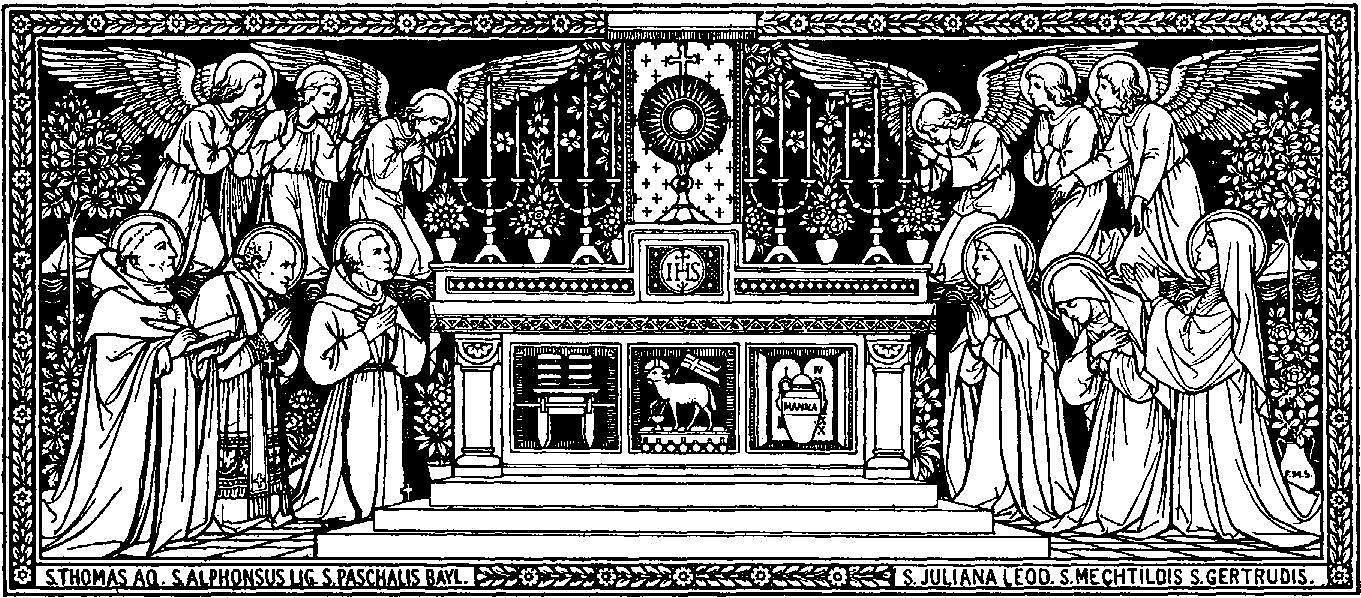
Our readings this weekend demonstrate invitations by God to a chosen people, who are always given the freedom to either accept or decline. But if they do accept, they do so not on their own conditions but on His. We should remember that in the relationships that God arranges with an elect people, He paints Himself as the Bridegroom and the People consequently become the Bride. It follows that the relationship involves the mutual give-and-take that characterises faithful marriage. With that in mind, let’s have a look at the gospel message, which terminates our month-long read through chapter six of the Gospel of S. John: the Holy Communion chapter.
“Jesus said to them, ‘Believe Me when I tell you this; you can have no life in yourselves, unless you eat the flesh of the Son of Man, and drink His blood. The man who eats My flesh and drinks My blood enjoys eternal life, and I will raise him up at the last day. My flesh is real food, My blood is real drink. He who eats My flesh, and drinks My blood, lives continually in Me, and I in him. As I live because of the Father, the living Father who has sent Me, so he who eats Me will live, in his turn, because of Me. Such is the bread which has come down from heaven; it is not as it was with your fathers, who ate manna and died none the less; the man who eats this Bread will live eternally.‘ He said all this while He was teaching in the synagogue, at Capharnaum. And there were many of His disciples who said, when they heard it, ‘This is strange talk, who can be expected to listen to it?’ But Jesus, inwardly aware that His disciples were complaining over it, said to them, ‘Does this try your faith? What will you make of it, if you see the Son of Man ascending to the place where He was before? Only the spirit gives life; the flesh is of no avail; and the words I have been speaking to you are spirit, and life. But there are some, even among you, who do not believe.’ Jesus knew from the first which were those who did not believe, and which of them was to betray Him. And He went on to say, ‘That is what I meant when I told you that nobody can come to Me unless he has received the gift from My Father.’ After this, many of His disciples went back to their old ways, and walked no more in His company. Whereupon Jesus said to the Twelve, ‘Would you, too, go away?’ Simon Peter answered Him, ‘Lord, to whom should we go? Thy words are the words of eternal life; we have learned to believe, and are assured that Thou art the Christ, the Son of God.’“
Gospel of S. John, 6: 54-70 [link]
We know how often Christ declared in that chapter, ‘I AM the Bread of Life.’ Last week, we saw that Christ as Wisdom has designed for His Church that she become a temple of His glory, that every Christian soul should be a temple of the Holy Spirit. This level of intimacy in a relationship takes the concept of human marriage to its very extreme. First, He (the Bridegroom) gives Himself entirely to us (the Bride), body and soul, through His great Sacrifice on the Cross, and then through the Sacrament of Holy Communion. Second, He invites us who believe in Him to give ourselves entirely to Him, body and soul.
If we have heard this idea before, it’s because it is the subject of the spiritual theology of the Catholic Church and is very present in our catechisms and very evident in the life and teachings of the Saints of the Church. ‘Are you willing to enter into this relationship with Me?’ He asks in the gospel reading today. ‘You have seen my miracles? Can I not do this inconceivable thing? Does it upset you if I do? Would you take the risk and have eternal life?’ And the horrifying thing is that He permits us to say No, and watches sadly as the people He loves turn their backs on Him. And He remains unapologetic and clear about this doctrine of the Holy Eucharist.
In the first reading, He invited the Hebrews to an earlier covenant relationship through Joshua, the captain of the people after the death of Moses. Look at the response of that people, in that time; they have escaped slavery in Egypt and seen the great miracles of the Holy One and, having passed through the wilderness on the way to the Holy Land, they now expect greater things. ‘We will be His people,’ they say, ‘and He our God.’
“‘…You crossed Jordan, and made your way to Jericho. And the men of Jericho withstood you, Amorrhite and Pherezite, Chanaanite and Hethite, Gergesite and Hevite and Jebusite, but I gave you the mastery over them. I sent hornets in your path, and drove two kings of the Amorrhites out of their countries, before they could suffer from bow or sword of yours. I have given you lands that others had tilled, cities to dwell in, not of your building, vineyards and oliveyards, not of your planting. And now, will you fear the Lord, giving Him full and loyal service, will you banish the gods your fathers obeyed in Egypt, or in Mesopotamia, and serve the Lord only? If the Lord’s service mislikes you, choose some other way. Shall it be the gods your fathers worshipped in Mesopotamia, or the gods of the Amorrhites, in whose land you dwell? I and mine will worship the Lord.’ And with that, the whole people cried in answer, ‘Never will we forsake the Lord, and yield ourselves to alien gods! Never will we forsake the Lord our God, Who rescued us and our fathers from slavery in Egypt, Who did signal miracles under our very eyes, Who protected us on our long journey, so beset by enemies, Who dispossessed all these tribes, of native Amorrhite stock, to make room for us here. Serve we the Lord; he is our own God.‘”
Book of Joshua, 24: 11-18 [link]
This response, which Christ was looking for in the gospel story, comes not from the majority of the crowds of people He had fed wonderfully with a few bits of bread and a couple of fish only a little while before. It comes from the impulsive fisherman who was probably dismayed to see the people shaking their heads and going away. He makes the commitment to the theology of the Eucharist with characteristic emotion, speaking for the other Apostles as usual, ‘There is nowhere else to go but to You, for You are the Holy One of God.’ And that is what you and I should do as Catholics, in the midst of a world of unbelief, atheism and despair. We are to look at the Man on the Cross and say to Him, ‘Stay with us always, for we shall never leave You.’ This is a marriage which should last forever.
And speaking of marriage, let’s have a look at S. Paul’s instructions to husbands and wives in our second reading today. Keep in mind here that he’s addressing a first-century Greco-Roman church, where women didn’t have the same social standing as men, and where slavery was a fact of life. Nevertheless, the Apostle says that wives should give the respect to their husbands that the Church gives to Christ, and that husbands should love their wives with the love God has for the Church.
“Give thanks continually to God, Who is our Father, in the Name of our Lord Jesus Christ; and, as you stand in awe of Christ, submit to each other’s rights. Wives must obey their husbands as they would obey the Lord. The man is the head to which the woman’s body is united, just as Christ is the head of the Church, He, the Saviour on whom the safety of His body depends; and women must owe obedience at all points to their husbands, as the Church does to Christ. You who are husbands must shew love to your wives, as Christ shewed love to the Church when He gave Himself up on its behalf. He would hallow it, purify it by bathing it in the water to which His word gave life; He would summon it into His own presence, the Church in all its beauty, no stain, no wrinkle, no such disfigurement; it was to be holy, it was to be spotless. And that is how husband ought to love wife, as if she were his own body; in loving his wife, a man is but loving himself. It is unheard of, that a man should bear ill-will to his own flesh and blood; no, he keeps it fed and warmed; and so it is with Christ and his Church; we are limbs of His body; flesh and bone, we belong to Him.”
Letter of S. Paul to the Ephesians, 5: 20-30 [link]
Modern feminism doesn’t like this language of submission, but given what I’ve already said and what Paul has written you may be able to see that the submission of husband and wife is mutual. If God can die shamefully on a cross for His Church and give of Himself to her every day in Holy Communion, husbands can rub their faces into the ground for the sake of their wives. Or, in the language of the reading, they can love their wives as they love their own bodies. So, every one of us who is or has been married has or has had the opportunity to live this mystery of Holy Communion everyday. This mystery of divine love, given to men in sacrament – God given to men, in order that men may be made gods.
 Catholic Louth and Mablethorpe