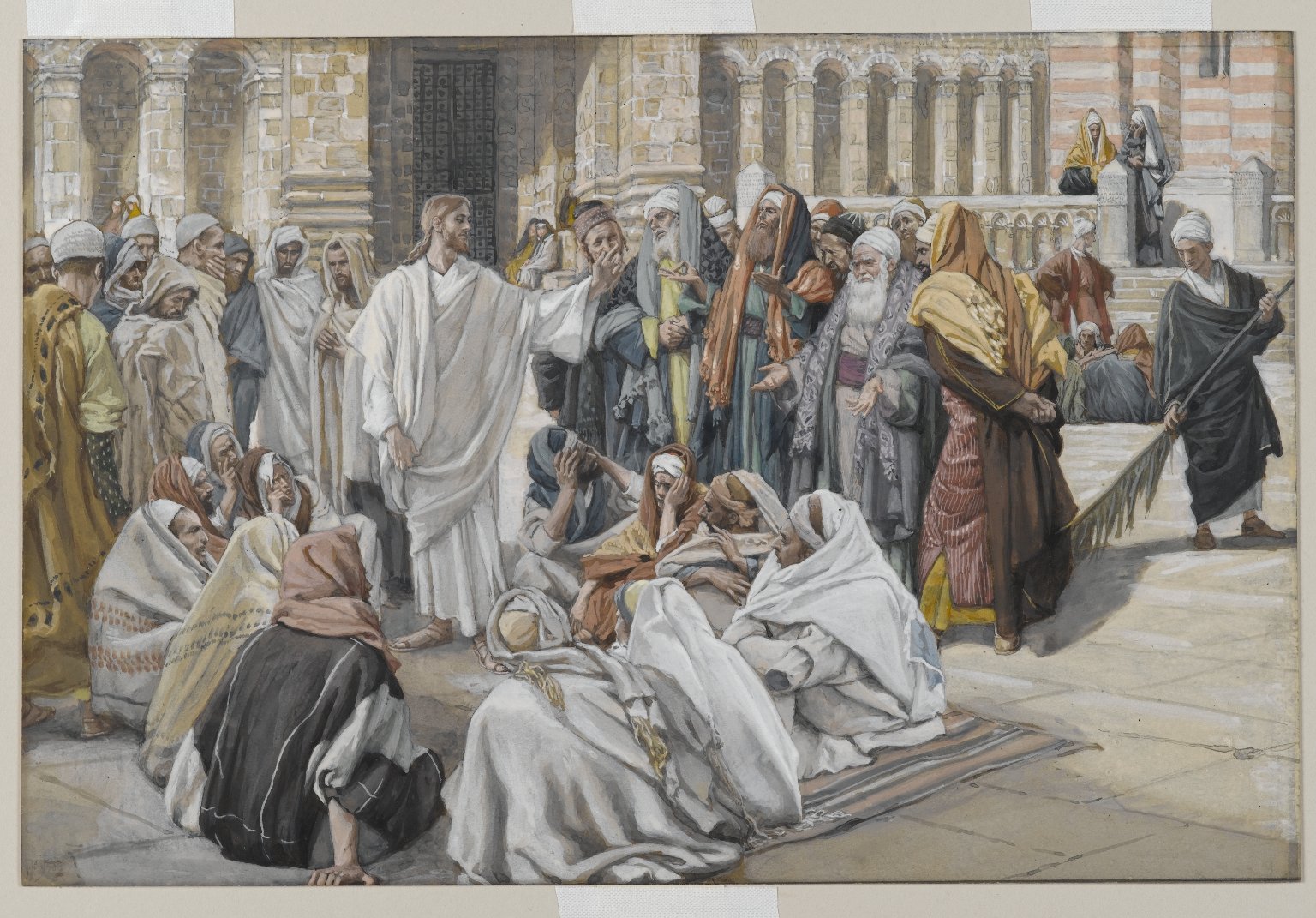
I think that one of the reasons the Pharisees and the disciples of Christ had so many arguments, as we are told by the gospel stories, is that they were both groups of orthodox Jews. And in the best tradition of the Jewish people, the Orthodox have a good old argument every now and again about the best way to observe the Law of Moses. Naturally, Christ, since He gave the Law to Moses in the first place, gets the better of these arguments and disputes. But that is not what the party of the Pharisees would tell us, if we could speak to them today. No, they would say, we must remain with the customs of our fathers. So then, what is this Law of Moses about which everybody was arguing? Let’s look at our first reading, which comes from Deuteronomy, which is greek for second-law: the law given to the people before their conquest and possession of the Holy Land.
“And now, Israel, pay good heed to the laws and the decrees I am making known to you. It is yours to observe them, if you would have life; if you would find your way into the land promised you by the Lord God of your fathers, and take possession of it. There must be no adding to this message of mine, no retrenching it; the commands I lay upon you are the commands of the Lord your God; keep them well. Your own eyes have witnessed what sentence the Lord passed against Beelphegor, purging out from among you all that worshipped at his shrine, while you, who remain faithful to the Lord, have lived to remember it. Be well assured that the laws and decrees I have given you come from the Lord Himself, and must still be observed when you have taken possession of the land that is to be yours. Keep them in honour and live by them; these are to be the arts, this the wisdom, that you teach the world, as men come to hear of these laws, and say to themselves, Surely they must be wise, surely they must be discerning folk, that belong to so great a nation as this! And indeed no other nation is so great; no other nation has gods that draw near to it, as our God draws near to us whenever we pray to Him. What other nation can boast that it has observances and decrees so rightly ordered as we have in this Law of ours, this law which I am setting before your eyes to-day?”
Book of Deuteronomy, 4: 1-8 [link]
Moses talks about laws and customs he has personally taught them, and says that the observance of these traditions and customs is the condition of avoiding death and possessing the Land. Add nothing, Moses says, and remove nothing from this my legacy to you. And that is the important note for us in the first reading. Over the course of time, as it is the way with human societies, the pharisees and the scribes and the rabbis had added to the law of Moses and, even if they had done so for very good reasons, these were still non-essential accretions.
Moses had prescribed ritual purification for the priests of the tabernacle in the desert, which was later applied to the priests of the Temple in Jerusalem. The pharisees and their associates had taken these ritual washings unto themselves, although they were not all priests, and were using ritual washings in the home and in common life, as we clearly see in the narrative of the gospel today. Now, we could probably see the piety in this: they were seeking after the holiness of the Temple priests. And we can see the hygienic benefits: with all this washing of the hands and forearms before meals, and the showering after returning from the marketplace, they were probably healthier than other Jews and certainly non-Jews.
“…the Pharisees, and indeed all the Jews, holding to the tradition of their ancestors, never eat without washing their hands again and again; they will not sit down to meat, coming from the market, without thorough cleansing; and there are many other customs which they hold to by tradition, purifying of cups and pitchers and pans and beds. So the Pharisees and scribes asked Him, ‘Why do Thy disciples eat with defiled hands, instead of following the tradition of our ancestors?’ But He answered, ‘You hypocrites, it was a true prophecy Isaias made of you, writing as he did, This people does me honour with its lips, but its heart is far from me; their worship of me is vain, for the doctrines they teach are the commandments of men. You leave God’s commandment on one side, and hold to the tradition of man, the purifying of pitchers and cups, and many other like observances.’ And He told them, ‘You have quite defeated God’s commandment, to establish your own tradition instead…'”
Gospel of S. Mark, 7: 1-9 [link]
But they made the mistake of associating these pieties of theirs with obedience to God, and the God Who had thundered the Law down to Moses was standing right there among them, as they accused His disciples of impiety and ignoring traditions. And He Who could see through the superficiality of their piousness, and into their hearts, was prepared to attack their hypocrisy. Those who persevere in uncharity and viciousness in their hearts, while appearing outwardly religious, cannot stand unscathed before the fire of divine love.
And so our Lord teaches us a very good lesson at the end of the gospel story today: it is this uncharity, this cruelty of the heart, and every other sin (and He lists several sins) – it is this that makes the heart unclean, and it comes from without. And you may wash and wash and wash your hands ritually, and you will probably live a long life on earth, but you will not necessarily acquire spiritual cleanness or purity before the Holy One, unless you turn away from sin and seek the true medicine that can purify and cleanse your heart of sin and malice. What is that true medicine? Let’s have a look at our second reading, from the apostle S. James.
“Whatever gifts are worth having, whatever endowments are perfect of their kind, these come to us from above; they are sent down by the Father of all that gives light, with whom there can be no change, no swerving from his course; and it was His will to give us birth, through His true word, meaning us to be the first-fruits, as it were, of all His creation. You know this, my beloved brethren, well enough. It is for us men to be ready listeners, slow to speak our minds, slow to take offence; man’s anger does not bear the fruit that is acceptable to God. Rid yourselves, then, of all defilement, of all the ill-will that remains in you; be patient, and cherish that word implanted in you which can bring salvation to your souls. Only you must be honest with yourselves; you are to live by the word, not content merely to listen to it. One who listens to the word without living by it is like a man who sees, in a mirror, the face he was born with; he looks at himself, and away he goes, never giving another thought to the man he saw there. Whereas one who gazes into that perfect law, which is the law of freedom, and dwells on the sight of it, does not forget its message; he finds something to do, and does it, and his doing of it wins him a blessing. If anyone deludes himself by thinking he is serving God, when he has not learned to control his tongue, the service he gives is vain. If he is to offer service pure and unblemished in the sight of God, who is our Father, he must take care of orphans and widows in their need, and keep himself untainted by the world.”
Letter of S. James, 1: 17-27 [link]
Every good gift, every perfect good, even the sanctifying grace that brings the purification we are looking for, comes from above from the Holy One, Who adopts us as His own children, plants His word within us as a seeding and nurtures the crop that will inevitably result, so that we should deliver the first-fruits of our produce to Him. And we all of us (hopefully) deliver those first-fruits of our personal devotion at Mass, every time we are here, offering it to Him in the offertory, placing it in that chalice the priest holds aloft while he says his secret prayers.
Just as Moses had required the people to make a commitment to God by following the commandments, James now asks that we submit to the word of the gospel planted within us, listening and obeying it. And James is clear that the true, pure and unspoilt religion is shown not by the superficialities of dress, accessories and numerous ritual washings, but as is made evident by the spirit of charity (towards widow and orphan, he says, but we can extend it further) and purity from the filth of sin and evil that always surrounds the Church, threatening to engulf her. But by the grace of God, she perseveres and stands in all holiness before the God Who loves her.
 Catholic Louth and Mablethorpe