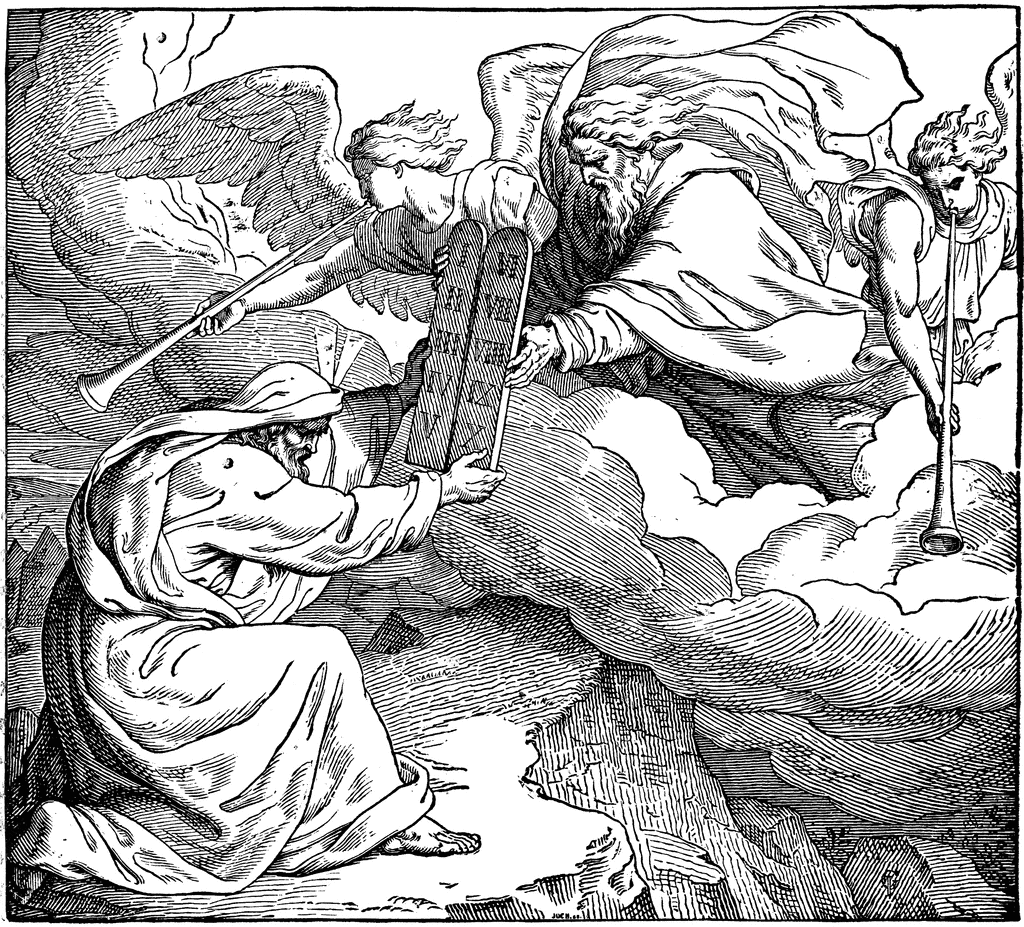
Our readings this weekend begin with the delegation of apostolic authority for ministry within the Church. Remember that the Greek word ‘apostle’ simply refers to somebody who is sent, but in the Christian context that refers to a very particular missionary with extraordinary delegated power and responsibility to govern and sanctify. We’re talking here about sacramental power, and associated powers to heal and to chase away demonic forces. If we look closely in the New Testament, the word ‘apostle’ seems almost synonymous with the early Christian priests, who were to bring the Holy Eucharist – the Mass – to the new communities formed or being formed around the Roman Empire, and beyond. Among these many early apostles, there was the closed group of the Twelve, whose we know so well, and whose number had to be restored after the betrayal of Judas, which was one by election.
So, what are these delegated powers and responsibility of the Christian apostle? Let’s have a look at the original story of the appointment by Moses of seventy elders to share his responsibility for the government of the people, in the first reading today.
“And when the Lord came down, hidden in the cloud, to converse with him, He took some of the spirit which rested upon Moses and gave it to the seventy elders instead; whereupon they received a gift of prophecy which never left them. This same spirit rested even upon two men, Eldad and Medad, who were still in the camp; their names were enrolled among the rest; but they had never gone out to the tabernacle. There in the camp they fell a-prophesying, and a messenger ran to bring Moses tidings of it. At this, Josue the son of Nun, that was Moses’ favourite servant, cried out, ‘My lord Moses, bid them keep silence.’ ‘What,’ said he, ‘so jealous for my honour? For myself, I would have the whole people prophesy, with the spirit of the Lord resting on them too.'”
Book of Numbers, 11: 25-29 [link]
The theme of government in this reading (the Seventy were meant to act as judges assisting Moses as supreme judge) is a sure indication that one of the powers and responsibilities of the seventy was indeed to govern the sacred community: to administer justice according to the Law of God, to maintain peace within that community, and to bring the Law to the people. Such an act – of bringing the word of God to the people – is precisely what prophecy means. A prophet is primarily a go-between, who draws the minds of men and women nearer to the mind of the Holy One. So, we see the Seventy of Moses prophesying almost immediately. Even when two of the appointed elders of the people had not attended the solemn commissioning, they received on account of their appointment the gift of interpreting the Law in the camp, and Moses declared, How I wish that everybody could so be inspired as to become an oracle of divine Wisdom.
This is a wish we should all have. We all yearn to know the will of God, we know that great men and women whom we call Saints became oracles of God in their own lifetimes, and we pray for the inspiration of the Holy Spirit that we too could be like them: Saints in a world of sin and darkness. For this is all about understanding the will of God as given by his commandments and testimonies, and communicating it to every last person in this world. Why? Because, as we dutifully responded to the psalm, The precepts of the Lord gladden the heart. Not just my heart, or your heart, or a generic Christian heart. No, they are meant to gladden every human heart, to draw all men and women eventually to their source, in the bosom of the God Who created them and loves them beyond all telling.
This is our true wealth, as King Solomon once realised: the divine Wisdom, by which we live well and live for others. So the Apostle S. James lands a bit of a diatribe in the second reading against those who treasure the passing goods of this world – gold and silver, etc. – all gathered at the expense of the happiness and well-being of others.
“Come, you men of riches, bemoan yourselves and cry aloud over the miseries that are to overtake you. Corruption has fallen on your riches; all the fine clothes are left moth-eaten, and the gold and silver have long lain rusting. That rust will bear witness against you, will bite into your flesh like flame. These are the last days given you, and you have spent them in heaping up a store of retribution. You have kept back the pay of the workmen who reaped your lands, and it is there to cry out against you; the Lord of hosts has listened to their complaint. You have feasted here on earth, you have comforted your hearts with luxuries on this day that dooms you to slaughter. You have condemned and murdered the innocent man, while he offered no resistance.”
Letter of S. James, 5: 1-6 [link]
Let us then treasure not wealth and status, but divine Wisdom, let us seek to learn it from our Christian sources: from Scripture and tradition, and from the Lives of the Saints. For are we not all in some way apostles? If sacramental power is delegated to a handful of select men, the rest of us are a type of missionary disciple, bringing the precepts and judgements of God to the rest of mankind, bringing the word of God to a world that doesn’t have it and sorely needs it. We, having acquired a measure of Christian charity, must teach others of our families and friends and those within our social circles how to do the same. If we see Christian charity at work near us, we should cheer it on even when it exists beyond the bounds of the Apostolic Church, as the Lord says in the Gospel, for nobody who works great miracles of faith in His Name can in any way curse Him. And anybody who gives a Christian man or woman at least a glass of refreshment for the good that they have done is marked down for reward by the Holy One.
“And John answered Him, ‘Master, we saw a man who does not follow in our company casting out devils in Thy Name, and we forbade him to do it.’ But Jesus said, ‘Forbid him no more; no one who does a miracle in My Name will lightly speak evil of Me. The man who is not against you is on your side. Why, if anyone gives you a cup of water to drink in My Name, because you are Christ’s, I promise you, he shall not miss his reward. And if anyone hurts the conscience of one of these little ones, that believe in Me, he had better have been cast into the sea, with a millstone about his neck. If thy hand is an occasion of falling to thee, cut it off; better for thee to enter into life maimed, than to have two hands when thou goest into hell, into unquenchable fire; the worm which eats them there never dies, the fire is never quenched. And if thy foot is an occasion of falling to thee, cut it off; better for thee to enter into eternal life lame, than to have both feet when thou art cast into the unquenchable fire of hell; the worm which eats them there never dies, the fire is never quenched. And if thy eye is an occasion of falling, pluck it out; better for thee to enter blind into the kingdom of God, than to have two eyes when thou art cast into the fire of hell; the worm which eats them there never dies, the fire is never quenched.'”
Gospel of S. Mark, 9: 37-47 [link]
So, just as the young men in the first reading apparently did not receive sanction for prophesying but were still given power by the Holy Spirit, so here a figure not linked to the Apostolic Church is working miracles with the authority of Christ’s Name. And the Holy Spirit works where He will. The reading ends with a warning about sin, to avoid which we must be prepared to end all relationships with other people that we know can destroy our souls spiritually. This can be very painful and a true martyrdom, for deep friendships we have cherished may have to be ended, because to continue them would be to risk committing sin and the consequent damnation. For we have a responsibility to acquire virtue and demonstrate it to all around us, for if we instead bring scandal to the Church with sin and vice – having become thereby bad or ineffective apostles – well, according to that gospel reading, there is a fire that is never quenched and a rotting that never ends.
 Catholic Louth and Mablethorpe