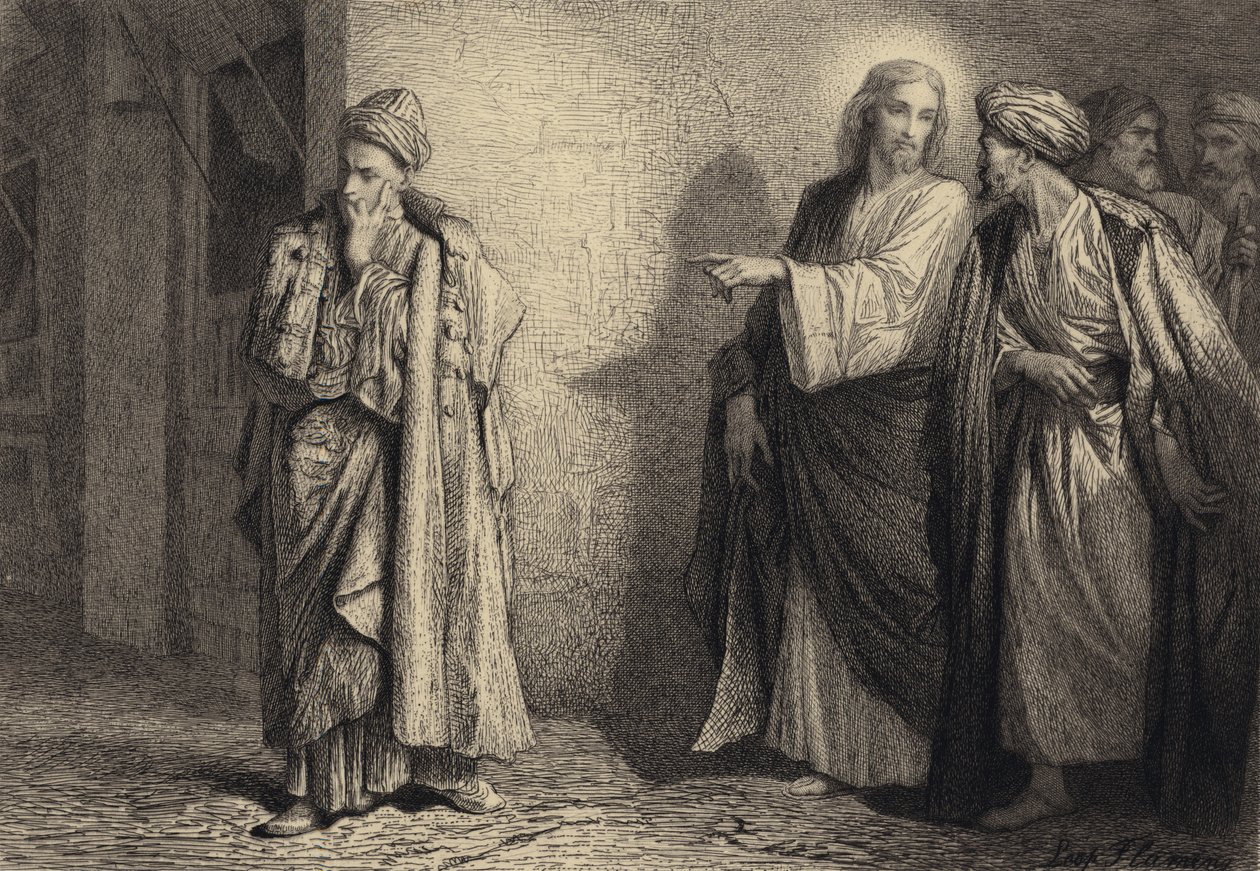
There’s something I mention reasonably often: integrity and sincerity. Let us define religion as rite and ritual: the ceremonies that walk us from soon after we are born, through the period of adolescence and early adulthood, that sanctify our ordinary life throughout and that then finally carry us into the tomb. Why do people who believe in God seek after religion? It perhaps is because they are seeking to please Him and enter into holiness. But many of us walk into the sacramental life of the church almost as automatons, going through the motions because that’s what’s done in a society that still has some sentiment of its Catholic routes.
But for the few now who still take religion seriously, holiness is crucial. ‘Holiness’ is a set-apartness, and it is not something we acquire for ourselves, but which is given us by the Holy One as we strive to approach Him. But how do we so strive? As heirs of the ancient covenants God made with the Hebrews, and the great new covenant He made upon the cross, we know that we are to keep His commandments to demonstrate our love for Him. He made us and knows how we should ideally live to fulfil His plan for us, and He desires to guide us towards that end. With His commandments. We see this striving after holiness through the keeping of the commandments in the heart of the young man of the gospel story.
“Then He went out to continue his journey; and a man ran up and knelt down before Him, asking Him, ‘Master, Who art so good, what must I do to achieve eternal life?’ Jesus said to him, ‘Why dost thou call Me good? None is good, except God only. Thou knowest the commandments, Thou shalt not commit adultery, Thou shalt do no murder, Thou shalt not steal, Thou shalt not bear false witness, Thou shalt not wrong any man, Honour thy father and thy mother.’ ‘Master,’ he answered, ‘I have kept all these ever since I grew up.’ Then Jesus fastened His eyes on him, and conceived a love for him; ‘In one thing,’ He said, ‘thou art still wanting. Go home and sell all that belongs to thee; give it to the poor, and so the treasure thou hast shall be in heaven; then come back and follow Me.’ At this, his face fell, and he went away sorrowing, for he had great possessions. And Jesus looked round, and said to His disciples, ‘With what difficulty will those who have riches enter God’s kingdom!’ The disciples were amazed at His words; but Jesus gave them a second answer, ‘My children, how hard it is for those who trust in riches to enter God’s kingdom! It is easier for a camel to pass through a needle’s eye, than for a man to enter the kingdom of God when he is rich.’ They were still more astonished; ‘Why then,’ they said to themselves, ‘who can be saved?’ Jesus fastened His eyes on them, and said, ‘Such things are impossible to man’s powers, but not to God’s; to God, all things are possible.'”
Gospel of S. Mark, 10: 17-27 [link]
I’ve done it all, says the rich young man to Christ, I have obeyed the Law of God, is there anything else I should do? The Law of Moses doesn’t answer that question. Even today, a typical rabbi will tell his disciples that they are to keep as many as possible of the 613 or so commandments of the ancient Law to be a good Jew. The radical demand Christ makes – to give everything up for His sake – is new to the common Jewish understanding, and it raises the bar ever higher. We could say that holiness – true and perfect holiness – is always beyond our reach. We are to strive after it, and seek to complete the sacrifice of who we are to God, and pray for Him to grant us His good graces, to make us holy.
We know from the history of the Church that some of the greatest Saints whose names we can remember – Lawrence, Agatha, Benedict, Dominic, Teresa, Francis, Rita, etc. – were men and women who did just what Christ asked of this young man of the gospel: they sought the desert experience, giving away family and wealth, giving away everything for the sake of Christ and the gospel. They tend in general to be martyrs for the faith, or confessing monks and nuns, or otherwise clergymen who lived common lives in colleges and convents. I do not mean that we who live in the world cannot acquire holiness, but you will perhaps admit that it is much harder for us, surrounded as we are by worldliness and temptations, and distractions of every sort.
Would that we could be carried away from this world of comfort and diversion into a wilderness, if only for a time, as Moses carried the people away from Egypt into the barrenness of Sinai. How hard it is, our Lord says, for the man rich in pocket and so anchored to this world to look beyond this world – how hard it is for him to acquire holiness – to draw near to God. But, then He goes on, it is not impossible, by the grace of God. Difficult, but not impossible. It needs a little effort on our part, and God will carry us the rest of the way. S. Peter takes up the plaintive note of the martyrs of every century, and the monks, the nuns, the hermits, as he asks, What about us, who have left all for Your sake and the sake of the Gospel?
“Jesus fastened His eyes on them, and said, ‘Such things are impossible to man’s powers, but not to God’s; to God, all things are possible.’ Hereupon Peter took occasion to say, ‘What of us, who have forsaken all, and followed thee?’ Jesus answered, ‘I promise you, everyone who has forsaken home, or brothers, or sisters, or mother, or children, or lands for My sake and for the sake of the gospel, will receive, now in this world, a hundred times their worth, houses, sisters, brothers, mothers, children and lands, but with persecution; and in the world to come he will receive everlasting life.'”
Gospel of S. Mark, 10: 27-30 [link]
And so Peter receives for all of these holy men and women the promise of Christ of due compensation in a world beyond this one. But meanwhile, living this life of consecration to God – a life we Christians are all called to – is to be accompanied by persecution from a world that doesn’t understand it and often sees it as a threat. How could men and women treasure divine Wisdom and understanding more than winning a lottery or driving expensive cars and living in large houses? But King Solomon would say (in our first reading)…
“Whence, then, did the prudence spring that endowed me? Prayer brought it; to God I prayed, and the spirit of wisdom came upon me. This I valued more than kingdom or throne; I thought nothing of my riches in comparison. There was no jewel I could match with it; all my treasures of gold were a handful of dust beside it, my silver seemed but base clay in presence of it. I treasured wisdom more than health or beauty, preferred her to the light of day; hers is a flame which never dies down. Together with her all blessings came to me; boundless prosperity was her gift.”
Book of the Wisdom of Solomon, 7: 7-11 [link]
As given by this reading from Wisdom, this necessary abandonment of or detachment from the world by Christians living in the world, and the seeking after God alone, is the pursuit of divine Wisdom that is sung about in the Old Testament. Obviously the ‘radical’ call of the Gospel is not entirely new at all, for it is buried within the Old Testament and needs to be drawn out and brought to our attention, as here. The sage says (in this reading), I held riches as nothing, nay, I valued divine Wisdom to be greater than such wealth.
We may end this post with the second reading from the letter to the Hebrews, which now calls the Wisdom of God His word. This word of God is alive and active, and it sifts men and women, dividing them between those who would reach after God and those who would not bother, and between those who have a lukewarm approach to religion and holiness and those who strive after it in all sincerity. That is how divine Wisdom knifes through so finely, judging between our most private thoughts and emotions. As God once said to Moses, and He does to us, we are to choose good and avoid evil, follow His commandments, and then He will be with us always, yes, until the very end.
“God’s word to us is something alive, full of energy; it can penetrate deeper than any two-edged sword, reaching the very division between soul and spirit, between joints and marrow, quick to distinguish every thought and design in our hearts. From Him, no creature can be hidden; everything lies bare, everything is brought face to face with Him, this God to Whom we must give our account.”
Letter of S. Paul to the Hebrews, 4: 12-13 [link]
 Catholic Louth and Mablethorpe