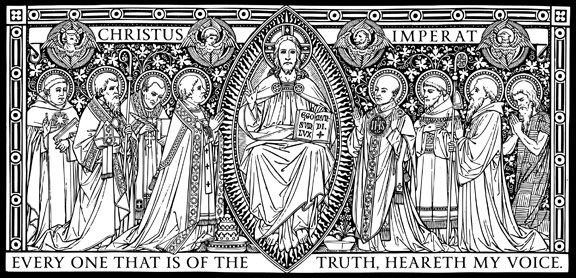
Once more, as we come to the end of the liturgical year, in these last Sundays before Advent, our readings become apocalyptic and speak of the end of all things. This sort of thing can be frightening to the people of this world – those who have set their hearts upon the things of this world. When we have invested very much upon material things, we don’t like to hear that the material world is doomed to pass away. So, the prophet Daniel speaks in our first reading of a great distress.
“Time, then, that Michael should be up and doing; Michael, that high lord who is guardian of thy race. Distress shall then be, such as never was since the world began; and in that hour of distress thy fellow-countrymen shall win deliverance, all whose names are found written when the record lies open. Many shall wake, that now lie sleeping in the dust of earth, some to enjoy life everlasting, some to be confronted for ever with their disgrace. Bright shall be the glory of wise counsellors, as the radiance of the sky above; starry-bright for ever their glory, who have taught many the right way.”
Prophecy of Daniel, 12: 1-3 [link]
But Daniel says of the Jews that a remnant of that people will be spared distress, that is, whose names are written down in the book of life (‘the record,’ above). The prophet speaks of a general resurrection of some to eternal life, and others to eternal disgrace – virtue will live forever, vice will not survive. Note that these last things: death, judgement, heaven and earth are all in the first reading. These are not Christian items per se, but Jewish ones.
Now, when we look upon the gospel reading for this weekend, our Lord uses the same words as Daniel, but He is more graphic in His description of the end. All the things we take for granted, sun and moon, stars in the firmament… everything will be shaken when the great Judge arrives to gather up His Elect (those whose names are written in the Book, or Record) – His Chosen – separating them out for eternal life from everybody else. So, again, death, judgement, heaven, hell. And we cannot know when this will happen, so we should always be prepared, as if it were to happen within the day, or perhaps within the hour.
“‘In those days, after this distress, the sun will be darkened, and the moon will refuse her light; and the stars will be falling from heaven, and the powers that are in heaven will rock; and then they will see the Son of Man coming upon the clouds, with great power and glory. And then He will send out His angels, to gather His Elect from the four winds, from earth’s end to heaven’s. The fig-tree will teach you a parable; when its branch grows supple, and begins to put out leaves, you know that summer is near; so you, when you see all this come about, are to know that it is near, at your very doors. Believe Me, this generation will not have passed, before all this is accomplished. Though heaven and earth should pass away, My words will stand. But as for that day and that hour you speak of, they are known to nobody, not even to the angels in heaven, not even to the Son; only the Father knows them.'”
Gospel of S. Mark, 13: 24-32 [link]
There are two dimensions to this theme of the end of all things: there is (i) the living of a life of virtue in the present, and (ii) the living in expectation of the second coming of Christ. And Christ’s continual warning to be prepared is meant for both: we are to live in the today, doing good, avoiding evil; and if we manage, then we shall be well-prepared for when He returns. And that bit about the fig tree in the gospel story is therefore about discernment, about discovering both good and evil, and maintaining self-control in the present, and perseverance in the Christian religion in the darkest hour. And it does also indicate the discernment of good and evil in the state of the world we live in, that we may safely attach ourselves to Christ in the midst of great turmoil.
The second reading, from the letter to the Hebrews, speaks of the same period of distress as the other readings, but describing it as a moment during which all the enemies of Christ are put under His feet, the last enemies being sin and death. In His great sacrifice on the cross, He has ended sin and death in His elect, those within whose hearts He has engraved His laws, and who therefore naturally follow His rule and are attached to His Sacred Heart.
“…He sits for ever at the right hand of God, offering for our sins a Sacrifice that is never repeated. He only waits, until all His enemies are made a footstool under His feet; by a single offering He has completed His work, for all time, in those whom He sanctifies. And here the Holy Spirit adds His testimony. He has been saying, ‘This is the covenant I will grant them,’ the Lord says, ‘when that time comes; I will implant My laws in their hearts, engrave them in their innermost thoughts.’ And what follows? I will not remember their sins and their transgressions any more. Where they are so remitted, there is no longer any room for a sin-offering.”
Letter of S. Paul to the Hebrews, 10 [link]
And, thus attached to Him, He has put away forever our past sin and transgression, and we need fear no long. When sun fails and moon dies, and all about us is quaking in terror, we shall stand up and look towards the heavens, for our Salvation – our long-awaited Jesus – will finally have arrived
 Catholic Louth and Mablethorpe