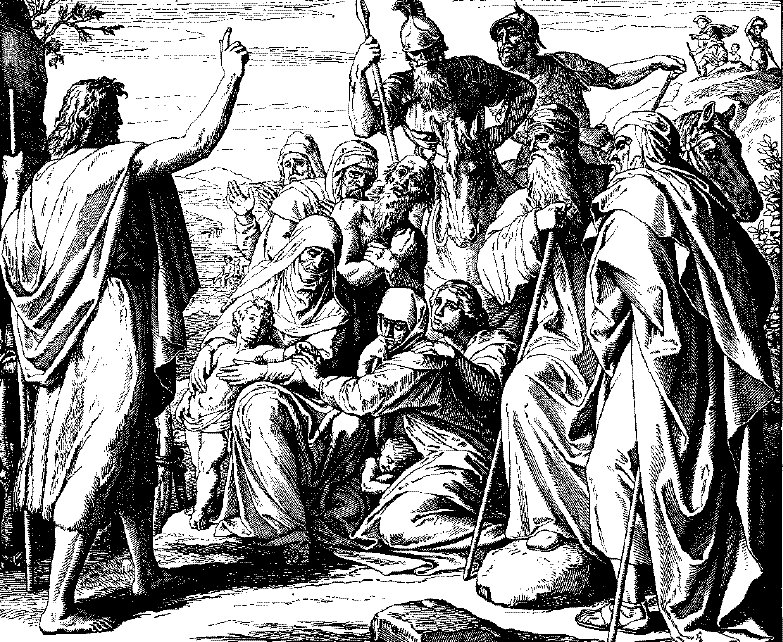
Let’s talk about John the Baptist. We don’t tend to see him as much more than the herald of Christ, and some of us may remember that he baptised our Lord in the Jordan river. We know that he had a particular ministry to the people, and his own baptismal rite for a spiritual washing to accompany their repentance and desire to return to God. But we know from S. Luke’s narratives that his father Zecharyah and his mother Elisabeth were both of the priestly family of Aaron the brother of Moses, and so John would have been destined from his birth for the priestly work of the Temple in Jerusalem. And he was dedicated from his birth to the Holy One in a special way.
And yet, he did not train for the Temple, and seems to have avoided the Temple to the point of fleeing into the wilderness of Judah, where he conducted his ministry. And it was a truly priestly ministry, even if it was ordered away from the Temple. What was a Hebrew priest? First, of course, there was the priest’s Temple ministry of offering divine worship, and conducting the sacrificial rites. But the priest was also a teacher and a ruler of the people. We call John ‘the baptist,’ the Jews who knew him would have called him John the son of Zecharyah the priest. He would have had a considerable following as a Jewish rabbi, and we see glimmers of that in the gospel, when for example we hear that many of his disciples became followers of Christ.
“And the multitudes asked him, ‘What is it, then, we are to do?’ He answered them, ‘The man who has two coats must share with the man who has none; and the man who has food to eat, must do the like.’ The publicans, too, came to be baptized; ‘Master,’ they said to him, ‘what are we to do?’ He told them, ‘Do not go beyond the scale appointed you.’ Even the soldiers on guard asked him, ‘What of us? What are we to do?’ He said to them, ‘Do not use men roughly, do not lay false information against them; be content with your pay.’ And now the people was full of expectation; all had the same surmise in their hearts, whether John might not be the Christ. But John gave them their answer by saying publicly, ‘As for me, I am baptizing you with water; but One is yet to come Who is mightier than I, so that I am not worthy to untie the strap of His shoes. He will baptize you with the Holy Ghost and with fire. He holds His winnowing-fan ready, to purge His threshing-floor clean; He will gather the wheat into His barn, but the chaff He will consume with fire that can never be quenched.'”
Gospel of S. Luke, 3: 10-17 [link]
It is obvious from our reading above that John had a moral authority, and his message came from the Law of Moses, a law that was designed above all to teach charity; hence the command to share, for tax-collectors and soldiers to not extort or exploit. But this was still not an ordinary teacher of the Law; there was something different about this consecrated soul, and I am certain it was his thorough dedication to God that was made at the time of his conception, when the angel appeared to his father Zecharyah. People don’t seize upon just any teacher and wonder if he may be the promised Messiah.
But they saw in John a teacher unlike other teachers; they heard prophecy once more, after hundreds of prophet-less years. And the holy man, with fire in his eyes, declared that his baptism was inferior, that he had only come to bring about repentance, and that the Holy One Himself was imminent, for only God Himself could bring judgement as John describes: gathering the wheat and burning the chaff. John practically uses the words of our first reading today, from the royal prophet Zephanyah: the Lord is in your midst as a victorious warrior, He will exult over you and renew you with His love.
“Break into song, fair Sion, all Israel cry aloud; here is joy and triumph, Jerusalem, for thy royal heart. Thy doom the Lord has revoked, thy enemy repulsed; the Lord, there in the midst of thee, Israel’s King! Peril for thee henceforth is none. Such is the message yonder day shall bring to Jerusalem: Courage, Sion! What means it, the unnerved hand? Thou hast one in the midst of thee, the Lord thy God, Whose strength shall deliver thee. Joy and pride of His thou shalt be henceforward; silent till now in His love for thee, He will greet thee with cries of gladness. Truants that were lost to the covenant I will reclaim; of thy company they are, thou shalt be taunted with them no longer…”
Prophecy of Zephonyah, 3: 14-15 [link]
We do not know how long John’s ministry was; the gospel narrative can make us think it was for only a few weeks or months before the arrival of Christ. But consider that it might have been a work of years, so that when Christ did arrive John’s handing over of the baton was a great act of humility of the servant for his Master. Or rather, in John’s own words from the gospel, as the best-man making way for the Bridegroom to take up His Bride, which is the Church of God.
What does a prophet do, when the glory of God manifests to the people? He steps aside. What is the prophet’s ultimate desire, aside from that the will of God be done? He wants the best for the people. That’s why he serves. That’s why our priests serve us today, not for themselves or their own glory, but for the glory of God and the salvation of souls. Whose souls? Ours. The second reading gives us another window into the soul of the priest of Christ’s church. The priest here is S. Paul, a man who suffered very much for the many small churches he had erected everywhere. And he says here to his Philippians that he wants their ultimate happiness, which they will only find in God. He wants to see the love, the charity of God manifest in them. He wants them to trust God entirely and not worry. And he wants them to pray, especially for peace of heart in every circumstance, good or bad.
“Joy to you in the Lord at all times; once again I wish you joy. Give proof to all of your courtesy. The Lord is near. Nothing must make you anxious; in every need make your requests known to God, praying and beseeching him, and giving him thanks as well. So may the peace of God, which surpasses all our thinking, watch over your hearts and minds in Christ Jesus.”
The letter of S. Paul to the Philippians, 4: 4-7 [link]
 Catholic Louth and Mablethorpe