I had begun to speak about the Mass last week, and I called it the festival (or feast) of love. I described this marital type of love as a total mutual self-giving between the Church and God her Lord, and said that such a love requires frequent purification, so that it can be perfected. Hence the penitential ritual at the beginning of every Mass.
Now we can talk about the readings that we have at Mass, something that the Church has inherited from the synagogues of the first-century Jews. As with any other people, the Jews are a people of memory and tradition. They remember in particular the promises made by God to their patriarchs Abraham, Isaac in Jacob. When they wrote that down, it became the book of Genesis. They remember their extraordinary rescue from Egypt under Moses. When they wrote that down it became the book of Exodus. Moses gave them an elaborate religious ritual and an equally elaborate legal code, or (we might say) a guidance for right living in the presence of God. When they wrote all that down, it became the books of Leviticus, Numbers and Deuteronomy.
Much of the rest of the Old Testament is a narrative history of this nation of Jews, how they repeatedly fell out of their relationship with God, and how they recovered by the guiding hands of priests, prophets, and kings. And they waited (and many of them still wait) for the arrival of a Messiah, Who would tie up all the loose ends and draw them and with them all the rest of mankind into a right relationship with God.
In the New Testament, a remnant of this Jewish nation describes how that was accomplished in the person of the God-man Jesus Christ. Just as the synagogue remembered Moses and the prophets, the Church remembers Moses and the prophets, Christ and His Apostles. Think of this part of the Mass as a family get-together, where stories may be told of the origins of the family, the traditions of the family, how the family honoured God in the past and still honours Him today. Of the very essence of Holy Mass, and one of the most significant properties of the Catholic Church, is tradition, by which we perform the rituals that were given to the Apostles at the beginning and have been hallowed by the centuries.
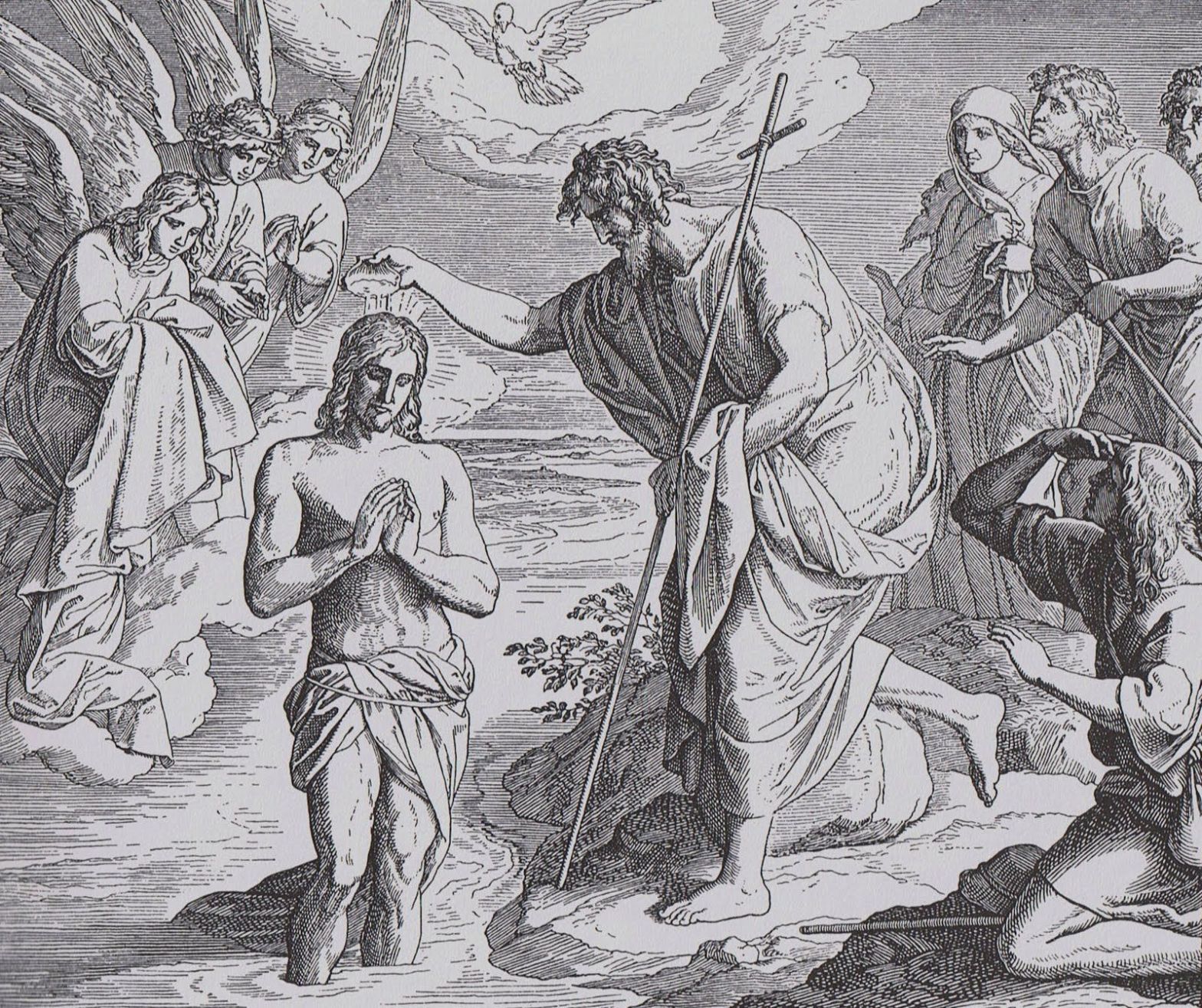
And, on this feast day of the baptism of OLJC, we must bring to our minds that long history of the Jewish nation, for God Himself in becoming a Jew honoured that history and tradition. The rituals of purification and washing away of sins were given to the people by Moses as a symbol of the setting-aside of the filth of sin, so that the people could make a suitable offering of themselves to God. They belonged to Him by His own election – He had declared them to be His – and for that offering to be perfect they had to set aside every other item that dominated their lives and distracted them from Him.
Baptism is like the penitential rite at the beginning of Mass, which recognises sin and wipes the slate clean, allowing the offering of the rest of our lives to God to be more beautiful, more pure, more single-minded. Baptism is the preliminary to a daily consecration of our lives to God. And Christ Himself goes through the motion of purification at the hands of his cousin John. Did He need to do so – He Who remained without sin? Of course not. But when John protested, He replied and said that it was necessary to do all that Righteousness demands.
Righteousness according to Scripture is the fulfilment of the commandments of God. Christ wished in His sacred humanity to be a righteous Jew, to carry out perfectly the very same Law that He had given to Moses after He spoke to him from the burning bush. For the same reason, the Immaculate one, His mother, also obeyed every command of the Jewish Law, undergoing the rites of purity, when she was always without sin. It is in humility that Christ thus bows His head and takes up the yoke that is laid upon the shoulders of sinful and mortal humanity, living every aspect of human life perfectly, and raising human life thereby to the heights of sanctity and immortality. So the sinless One must needs undergo a ritual purification, and suffer and die for sin, for He takes upon Himself our sins, and is then sealed in the tomb of death designed for mortal men and women. But then, unexpectedly He walks out of it, walks out of the clutches of death, and in so doing carries mankind with Him.
“It was while all the people were being baptised that Jesus was baptised too, and stood there praying. Suddenly heaven was opened, and the Holy Spirit came down upon Him in bodily form, like a dove, and a voice came from heaven, which said, ‘Thou art My beloved Son, in Thee I am well pleased.'”
Gospel of S. Luke, 3: 21-22 [link]
 Catholic Louth and Mablethorpe