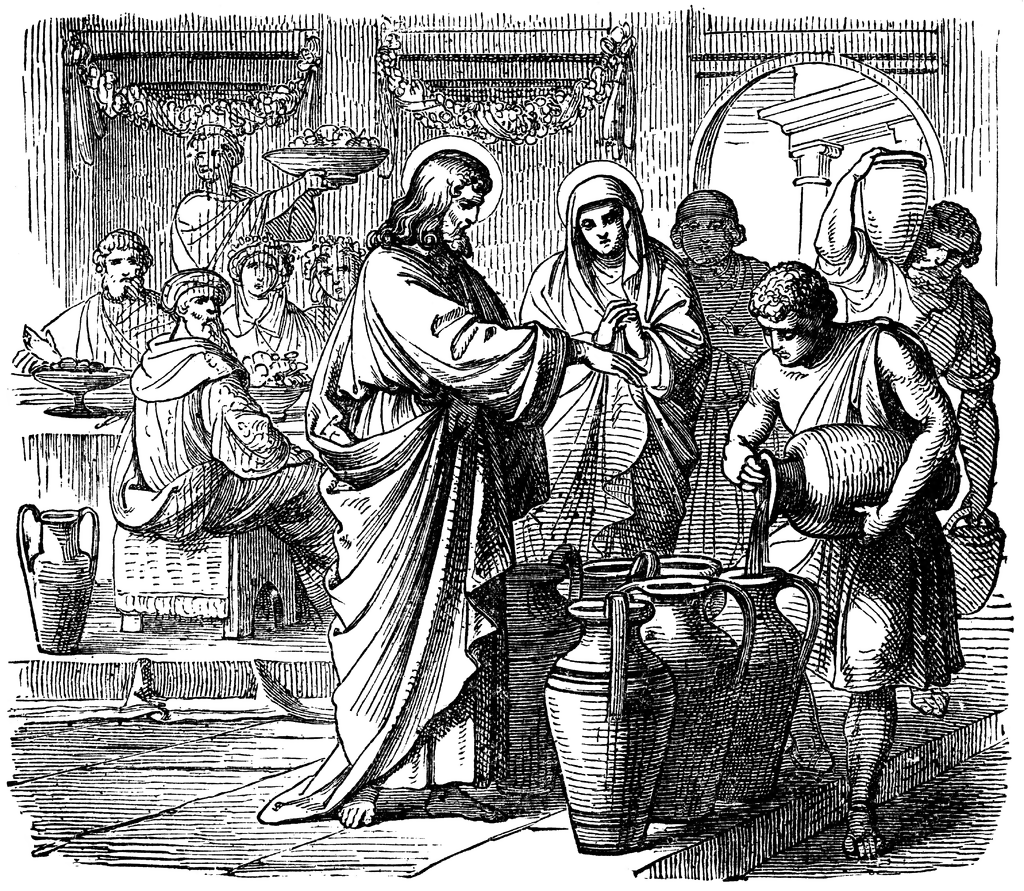
“Two days afterwards, there was a wedding-feast at Cana, in Galilee; and Jesus’ mother was there. Jesus Himself, and His disciples, had also been invited to the wedding. Here the supply of wine failed; whereupon Jesus’ mother said to Him, ‘They have no wine left.’ Jesus answered her, ‘Nay, Woman, why dost thou trouble Me with that? My time has not come yet.’ And His mother said to the servants, ‘Do whatever He tells you.’“
Gospel of S. John, 2: 1-5 [link]
In the last two weeks, I called the Mass a festival or celebration of love, and specifically of the type of love which sacrifices itself for the sake of the person or persons loved, and a love that is demonstrated by the man on the Cross, which is why the crucifix has come to become a common feature of our churches and altars. The Mass is then a participation in the wedding feast of the Lamb, as is mentioned in the book of Revelation and in the gospels as the feast given by the high king to which many are invited. I also spoke of the purification of our own reciprocal love for God through penitence and confession, and I then described the readings as a memorial of the work of God throughout the history of the Hebrew and Jewish nation and the Church – what we call ‘salvation history.’ A sort of family history.
But I shall say today that the readings are also moral lessons. In fact, before the liturgical changes of the 70s, we used to call at least the first reading at Mass ‘the Lesson.’ So, we had the lesson and the Gospel. The Holy Father Paul VI decided that we should have a greater dose of S. Paul every Sunday and on holy days, and we received a second reading. Another lesson. So, we have two lessons and the gospel, and all of these give us moral and spiritual guidance. How we are to live our lives. The Hebrews/Jews have another word for that – ‘Torah,’ which we translate in English as Law. The Law of Moses.
And the Church declares that this Law of God became flesh and dwelt among us, and that the Word of God – the Guidance of God for our lives – took on a human face. And now we’re going to come back around to the subject of self-sacrificial love. Because that is the undergirding and the foundation of the Law of Moses of the Old Testament and the Law of Christ in the New Testament – the love for God and the consequent love for neighbour. That is what we are taught in the readings, and hopefully in the homily that follows them: how it is that we are to bring to bear practically this self-sacrificial love in our lives today. The Church uses Scripture – the Bible – and the wisdom she receives constantly through the inspiration of the Holy Spirit to produce for us such guidances – in the catechisms – which enable us to fulfil the Law of God in our own time.
And it is this type of self-sacrificial love that turns water into wine.
The beauty of this story of the wedding at Cana that we’ve had in our gospel reading this weekend is in Christ’s devotion to His holy Mother. When she said, Do something about that wine situation, He responded and said, But, Mother, my hour has not yet come. What hour is that? I’ve heard it said often that Christ’s hour was His crucifixion. Now, if the crucifixion was the extraordinary self-emptying and sacrifice of Christ, by which the divine love of God was finally made manifest in all its glory, then this excruciating torment of Christ’s is here connected with the wedding at Cana.
Christ says to His Mother, If I do this thing for you – if I bring them the wine they need – you know what comes next, you know that I shall next walk up to Jerusalem and be tortured and killed. So, this is not necessarily a smiling and cheerful Mary asking for this miracle at the wedding, but a sorrowful mother preparing with her request to offer her Son for the salvation of the world. When the master steward declared that the water drawn out was the best wine he had ever tasted, the Immaculate Heart looked forward to the Cross of her Son. And it is apparent to me that this is where the Catholic tradition of intercession to the Holy Mother begins. She can obtain the impossible from her Son, because of His extraordinary devotion to her.
And now, why this Sacrifice on the Cross? Could not humanity have been saved by God without this horrible blood-letting? We do not quite understand why blood sacrifice is required by God, but we know from Scripture that it is, and that this requirement is so serious that God Himself will undergo the pain of it, in order that the men and women He loves will not suffer eternal death. So, He says through Isaiah in our first reading, For Jerusalem’s sake, I will not be silent, I shall not weary, until her integrity shines forth in Christ My beloved Son, until her salvation – her Jesus – flames forth like a torch. And that torch has never burned brighter than from the Cross, not only for the benefit of the Jews but all the nations. And the new community – the new family – that is born out of that burning love of the Sacred Heart, the heart of God bared upon the Cross, would have a new name. This the prophet says. The new congregation would be named after her Lord, she would be called Christian.
“For love of Sion I will no more be silent,
Prophecy of Isaias, 62: 1-3 [link]
for love of Jerusalem I will never rest,
until He, the Just One, is revealed to her like the dawn,
until He, her deliverer, shines out like a flame.
All the nations, all the kings of the nations, shall see Him,
the Just, the glorious,
and a new name shall be given thee by the Lord’s own lips.
The Lord upholds thee, His crown, His pride;
thy God upholds thee, His royal diadem.”
 Catholic Louth and Mablethorpe