To recap my little descriptions of the Mass on the last three Sundays, I called the Mass a celebration of the self-sacrificing love of God, as given by the Man on the cross. I might as well also call it a celebration of the human community that that Love has established – the Church, in all its hierarchical splendour. I don’t mean only the hierarchy of bishops and priests; every one of us is a member of the hierarchical constitution of the Church. As a human community, we have a history, and as a human community we have a code of conduct and rule of life, and a government also. S. Paul compared this communal aspect of the Church to the way parts of the animal body (we all have) work together to form a whole. We actually have this as our second reading this weekend. It is rather long for a second reading, but we priests like to hammer in a point, don’t we? Here’s a short extract…
“A man’s body is all one, though it has a number of different organs; and all this multitude of organs goes to make up one body; so it is with Christ. We too, all of us, have been baptised into a single body by the power of a single Spirit, Jews and Greeks, slaves and free men alike; we have all been given drink at a single source, the one Spirit.”
First letter of S. Paul to the Corinthians, 12: 12-13 [link]
The readings and the homily at Mass serve the upkeep of our social fabric, by preserving the stories of the founding of our community or family and the consequent social rule of Christ that is exercised in our midst. And then, this family of ours (around the world) approaches the heart of the Mass, the ‘source and summit of our lives’ (as the second Vatican council called it), when the community approaches physical union with Christ her Lord. But before this feast of faith, there are the Offertory rites, when we make our offering of ourselves to our divine Spouse. Remember my frequent mention of our individual relationship with God (as well as the communal relationship of the Church with Christ) as spousal.
In the Offertory, we may as well be making our vows to Him (He having made His own already) – in sickness and in health, for better or for worse, etc. – and the Eucharistic Prayer that follows is a great vote of thanksgiving and praise to the Holy One, of remembering His favours to us and asking for more. In the next few weeks, I shall be running slowly through the first Eucharistic Prayer – the Roman canon – which I have chosen because it is our most ancient Eucharistic Prayer, already in evidence over 1,500 years ago and traditionally much older. In looking at it, I hope to draw us into the Jewish Temple of ancient times, where our holy religion began in its essentials, and where (as per the book of Revelation) it will end.
And speaking of the Jewish Temple where our religion began, we have a narrative in our first reading this weekend of a religious service that was conducted after the second Jewish Temple was built, several decades after King Solomon’s Temple was destroyed by the Babylonian empire (586 BC).
“…on the first day of the seventh month, the priest Esdras fetched out the book, in the presence of a great throng of men and women, with such children as were old enough to understand it. And there in the open space before the Water-gate he proclaimed the Law, before men and women and such younger folk as could take it in, from daybreak to noon, and all listened attentively while the reading went on. A wooden pulpit had been erected to carry the sound better, and at this the scribe Esdras stood; with him were Mathathias, Semeia, Ania, Uria, Helcia and Maasia on his right, Phadaia, Misael, Melchia, Hasum, Hasbadana, Zacharia and Mosollam on his left. Esdras was plainly seen, as he opened the book, by all the people underneath. When he had opened it, all rose; and when he blessed the Name of the Lord, the great God, all lifted their hands and answered, ‘Amen, amen’; and with that they bowed down and worshipped with their faces close to the ground. Then the Levites came forward, Josue, Bani, Serebia, Jamin, Accub, Sebthai, Odia, Maasia, Celita, Azarias, Jozabed, Hanan and Phalaia; these enjoined silence on the people, as they stood there in their places for the reading of the Law. And they read out the book of the law, clear and plain to give the sense of it, so that all could understand the reading.”
Book of II Esdras (aka. Nehemiah), 8:2-8 [link]
Nehemiah, the author of this book, was the Jewish governor of his time and it had been his task to restore the security of Jerusalem by rebuilding its encircling wall. But in our story here, let’s find a liturgical structure that we might find familiar. The priest Ezra brings together a congregation of men, women and children – so do we. He reads to them from the book from morn ’til noon – we thankfully don’t have readings that long at Mass. When he reads from his wooden dais or pulpit, probably from a lectern, everybody stands up – we still do that for the gospel. Ezra blesses the Holy One and everybody answers Amen, Amen – we do this at the end of the Eucharistic Prayer. And Ezra translates the Hebrew of the book and explains it – that sounds suspiciously like a homily to me, except much longer.
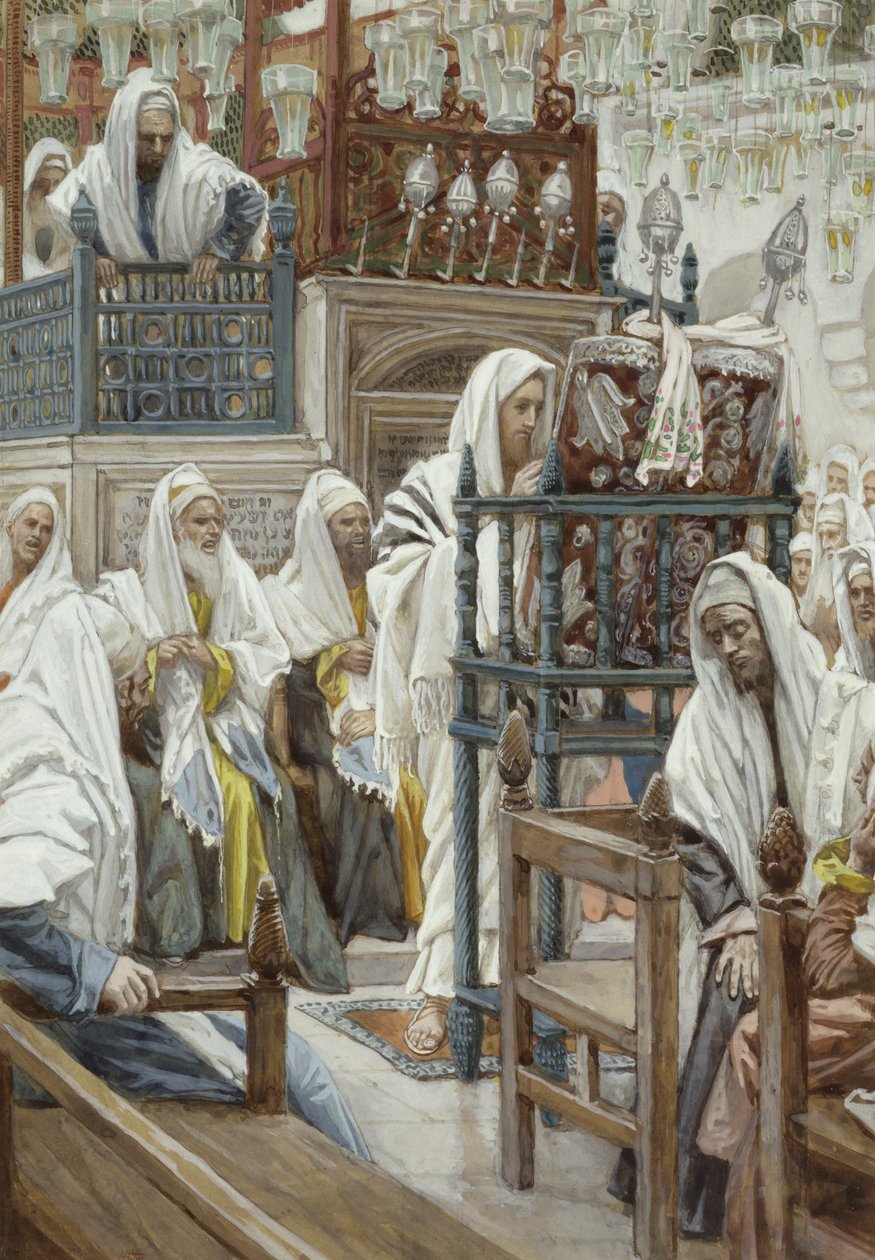
And it all ends with a bit of a feast – I needn’t mention Holy Communion. Historically, in the time of Ezra and from the time before the destruction of King Solomon’s Temple, the Jewish people had been scattered throughout the known world. Wherever they went, they already began to establish what we would recognise as synagogues to serve their national culture and identity, even as they do today. It was at one of these synagogues in the Greek area of Galilee in the north of the Holy Land that our Lord stood up, according to the gospel story, to tell His Jewish brothers and sisters that their long wait for a Messiah and the Successor of King David was over. That what Moses and the prophets, what Ezra and Nehemiah had established was being fulfilled. That Love had finally arrived and was standing before them.
“And Jesus came back to Galilee with the power of the Spirit upon Him; word of Him went round through all the neighbouring country, and He began to preach in their synagogues, so that His praise was on all men’s lips. Then He came to Nazareth, where He had been brought up; and He went into the synagogue there, as His custom was, on the sabbath day, and stood up to read. The book given to Him was the book of the prophet Isaias; so He opened it, and found the place where the words ran: ‘The Spirit of the Lord is upon me; He has anointed me, and sent me out to preach the gospel to the poor, to restore the broken-hearted; to bid the prisoners go free, and the blind have sight; to set the oppressed at liberty, to proclaim a year when men may find acceptance with the Lord, a day of retribution.’ Then He shut the book, and gave it back to the attendant, and sat down. All those who were in the synagogue fixed their eyes on Him, and thus He began speaking to them, ‘This scripture which I have read in your hearing is to-day fulfilled.'”
Gospel of S. Luke, 4: 14-21 [link]
 Catholic Louth and Mablethorpe