In the last few weeks, I presented the Liturgy of the Word, together with the Penitential Rite and the recitation of the Creed as a sort of introductory session in the ‘marriage feast of the Lamb,’ which is an early description of the Mass. It’s like when you’re invited to a dinner party, but in a larger home you are led from the front door through hallways and ante-rooms before you arrive at the set table. In like fashion, the Mass is ordered in time as a dinner party is ordered in space.
So, here we are, having been led through the doorway of penitence and so being of readiness for union with God, and having been walked progressively through the ante-rooms of the Old Testament reading and the writings of S. Paul and others, and then the parlour of the gospel reading, a deacon (which is Greek for ‘servant’) stands before you and bids you prepare for your meeting with the Host of the event, the great King. He has offered you His heart, now you are to offer Him yours. So you recite the Creed, I believe in God the Father, I believe in God the Son, I believe in God the Holy Spirit, and you place your heart upon the altar, so-to-speak.
And then you hear the ministerial priest declare, Pray brothers and sisters, that my sacrifice and yours may be acceptable to God the Almighty Father… and the veil is lifted before the door into the dining room, and before you is the High King, Who stands to greet His guests. In our ears are the words of the priest as he calls out, Lift up your hearts, and we reply, We lift them up to the Lord. Soon afterwards, we are singing the song of the angels, Holy, Holy, Holy is the Ancient One, Hosanna in the Highest, and our gaze settles upon the familiar face of Christ as we say, Blessed is He Who comes in the name of the Lord. Thus have we fully entered into the heavenly Temple, and are prepared for the heart of the Mass: the Eucharistic prayer.
And this idea of entry into a temple may be an interesting way to introduce today’s festival, insofar as the Holy One enters His own Temple in Jerusalem, which was a facsimile of the heavenly Temple; and He enters to establish forever the locus of divine worship. The Holy Family honours their ancient religion with its Temple ritual on the eve of its transformation, which would happen on the hill of the Crucifixion. The Apostle S. John says in his gospel that the true Temple – the true Shrine – is the body of Our Lord. When that new Shrine hung dead upon the cross, a dreadful earthquake shook the old shrine and its veil was torn asunder. When that Body rose gloriously on Easter Sunday, true worship could only again take place through it. One of the principal points of the old Sacred Heart devotion was and is entering into the heart of Christ. As we say at the end of the Eucharistic prayer, Through Him, with Him, and in Him…
The Presentation of the Lord in the Temple comes precisely forty days after Christmas and is also connected with the Hebrew tradition of the purification of the mother after the birth of her son, which gives us some of our old Christian traditions of the ‘churching of women.’ This is very much a festival of both Our Lord and of His holy Mother. The prophet Malachi in our first reading looks forwards centuries before the event to the entry of the Holy One into His Temple in Jerusalem.
“See where I am sending an angel of Mine, to make the way ready for My coming! All at once the Lord will visit His temple; that Lord, so longed for, welcome herald of a divine covenant. Ay, says the Lord of hosts, He is coming; but who can bear the thought of that advent? Who will stand with head erect at His appearing? He will put men to a test fierce as the crucible, searching as the lye that fullers use.”
Prophecy of Malachias, 3: 1-2 [link]
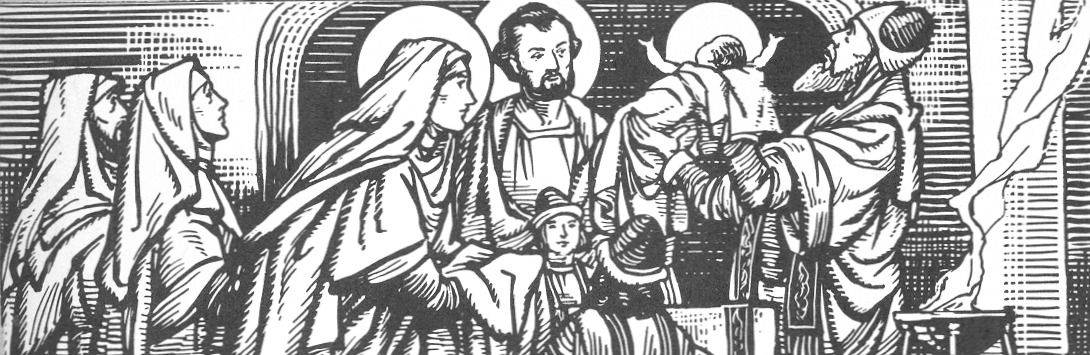
Those of you who listen to or read my ramblings about the Old Testament know that Solomon’s great Temple was destroyed in 587BC and a second Temple was built, which still stood in the first century. Malachi lived in the time of the second Temple, which was notably without the supernatural effects of Solomon’s Temple, which had had mysterious clouds and smoke, flashings of light, etc. The prophet looked into the future and saw when these supernatural effects would return, when the God of Israel would enter once more into His sanctuary in Jerusalem. The second reading this weekend tells us how the God of Israel took His descent as a human being from those very Hebrews whom Malachi was prophesying to, from the stock of Father Abraham. And the gospel story tells us of the circumstances of this extraordinary figure of the God-man being carried into the second Temple by His Mother Mary, closely followed by their guardian S. Joseph, who made the requisite sacrifice of four birds for the ‘churching’ of his wife.
The old priest Simeon was waiting for them. He was a prophet, not unlike Malachi, and he knew that he before he died would see the Holy One enter His Temple, as Malachi had foretold. With a joy that has echoed down to us in his famous words, Now, Master, you can let your servant depart in peace, S. Simeon returns the Child to Our Lady, saying to her that she would have to suffer much on the Child’s behalf, but through it all would Judgement come upon mankind, and Salvation to all who believe.
“At this time there was a man named Simeon living in Jerusalem, an upright man of careful observance, who waited patiently for comfort to be brought to Israel. The Holy Spirit was upon him; and by the Holy Spirit it had been revealed to him that he was not to meet death, until he had seen that Christ Whom the Lord had anointed. He now came, led by the Spirit, into the Temple; and when the Child Jesus was brought in by His parents, to perform the custom which the law enjoined concerning Him, Simeon too was able to take Him in his arms. And he said, blessing God, ‘Ruler of all, now dost Thou let Thy servant go in peace, according to Thy word; for my own eyes have seen that saving power of Thine which Thou hast prepared in the sight of all nations. This is the light which shall give revelation to the Gentiles, this is the glory of Thy people Israel.‘ The father and Mother of the child were still wondering over all that was said of Him, when Simeon blessed them, and said to his Mother Mary, ‘Behold, this Child is destined to bring about the fall of many and the rise of many in Israel; to be a sign which men will refuse to acknowledge; and so the thoughts of many hearts shall be made manifest; as for thy own soul, it shall have a sword to pierce it.”
Gospel of S. Luke, 2: 25-35 [link]
 Catholic Louth and Mablethorpe