Last week, I mentioned the reality of the Blessed Sacrament, and how we are to behave when the very Body and Blood of Christ – Christ Himself – lies upon the altar. But why is it that this should be? Why have Christ upon an altar at all? As we continue with the frame of the Mass, we find that after a quick memorial of the suffering, death, resurrection and ascension into heaven of Christ, the Eucharistic Prayer gives us the answer, for it calls the now-consecrated bread and wine a pure victim, a holy victim, a spotless victim.
This throws us all the way back into the Old Testament, when the victims of the Temple sacrifices of the Hebrew nation were animals. And those sacrifices were intended to purify the people so that they could approach the holiness of God. The Church, looking upon that situation, would tell us that those animal sacrifices had no power of their own; rather, what God has looked for always is a humble and contrite heart, a repentant sinner, one who goes far enough in seeking God’s forgiveness as to seek the priesthood of the Jerusalem Temple. The Church also tells us that it is the great Sacrifice of Christ that truly redeems, and that the animal sacrifices looked forward to Calvary and Good Friday. They had no power of themselves then.
To return to our question, why should the Body and Blood of Christ be lying upon an altar in a Catholic Church…? Because the Mass is a Temple liturgy which echoes the worship of the heavenly Temple, and this presence of Christ upon our altars forms the greatest part of the offertory of the Church – our joint offering to God the Father of ourselves is made together with Christ’s offering of Himself. So, the next time we make a big sacrifice (or a little one) – and Lent is a season of personal sacrifices made – we mustn’t forget to offer it up, and bring it to Mass, where it can lie upon the altar with Christ.
Finally, to hammer in the unity of the Sacrifice of the Mass with the sacrifices of the Hebrews, the Eucharistic prayer also mentions three ancient priests – Abel the son of Adam, the patriarch Abraham and the mysterious priest-king Melchizedek – asking God to accept our offering, as He once accepted theirs.
Let’s continue with this theme of priesthood and offering as we look at our readings this weekend. In the first reading from Deuteronomy, we find what we could call the Creed of the Hebrew nation.
“Thereupon the priest will take the basket from thy hand, and set it down before the altar of the Lord thy God. In that divine presence, thou wilt continue thy protestation: My fathers were wanderers, hunted to and fro in Syria, when they made their way into Egypt and began to dwell there, only a handful of them; but they grew to be a great people, hardy and numerous. Whereupon the Egyptians treated us ill and persecuted us, and the burden we must bear was insupportable; so we cried out to the Lord God of our fathers, and he listened to our plea, and took pity on our affliction, the toil and oppression we suffered; rescued us from Egypt by force, with his arm high uplifted to strike great terror, and perform great wonders and portents, and brought us here, where he has given us a land that is all milk and honey. That is why I am offering first-fruits, now, out of the land which the Lord has given me. So leave them there, in the presence of the Lord thy God, and when thou hast paid worship to this Lord and God of thine…”
Book of Deuteronomy, 26: 4-10 [link]
Remember our own Creed – I believe in the Father, I believe in the Son, I believe in the Holy Spirit, etc. which we have as part of the Mass on Sundays and holy days. The setting of the Hebrew Creed in the reading is also a divine liturgy, with a priest offering a sacrifice of first-fruits on behalf of the people. We could take the frame of this Hebrew Creed: Abraham our father, enslavement in Egypt, rescue by God with great miracles, the promise of the Holy Land, and behold we make these offerings… and we could give it a Christian aspect: God our Creator, Adam our father, enslavement to sin and death, rescue by Christ with His life-death-resurrection-ascension, the promise of Heaven, and behold we make these offerings at Mass…
Our gospel story carries us out into the wilderness with Christ, as He endures His forty days and forty nights of preparation for ministry. Let us approach our Lenten observances in the spirit of offertory. Giving up even small things is difficult. There are Eastern Catholics who give up not only sweets and alcohol but all animal products – including dairy products – for the duration of Lent. Now, that is very difficult, and even scary. And just as with every other privation we may suffer during the rest of the year, we had best offer up the Lenten sacrifices we make. And there’s no better time to make that offering in prayer than at Mass, on Sunday or during the week.
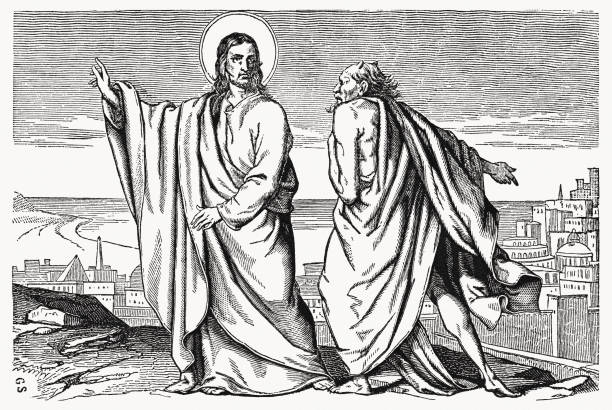
We can be sure that the enemy of our souls will not only come to ruin our Lent at the end of it, just as he probably tempted Christ through all of His forty days, and not just with this parting salvo in our gospel story today. If we maintain our discipline and are hungry, we will be tempted to take liberties; if we give up our devotion to things other than God during Lent, we will be tempted to return to them.
But, we shall be strong and persevere, eyes fixed upon Christ, and the serpent will have to leave in frustration, to perhaps return at a later time.
“Jesus returned from the Jordan full of the Holy Spirit, and by the Spirit He was led on into the wilderness, where He remained forty days, tempted by the devil. During those days He ate nothing, and when they were over, He was hungry. Then the devil said to Him, ‘If Thou art the Son of God, bid this stone turn into a loaf of bread.’ Jesus answered him, ‘It is written, Man cannot live by bread only; there is life for him in all the words that come from God.’ And the devil led Him up on to a high mountain, and shewed Him all the kingdoms of the world in a moment of time; ‘I will give Thee command,’ the devil said to Him, ‘over all these, and the glory that belongs to them; they have been made over to me, and I may give them to whomsoever I please; come then, all shall be Thine, if Thou wilt fall down before me and worship.’ Jesus answered him, ‘It is written, Thou shalt worship the Lord thy God; to Him only shalt thou do service.’ And he led Him to Jerusalem, and there set Him down on the pinnacle of the temple; ‘If Thou art the Son of God,’ he said to Him, ‘cast thyself down from this to the earth; for it is written, He shall give his angels charge concerning thee, to keep thee safe, and they will hold thee up with their hands, lest thou shouldst chance to trip on a stone.’ And Jesus answered him, ‘We are told, Thou shalt not put the Lord thy God to the proof.’ So the devil, when he had finished tempting Him every way, left Him in peace until the time should come.”
Gospel of S. Luke, 4: 1-13 [link]
 Catholic Louth and Mablethorpe