I shall end today with my descriptions of the Mass, and next weekend, I shall begin with the Rosary. The Mass, as the second Vatican Council said, is the source and summit of our lives. It is our nearest encounter with the Holy One, the moment when heaven touches earth, and we stand among angels and Saints around the throne of God as a worshipping community. In the past, I have portrayed the various parts of the Mass as an ascent on a holy mountain and as an entry into a sacred space – a sanctuary. I have tried to say how everything prepares us for the Consecration at Mass – when we first adore Christ-made-Present – and for Holy Communion immediately afterwards – when we physically receive Christ-made-Present.
The parallel to this Holy Communion made from the very pages of the New Testament is the exit of the Hebrews from Egypt – their Passover – before they began their long trek towards their Promised Land. As I have said repeatedly, our Egypt is this world and our Promised Land is eternal happiness with God in heaven. That’s why we call Christ our Passover Lamb, and we say Lamb of God, Lamb of God, just before we receive Holy Communion. In the story of the Hebrew Passover and the trek through the desert, the people grew hungry and thirsty, and ached to go back to the comforts of Egypt, and they were fed by God with a ‘bread from heaven.’ Our first reading this weekend is about this coming to an end, when the Promised Land had been acquired. Similarly, in our trek through the desert of this life, we grow spiritually hungry and thirsty and ache far too often to return to the pleasures of this world, and we are fed by God with the true ‘bread from heaven,’ the Blessed Sacrament.
And so we descend from our holy mountain of the Mass, and we leave the blessed sanctuary behind, fed through Holy Communion by God with God. And to what end? What is the point of Mass? Simply, and in a word – holiness. We are to become holy, shorn of sin and evil, we are to be as Adam and Eve were before their Fall. Having become holy, we are also supposed to make the world holy, by drawing other men and women to Christ, thus becoming ministers of God, ambassadors of Christ. And so, when the priest comes to the end of Mass, he says, Go in peace, glorifying God with your lives, to love and serve the Lord, etc.
And our readings this weekend are providentially about Passover, Holy Communion, and participating in Christ’s new Creation. Taste and see that the Lord is good. In our second reading, S. Paul says that the new Creation is in the hearts of men and women.
“…when a man becomes a new creature in Christ, his old life has disappeared, everything has become new about him. This, as always, is God’s doing; it is He Who, through Christ, has reconciled us to Himself, and allowed us to minister this reconciliation of His to others. Yes, God was in Christ, reconciling the world to Himself, establishing in our hearts His message of reconciliation, instead of holding men to account for their sins. We are Christ’s ambassadors, then, and God appeals to you through us; we entreat you in Christ’s name, make your peace with God. Christ never knew sin, and God made him into sin for us, so that in him we might be turned into the holiness of God.”
Second letter of S. Paul to the Corinthians, 5: 17-21 [link]
Remember that Christ said to His adversaries that the Kingdom of God was already among the crowds of people listening to Him. He, the King of Hearts, was already receiving the allegiance of thousands before the Crucifixion – we know, because He was feeding them miraculously in the desert. In so far as we go away after Mass in peace, glorifying the Lord by our lives, we should endeavour constantly to spread the knowledge of Christ and of the commandments of Christ to others, bringing them to Him and so enlarging His Kingdom.
“This day, the Lord said to Josue, ‘I have reversed the lot that made you slaves in Egypt;’ and so the place came to be called Galgal, Turning Round, the name it still bears.”
Book of Joshua, 5: 9 [link]
What is the ‘shame of Egypt’ or the ‘slavery of Egypt’ that is mentioned here, at the top of the first reading this weekend? It is idolatry, and the worship of false gods, that is, evil spirits. We know how contagious idolatry is. The moment the Hebrews thought they had lost Moses, because he was too long up the mountain, they tried to establish an Egyptian fertility religion with the golden calf. And we know that the moment the people we know and love forsake Christ, they find some other object of devotion to replace Him. Turning around from idolatry and back to God is so significant that when the people have made the pledge in the newly-attained Promised Land, their very camp is named Galgal – literally, turning around.
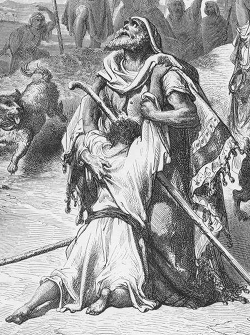
“‘And when the son said, Father, I have sinned against heaven and before thee; I am not worthy, now, to be called thy son, the father gave orders to his servants, Bring out the best robe, and clothe him in it; put a ring on his hand, and shoes on his feet. Then bring out the calf that has been fattened, and kill it; let us eat, and make merry; for my son here was dead, and has come to life again, was lost, and is found. And so they began their merry-making. The elder son, meanwhile, was away on the farm; and on his way home, as he drew near the house, he heard music and dancing; whereupon he called one of the servants and asked what all this meant. He told him, Thy brother has come back, and thy father has killed the fattened calf, glad to have him restored safe and sound. At this he fell into a rage, and would not go in. When his father came out and tried to win him over, he answered his father thus, Think how many years I have lived as thy servant, never transgressing thy commands, and thou hast never made me a present of a kid, to make merry with my friends; and now, when this son of thine has come home, one that has swallowed up his patrimony in the company of harlots, thou hast killed the fattened calf in his honour. He said to him, My son, thou art always at my side, and everything that I have is already thine; but for this merry-making and rejoicing there was good reason; thy brother here was dead, and has come to life again; was lost, and is found.'”
Gospel of S. Luke, 15: 21-32 [link]
Those of us who are still attached to Christ are like the older brother in this gospel story, for we have not left the Father’s house. But we know others who have. We have to work to bring them back. The Holy Father John Paul II called this the ‘new evangelisation’ – bringing back former Christians to the practice of religion. These may have squandered the graces they had in Baptism, Confirmation and Holy Communion, and we could understand perhaps the indignation of the older brother in the story. It is not unlike the indignation of the Pharisees and scribes, who were struggling to perfect their observance of the Law of Moses, and were seeing public sinners entering into the promises of Christ right before them.
Remember the parable of the shepherd who would leave ninety-nine sheep in safety to rescue the one truant. W should always marvel at the heart of God – the Sacred Heart – Who looks at all repentant hearts with great joy, calls His angels and Saints and all His Church to Him and says, Rejoice with me, for they were dead, and are now alive.
 Catholic Louth and Mablethorpe