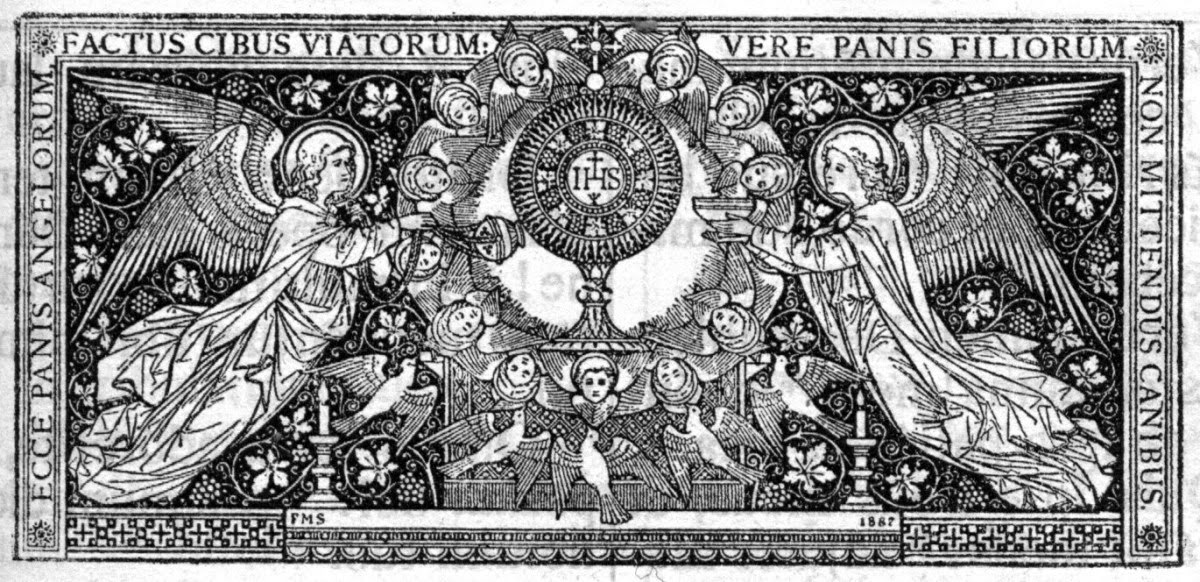
I thought I would begin a trend of homilies not only on the Scripture reading but on the popular hymns that we have become used to singing. On this feast day of Corpus Christi, I shall quickly mention the famous hymn of S. Thomas Aquinas called Adoro te devote, which is translated into English in our hymn-books by the great English Jesuit Gerard Manley Hopkins as Godhead here in hiding, or Lost all Lost in Wonder. As we celebrate this weekend the greatest mystery of our faith – the Holy Eucharist, the Blessed Sacrament – which has separated us out from the protestant and evangelical communities in these isles – we could let S. Thomas and indeed our poet Hopkins teach us a little about this great gift to us.
| 1. Godhead here in hiding Whom I do adore Masked by these bare shadows, shape and nothing more. See, Lord, at Thy service low lies here a heart; Lost, all lost in wonder at the God Thou art. 2. Seeing, touching, tasting are in Thee deceived; How says trusty hearing? that shall be believed; What God’s Son has told me, take for truth I do; Truth Himself speaks truly or there’s nothing true. 3. On the cross Thy Godhead made no sign to men; Here Thy very manhood steals from human ken: Both are my confession, both are my belief, And I pray the prayer of the dying thief. 4. I am not like Thomas, wounds I cannot see, But I plainly call Thee Lord and God as he: This faith each day deeper be my holding of, Daily make me harder hope and dearer love. | 5. O Thou, our reminder of the Crucified, Living Bread, the life of us for whom He died, Lend this life to me, then; feed and feast my mind, There be Thou the sweetness man was meant to find. 6. Like what tender tales tell of the Pelican, Bathe me, Jesus Lord, in what Thy bosom ran: Blood that but one drop of has the pow’r to win All the world forgiveness of its world of sin. 7. Jesus Whom I look at shrouded here below, I beseech Thee, send me what I thirst for so, Some day to gaze on Thee face to face in light And be blest forever with Thy glory’s sight. |
The first verse is the very Catholic acknowledgement, directly from Scripture and from Tradition, that the consecrated bread after Mass has been said is the very Godhead in hiding, masked behind the appearances of bread. That’s why the Saint and the poet are lost, all lost in wonder at God being present in the little circle of bread. We cannot see it with the eyes of the flesh, cannot feel it with the hands, cannot taste it with the tongue, but we accept the word of Christ when He said, My flesh is real food, my blood is real drink, etc. That’s the subject of the second verse, and the third links the Bread of the Last Supper to the Body that hung upon the cross the next day. Just as Christ is hidden in the Blessed Sacrament, His divinity was hidden on the cross… but the Catholic makes profession in both cases, like the dying thief Dismas, who receives at once the blessing of Christ (this very day you will be with Me in paradise) and so was the thief who first stole paradise.
The fourth verse places us in the shoes of S. Thomas the Apostle, who after the Resurrection refused to believe Christ had risen until he could see and touch/feel. Should we respond like Thomas, or elsewise? Christ had said to Thomas in reply that He believed because he could see and touch, and that blessed are they who cannot do these things and yet believe. Hundreds of years later, then, S. Thomas Aquinas sings that he is not like the first S. Thomas who is able to see and touch, but he still makes profession, as he hopes we shall as well. I shall skip over the fifth verse, which asks of the Blessed Sacrament (Christ) to feed us and be our sweetness on this our pilgrimage through life and towards God, and the sixth verse (which is usually missing from our modern hymnals, which are probably embarrassed by its rather unscientific basis) addresses Christ in the Blessed Sacrament as the Holy Pelican, which refers to a medieval idea that the dying chicks of a pelican are revived by the mother piercing her own body and feeding them with her life-blood; this is of course scientifically incorrect, but it has persisted in our Catholic iconography, because of its reference to Christ reviving us with His Body and Blood in Holy Communion.
The final verse demonstrates the goal of the sacramental life of the Church, which is to acquire the beatific vision, that is, to reach the embrace of God that we call Heaven, where we shall be blest forever by the sight of God’s glory.
“Melchisedech, too, was there, the king of Salem. And he, priest as he was of the most high God, brought out bread and wine with him, and gave him this benediction, ‘On Abram be the blessing of the most high God, Maker of heaven and earth, and blessed be that most high God, Whose protection has brought thy enemies into thy power.’ To him, Abram gave tithes of all he had won.”
Book of Genesis 14: 18-20 [link]
Our readings on the feast day of Corpus Christi focus in one way or another upon this great gift of the Eucharist, the gift of Christ Himself. This gift of bread and wine, His Body and Blood, which He gave for the first time at the Last Supper is (as I have said) linked directly to the Sacrifice on the cross the following day. This is perfect love: the pouring out of the life of a father – a parent – so that his (her) children may live. Like that medieval pelican idea mentioned above. In the first reading, we hear an ancient echo of the gift of bread and wine in the story of Father Abraham and Melchisedech; the mysterious figure of Melchisedech is only again referenced in Scripture in Psalm 109(110), the famous Messianic psalm that refers to the Son of David who will conquer all things. In the second reading, we get the very first narrative of the Last Supper, for this letter of S. Paul’s was written long before the Gospels were read in the churches.
“The tradition which I received from the Lord, and handed on to you, is that the Lord Jesus, on the night when He was being betrayed, took bread, and gave thanks, and broke it, and said, ‘Take, eat; this is My Body, given up for you. Do this for a commemoration of Me.’ And so with the cup, when supper was ended, ‘This cup,’ He said, ‘is the new testament, in My Blood. Do this, whenever you drink it, for a commemoration of Me.’ So it is the Lord’s death that you are heralding, whenever you eat this bread and drink this cup, until He comes.”
First letter of S. Paul to the Corinthians, 11: 23-26 [link]
In the gospel story, we find a miracle of the superabundant dividing of bread and fish among thousands. At Mass, today and until the end of time, we witness and live the superabundant dividing of Christ among us. May He blessed forever in the Most Holy Sacrament of the Altar.
“But the multitudes heard of it, and followed Him; so He gave them welcome, and spoke to them of the kingdom of God, and cured those who were in need of healing. And now the day began to wear on; and the Twelve came and said to Him, ‘Give the multitudes leave to go to the villages and farms round about, so that they can find lodging and food; we are in desert country here.’ But He told them, ‘It is for you to give them food to eat.’ ‘We have no more,’ they said, ‘than five loaves and two fishes, unless Thou wouldst have us go ourselves and buy food for all this assembly.’ About five thousand men were gathered there. So He said to His disciples, ‘Make them sit down by companies of fifty;’ and they did this, bidding all of them sit down. Then He took the five loaves and the two fishes, and looked up to heaven, and blessed them, and broke, and gave them to His disciples, to set before the multitude. All ate and had their fill, and when what they left over was picked up, it filled twelve baskets.”
Gospel of S. Luke, 9: 11-17 [link]
 Catholic Louth and Mablethorpe