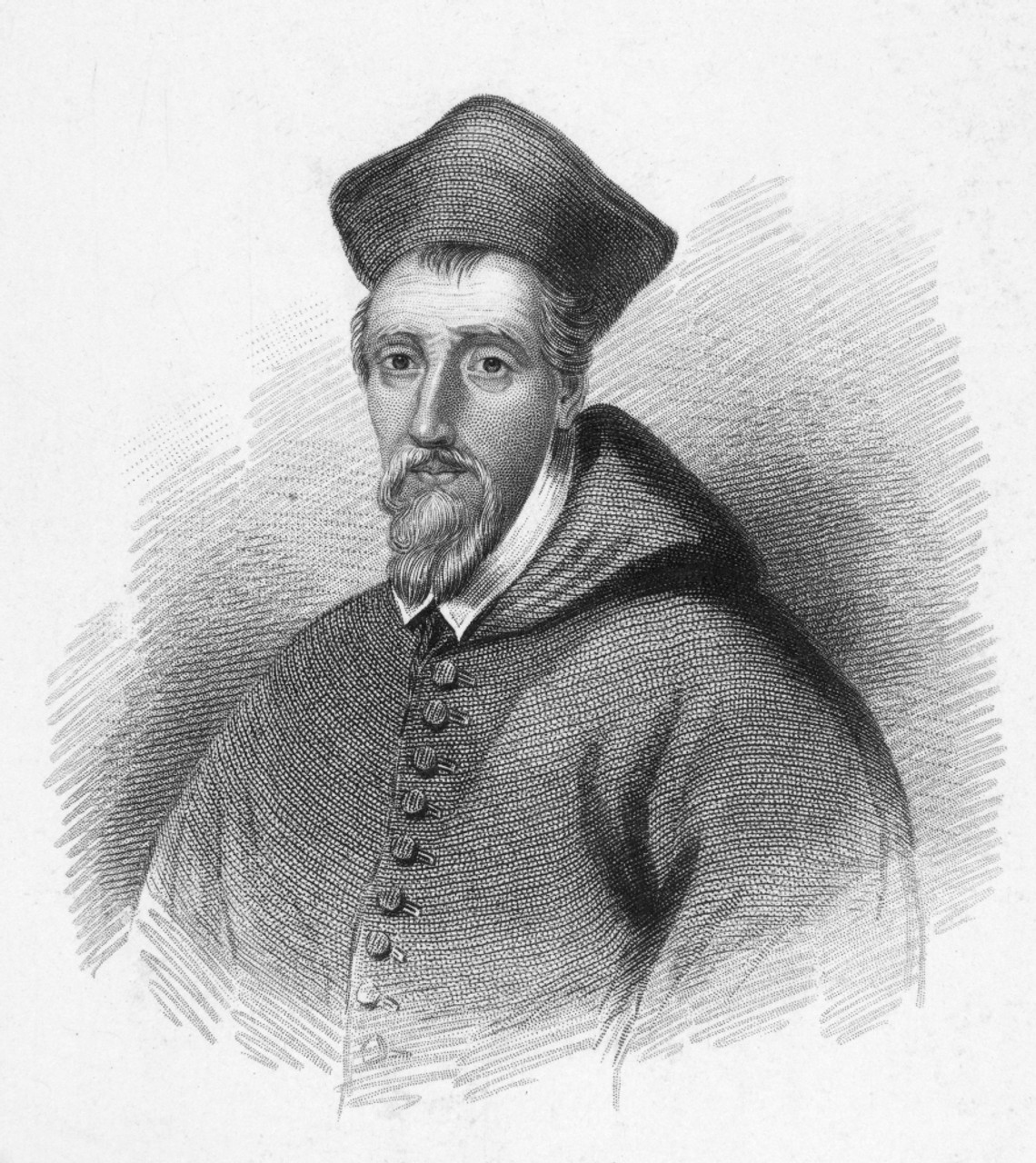
I first developed an appreciation for Cardinal Allen when I first heard about his work at our seminary in London (the seminary of the archbishop of Westminster), which was named after him. At Allen Hall, we were told about the sacrifice of the English seminary priests during the reign of HM Elizabeth I in the second half of the sixteenth-century. Many of those devoted young men passed through the seminaries of the English colleges on the Continent, notably Douai and Rome. Our saintly luminaries at the seminary were students mostly of Douai, although several had passed through Rome, and the seminary at Allen Hall is the sole heir now of the venerable English College of Douai. We take seminaries for granted today, but they were a new idea at the time, and one of the pioneers of these houses of formation was the man behind the organisation of much of what we know as the English Mission: the movement to restore England to communion with the Successor of Peter, after the mutilations of the protestant revolution. That man was Cardinal William Allen, who lived much of his life in exile, but always with his face turned towards his beloved England.
William Allen was born at Rossall Grange, in the parish of Poulton-le-Fylde, in Lancashire, in 1532. The family home belonged to the nearby Cistercian abbey of Dieulacres, where a family member, Thomas Allen, was abbot, but the family owned property in the region and were well-known in the county. When HM Henry VIII (1509-1547) began his attempts to annul his marriage to Queen Katherine of Aragon, who had failed to give him the male heir he desired, and when the king began the schism with Rome and the progressive ruination of the English Church, Allen was a child. Soon, the bishop of Rochester, S. John Fisher, and the former chancellor of the realm, S. Thomas More, met their end in the tower (1535) for their refusal to accept the royal supremacy over the English Church, and the popular Pilgrimage of Grace failed (1536) after its leaders foolishly trusted the government and disbanded their numbers. Many Lancashire families like the Allens remained in their loyalty to Rome.
Oxford and Louvain
The successor to King Henry was his ailing young son Edward VI (1547-1553), whose regent, his uncle Edward Seymour, duke of Somerset, was an ardent protestant, who (together with the protestant archbishop of Canterbury Cranmer) desired to force the English Church down the way of Continental protestantism. In these difficult years, as the churches were ruined and the Catholic rites progressively replaced, Allen arrived at Oxford, where he was admitted to Oriel College, taking his BA three years later, and then a fellowship at his college. When Queen Mary Tudor (1553-1558) was crowned and began the reconciliation of the English Church and the English nation with Rome, her archbishop of Canterbury Reginald Pole marked Allen for higher things. He had now taken his MA (1554) and was principal of S. Mary’s Hall, a residence near Oriel College. Sadly, the queen died shortly and all her good work was undone by her protestant half-sister Elisabeth Tudor (1558-1603), who as queen restored the fortunes of the English protestants. When the supremacy of the kings of England over the English Church was returned with new Acts of Uniformity and Supremacy, churchmen were required to conform. The scholar Allen remained at Oxford until 1561 and then joined a large number of English Catholics going into exile in the Spanish Netherlands, at Louvain. Having joined the university there (1563), Allen began to tutor for a living. When he returned to visit family in Lancashire in 1563, he took note of the underground Catholic Church and the work of the recusant families, and encouraged them to stand fast and not attend the new protestant church services. He also joined the controversy with the protestant divines with his first tract, Certain brief reasons concerning the Catholic faith (1564).
Being known to the authorities, he had to keep moving to avoid arrest, but he was eventually forced into exile once more (1565) and returned to Louvain, taking Orders as a priest at Malines. The politics of the region were worsening as Calvinism spread in Holland and the protestant party of the Huguenots pushed against the Catholic powers of Spain and the French House of Guise. In the Spanish Netherlands, opposition to the occupation by Spain was increasing. Meanwhile, nearer home, the Catholic Mary Queen of Scots posed a threat to Queen Elisabeth as a more legitimate successor to the throne of England. As the threat of a Spanish invasion of England grew, and with the presence of Mary Queen of Scots in England from 1568, the government became increasingly anti-Catholic, in its law and policy.
Douai and Rheims
Philip II of Spain had founded the University of Douai in the Spanish Netherlands (1559) in order to promote the Catholic reformation of the Council of Trent (1545-1563) in the area. On the 29th of September, 1568, Allen inaugurated the English College at Douai, to duplicate the Oxford system for Catholic scholars in exile, preparing these for a time when England would return to the Catholic faith. As this became increasingly unlikely in the near future, Douai became a training college for Catholic clergy who would work on mission in England – a seminary. Allen thought his students should be well-grounded in the classics, and in philosophy and theology, but also in their knowledge of Scripture, well-prepared not only to provide the sacraments to the underground English Catholics but also for controversy with the Anglican divines. Under its prefect of studies, Dr. Richard Bristow, Douai became known for its excellence in scholarship and practical training. In 1573, the first seminary priests were ordained for this English Mission and began the dangerous return home. The first Douai priest to suffer torture and death was S. Cuthbert Mayne (1577).
In the turmoil of the sectarian politics of the time, Allen and his cooperators worked constantly with the singular aim of restoring England to communion with the Holy See of Rome. The removal of Queen Elisabeth was seen as crucial by many of them, especially after the Holy Father S. Pius V in his bull Regnans in Excelsis (1570) declared the queen excommunicate and her subjects released from their duty of allegiance to her. Whatever the intentions of the pope, the practical result was a chokehold on English Catholics, as the government declared all motions against the queen as treasonous and the very name of William Allen was itself associated with treason. Allen was summoned to Rome as a leader of the Catholics in exile, to advise about a Spanish invasion from the Netherlands (1575). Soon after his return to Flanders, the Dutch revolt against the Spanish occupiers and the relationship between the English College at Douai with Spain put the English community at Douai at risk. The English College moved from Douai to Rheims (1578), while the rector Dr. Bristow remained behind with the younger students. The English College at Rheims became the new centre of the English Catholics in exile, a new target for spies of the English government and its spymaster Sir Francis Walsingham. One of his spies almost succeeded in assassinating Allen and the other students in 1582. The English College was able to return to Douai in 1593, but not before Allen’s Bible-translation project, begun in 1578 at Douai, produced an English New Testament suitable for the use of Catholics (1582). The Old Testament was delayed by circumstances and only appeared in the time of King James (1609). The Douai-Rheims version of Holy Scripture was extremely successful, and has served English-speaking Catholics well into the twentieth and the twenty-first century.
Rome
The difficulties that the English College had faced at Douai led Allen to consider a new establishment in the Holy City, and on a visit to Rome in 1576 he set his sights upon the English hospice on the Via de Monserrato. Under the rectorship of the Welsh priest Dr. Morys Clynnog, English students began arriving there (1576) and evetually the Holy Father Gregory XIII solemnly founded the seminary of the Venerable English College there (1579). The bull was received at the College by the new rector, the Italian Jesuit Father Alfonso Agazzari, a friend of Allen’s. Allen arrived to assist in 1579, and to secure support from the young Society of Jesus (founded 1540) for the English Mission. His hope was shared by the English Jesuit Robert Persons, an Oxford man from Somerset, who himself shortly arrived on the shores at Dover, in the guise of a soldier. Not long afterwards, S. Edmund Campion arrived there and moved on to London. The reputation of the Jesuit Order as the army of the pope in Rome placed Walsingham’s spies on high alert, and Father Campion was quickly arrested and executed (1581), charged under the Treasons act (1382) with plotting to kill the queen. Allen and Persons were simultaneously charged with the same.
Allen had published an account of the foundation of the English Colleges at Douai, Rheims and Rome in 1581, and shortly afterwards a Brief history of the glorious martyrdom of twelve reverend priests, which included an account of the martyrdom of Father Campion and other seminary priests. As the government continued to associate Catholicism itself with treason, and so poison the popular mind against the work of Allen and his cooperators, a propaganda war began. The former priest-hunter William Cecil Lord Burghley published his Execution of justice in England (1583), and Allen replied with a True sincere and modest defence of the English Catholics (1584). Allen was eager to dissociate the English Catholics from accusations of treason, and to demonstrate that the executed priests and their lay associates were victims of a religious persecution, rather than traitors against the Crown, guilty of sedition. In 1585, the queen ordered the banishment of Catholic priests from the kingdom, and every priest ordained abroad since 1559 would be arrested for treason and if convicted (and if he refuse the Oath of Supremacy and to leave within a prescribed period) be subjected to execution by hanging, drawing and quartering. All cooperators with these priests would also suffer grievously.
Allen’s health began to deteriorate from 1585, but he persisted in his work for the English Mission. That same year, he was in Rome, asking the Holy Father Sixtus V for financial support for the English College in Rheims. Tensions between England and Spain increased as the threat of a Spanish invasion grew. The Babington plot to free Mary Queen of Scots (1586), who had been imprisoned by the queen, and place her as legitimate queen upon the English throne had led to Mary being executed (1587) and the measures against the English Catholics tightened. Allen and the Jesuit Persons advised the Spanish Philip II that the queen had to be removed and the famous armada was assembled. If the invasion were successful, the English Church would need to be adequately governed, and the Holy Father Sixtus V appointed Allen a cardinal, possibly a future archbishop of Canterbury and chancellor to a Catholic king of England. Instead, the Spanish armada was destroyed (1588) by a combination of unplanned weather and the skill of the English navy. Allen had planned a deposition of the queen, and his plans were used by the government as ammunition against English Catholics, leading to a new wave of executions in the years that followed. Nevertheless, the majority of English Catholics were loyal to the queen, and were prepared to take arms in the defence of the realm.
Cardinal Allen remained dedicated to the English Mission, but thereafter mostly withdrew from politics, focusing instead on scholarship and hospitality to English visitors to Rome. In 1589, he was appointed archbishop of Malines by the Spanish king, but he was not confirmed by the pope and never took up that ministry. He died at Rome on the 16th of October, 1594, and was buried in the chapel of the Venerable English College, where his tomb was honoured until that chapel was destroyed by Napoleonic troops in 1798. This then is the legacy of the great Cardinal: his scholarship, his work for the education of English Catholics in exile and the formation of the seminary priests he sent to the English mission, his making of Martyrs, his determination to return the English Church to communion with Rome, his love for the old Religion of England, his great love for England.
Source: Cardinal William Allen (1532-1594), Stewart Foster OSM, CTS Publications, London 1993.
 Catholic Louth and Mablethorpe