I had said last week that I would speak for a few weeks about the teaching of the Church on human dignity. We know from Sacred Scripture that the Holy One, God our Lord, prizes human life above every other type of life in this world. Even that is an idea that has numerous opponents in our present age, when school children even are taught in many ways how human life is a type of cancer on this planet and is bringing the delicate ecosystem we are a part of to ruin.
Then there are population-control advocates bent upon the reduction of the human population, and we are well familiar with their techniques in recent decades. Think of anything that falls under the banner of ‘family planning,’ which is supposed to be a benefit to hard-working parents, who cannot afford large families because of the ridiculously low wages they earn. But who then controls the economy and sets those wages?
So, then… we are a cancer upon this world, are we? And yet, the Catechism tells us that we are the pinnacle of God’s creation, created in His very own likeness? How so? In so far that we can know and will as no other species of being can, and in so far as we can love and sacrifice who we are for the people and things that we love. For the Catechism says that this image of God shines forth in the communion of persons. The image of God in man is manifested in community life. And the first building block of our communities is the family. Our Lady said to Sister Lúcia, one of the visionaries of Fátima, that the final battleground between heaven and hell over the souls of men and women will be over marriage and family life.
“‘Christ… in the very revelation of the mystery of the Father and of His love, makes man fully manifest to himself and brings to light his exalted vocation.’ It is in Christ, ‘the image of the invisible God,’ that man has been created ‘in the image and likeness’ of the Creator. It is in Christ, Redeemer and Saviour, that the divine image, disfigured in man by the first sin, has been restored to its original beauty and ennobled by the grace of God. The divine image is present in every man. It shines forth in the communion of persons, in the likeness of the union of the divine Persons among themselves… Endowed with ‘a spiritual and immortal’ soul, the human person is ‘the only creature on earth that God has willed for its own sake.’ From his conception, he is destined for eternal beatitude.”
Catechism of the Catholic Church, §1701-1703 [link]
And so, it is not surprising that the Church finds herself fairly alone as a community in standing up for marriage and family life, and therefore in defending the image of God in man – that is, in defending human dignity. Another aspect of the Catholic doctrine of human dignity is the destiny of human beings (mentioned above), an idea also greatly attacked by modern thought. We may have heard people say over and over for decades that human life is meaningless, we may have seen the devastation caused by atheistic communism and other recent ideologies that (especially in the twentieth century) have used new technologies to destroy millions of lives. The modern world often looks at men and women like cattle, to be used and then thrown away. Children can now be used as fashion accessories and technology like IVF and the associated surrogate pregnancies may be used to customise babies for political points and popularity.
And Holy Church stands up in the midst of all this and tells us that human life has a meaning, that men and women were created by God for God, that we are to return to Him in eternal beatitude, that we are able to seek the Truth – and direct ourselves towards it, and find our perfection in that Truth, that Love – in God. True, unselfish human freedom then is not about being able to do absolutely anything that takes our fancy to ourselves and to other people; rather, true freedom is bound by charity and a consideration of others and their native dignity, but also keeping in mind always that desired end God has for every one of us: eternal happiness with Him.
“…but only if thou wilt obey Him, and hold fast to the commandments and observances this Law contains, returning heart and soul to Him, thy Lord and thy God. It is not above thy reach, it is not beyond thy compass, this duty which I am now enjoining upon thee. It is not a secret laid up in heaven, that thou must needs find someone to scale heaven and bring it down to thee before thou canst hear what it is, and obey it. It is not an art, practised far overseas, that thou must wait for some one to go voyaging and bring it back to thee before thou canst learn to live by it. No, this message of mine is close to thy side; it rises to thy lips, it is printed on thy memory; thou hast only to fulfil it.”
Book of Deuteronomy, 30: 10-14 [link]
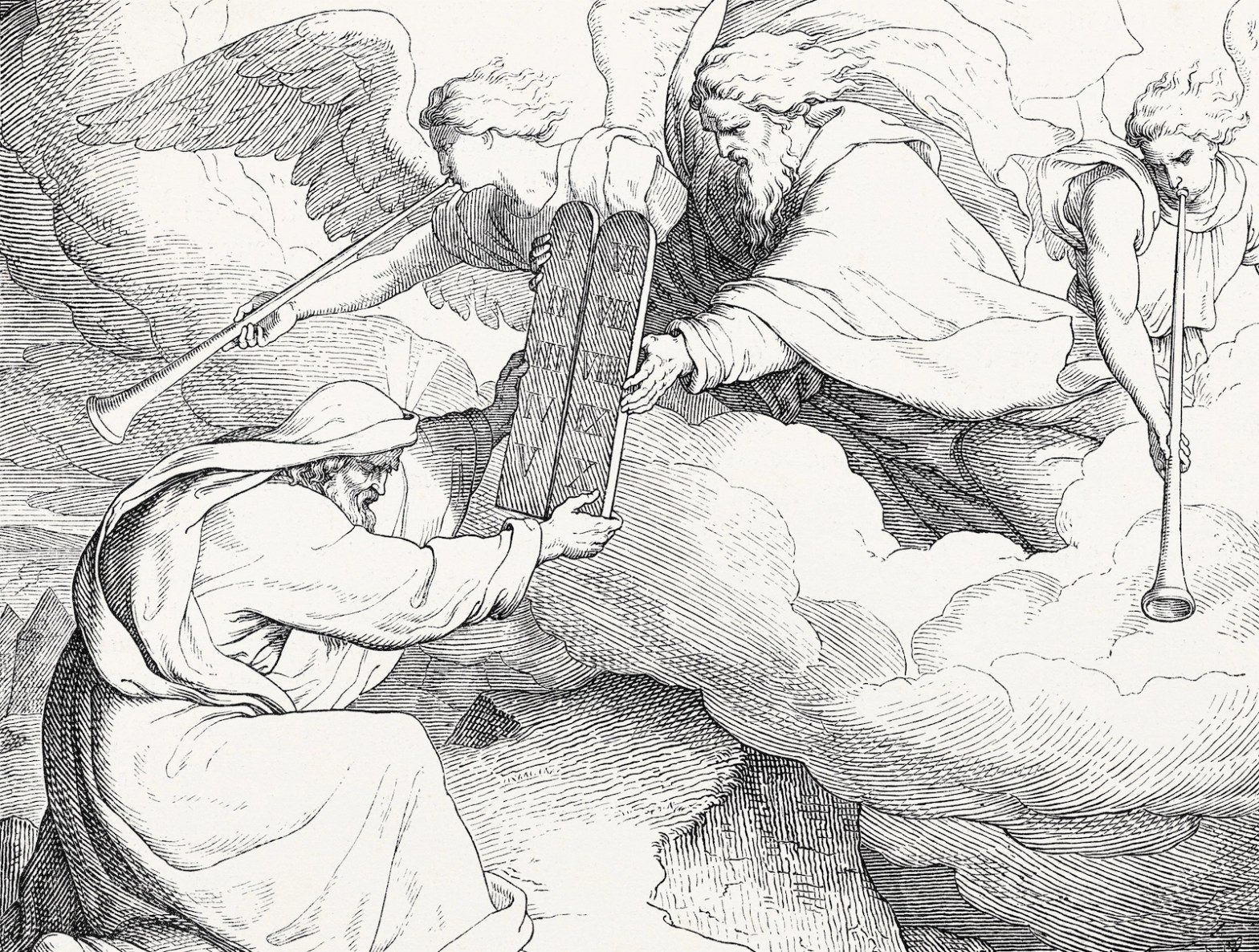
It is human dignity and the respect for other people that underlies the law of charity that is presented to us by Moses, and which he talks about in our first reading today (above). Charity is not only about throwing money at charitable organisations in foreign countries, for charity begins at home. It is not easy, but as Moses says it is not beyond our strength, not beyond our reach, for we need not exert ourselves very much to acquire the divine Wisdom, Who dwells within us.
Moses was speaking some 1,400 years before Christ, long before the first Christian Pentecost and the Sacraments of the Church, and now we have the Holy Spirit living within us. Are we not better off than the crowds that heard Moses? Do we not have the Holy One born in the flesh, the Son of God and of Mary, Whom we receive in Holy Communion, to whom (as S. Paul says in the second reading) all things are subject, even the spiritual enemies of our souls?
“He is the true likeness of the God we cannot see; His is that first birth which precedes every act of creation. Yes, in Him all created things took their being, heavenly and earthly, visible and invisible; what are thrones and dominions, what are princedoms and powers? They were all created through Him and in Him; He takes precedency of all, and in Him all subsist. He too is that head Whose body is the Church; it begins with Him, since His was the first birth out of death; thus in every way the primacy was to become His. It was God’s good pleasure to let all completeness dwell in Him, and through Him to win back all things, whether on earth or in heaven, into union with Himself, making peace with them through His blood, shed on the cross.”
Letter of S. Paul to the Colossians, 1: 15-20 [link]
We cannot be afraid, and we shall fight for human dignity, for the men and women whom Christ loves and for whom He gave His life. And so when we are minded to help those who need it and ask ourselves, Who is my neighbour?, the answer is probably not found only in foreign countries and faraway lands, but rather just down the road, with the old and the vulnerable in their homes, the mothers coerced by a corrupted society into choosing abortion when they would rather not, the despairing family man who just lost his job and doesn’t know how to support his family. We shouldn’t have to look too far to find our neighbour.
“It happened once that a lawyer rose up, trying to put Him to the test; ‘Master,’ he said, ‘what must I do to inherit eternal life?’ Jesus asked him, ‘What is it that is written in the law? What is thy reading of it?’ And he answered, ‘Thou shalt love the Lord thy God with the love of thy whole heart, and thy whole soul, and thy whole strength, and thy whole mind; and thy neighbour as thyself.’ ‘Thou hast answered right,’ He told him; ‘do this, and thou shalt find life.’ But he, to prove himself blameless, asked, ‘And who is my neighbour?’ Jesus gave him his answer; ‘A man who was on his way down from Jerusalem to Jericho fell in with robbers, who stripped him and beat him, and went off leaving him half dead. And a priest, who chanced to be going down by the same road, saw him there and passed by on the other side. And a Levite who came there saw him, and passed by on the other side. But a certain Samaritan, who was on his travels, saw him and took pity at the sight; he went up to him and bound up his wounds, pouring oil and wine into them, and so mounted him upon his own beast and brought him to an inn, where he took care of him. And next day he took out two silver pieces, which he gave to the inn-keeper, and said, Take care of him, and on my way home I will give thee whatever else is owing to thee for thy pains. Which of these, thinkest thou, proved himself a neighbour to the man who had fallen in with robbers?’ And he said, ‘He that shewed mercy on him.’ Then Jesus said, ‘Go thy way, and do thou likewise.'”
Gospel of S. Luke, 10: 25-37 [link]
 Catholic Louth and Mablethorpe