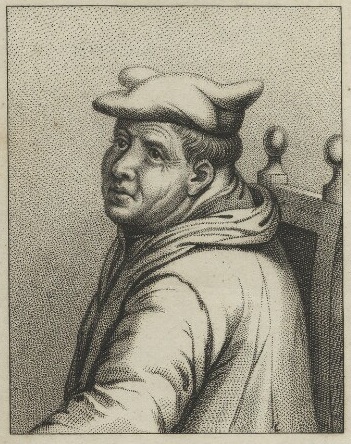
I’ve been curious about the English bishops of the sixteenth century who went through the car-crash of the English reformation. We sometimes hear of the great bishop of Rochester, S. John Fisher, the only one of the English bishops to stand up to King Henry VIII, and who paid for this with his life. S. John was appointed cardinal while in his prison cell not long before his martyrdom but was unable to accept the appointment. However, he is often pictured in his cardinatial red. But what of the others?
Let’s learn about Edmund Bonner (1500-1569), the bishop of London, who’s rises and falls were typical of the English nation of his time, which had learnt to honour the king, as he were set over her by God Himself. Which is all right and proper, in good times. But the integrity of S. John Fisher and the former chancellor S. Thomas More was rare, and the other bishops preferred to compromise with the schismatic rule of the king, and the later heretical rule of his son. Bonner was one such. He compromised at first (although remaining very conservative when faced with the protestantisation of the English Church), returned to Catholicism under the reign of Queen Mary Tudor, and afterwards remained firm, dying in prison under the protestant Queen Elizabeth.
Edmund Bonner was chaplain to Cardinal Wolsey, King Henry’s chancellor. When Wolsey failed to obtain for the king the annulment of his marriage to Queen Katherine of Aragon, he was abused and died soon afterwards, and despite Bonner’s loyalty to the archbishop, he became a diplomatic envoy of the king. When the king broke communion with Rome and drew the English Church with him into schism, Bonner signed the Act of Supremacy (1534) and accepted a schismatic but still valid episcopal consecration to the See of London. He was fiercely Catholic in his doctrine, but loyal to the King in his ‘reformation’ of the English Church, trying offences against the king’s Act of Six Articles (1539), which aimed to end disunity and religious debate with a decidedly tradionalist stand against the protestant novelties being broadcast from the Continent. When the king died and his son, the child-king Edward VI (1547-1553), was enthroned, protestantism was increasingly forced upon the English Church, and when Bonner resisted he found himself in the Marshalsea prison for refusing to recognise the king’s supremacy.
Bonner was restored when Queen Mary was enthroned (1553) and returned to popular acclaim to the cathedral of London. After his ill-treatment at the hands of the protestants during the reign of King Edward, Bonner now presided over the trials of belligerent protestants, and earned the hatred of the protestant hagiographer John Foxe, who later in his famous Book of Martyrs called the old bishop ‘Bloody Bonner.’ Quite like the protestants began to call Queen Mary ‘Bloody Mary.’ Despite this later protestant campaign against Bonner, he is known to have conducted the heresy trials patiently and to have tried hard to convince the protestants to renounce their errors, desperate to save these his opponents, in both body and soul. When this failed, he was forced by custom to hand them over to the secular authority for due punishment. At a time when politics and religion were intertwined, such dissenters were seen as a national security risk. The glorious Queen Elizabeth later treated Catholics similarly, and on a much larger scale. But Bonner was known to be persuasive, and protestant leaders feared his ability to diminish their numbers with his words; he was hated more for this ability to return people to union with Rome than for his part in the executions.
When Queen Mary died (1558), and Queen Elizabeth was crowned and began to destroy the work of the reconciliation of England to Rome and the Holy Father, Bonner was deprived of his See of London for refusing to end the offering of the Holy Mass and the chanting of the Hours in the Cathedral of S. Paul, and for refusing to sign the new Act of Supremacy (1558). The Mass had been banned again in 1559. Back went Bonner to the Marshalsea, this time for good. He died there in 1569, and if he has not been acknowledged as a martyr for the Old Religion of England this would likely be because of his connection with the executions under Queen Mary.
Source: M. Davies, Cranmer’s Godly Order, Angelus Press, 2014.
 Catholic Louth and Mablethorpe