I shall continue what I have been saying now for the last two Sundays, treating human dignity. Last week, I spoke of the image of God in man, and that man is the only creature willed by God for his own sake, with an eternal destiny to beatitude with God. Mankind is made to create in a way similar to God, to make and remake, to seek what is true and beautiful, and to work to establish it with freedom. I did say also that man’s freedom is bound by charity, by love, so that we cannot do absolutely anything with ourselves or to each other, but should seek both our good and the good of others also.
This is where we begin to talk about good and evil. Evil is not anything really, but the absence of good – it is the disorder that enters into the divine plan, challenges the Will of God. If God Himself has endowed human beings with their native dignity, and His law of charity obliges us to honour that dignity, then living a truly moral life involves making choices that prioritises not our own desires, but the well-being of others. If this goodwill – this truly human charity – is drawn to its very extreme, we end up upon a cross alongside Christ, giving ourselves up as He did for love. As the Catechism states, living a moral life bears witness to the dignity of the person. And it must always do.
“By his reason, man recognizes the voice of God, Which urges him ‘to do what is good and avoid what is evil.’ Everyone is obliged to follow this law, which makes itself heard in conscience and is fulfilled in the love of God and of neighbour. Living a moral life bears witness to the dignity of the person.
Catechism of the Catholic Church, §1706 [link]
But as I mentioned last week, there is a destructive inclination within us, which causes us fight each other, to destroy each other, and to seek justifications for such behaviour. There is a more frightening side of this, because the ancient Hebrew/Jewish tradition and the Catholic tradition tell us that there are spiritual forces bent upon our destruction, spiritual forces who envy our ability to relate to the Holy One, God our Lord, in a way that is forbidden them. These enemies of our souls would attempt to cause us to pervert our freedoms, to deny what charity demands and to choose selfishness instead. When our first parents (Adam and Eve) listened to the voice of the serpent in the Garden, they made us susceptible to the same whispered voice. The Catechism states that we are now inclined to evil and subject to error, divided within ourselves.
“‘Man, enticed by the Evil One, abused his freedom at the very beginning of history.’ He succumbed to temptation and did what was evil. He still desires the good, but his nature bears the wound of original sin. He is now inclined to evil and subject to error: Man is divided in himself. As a result, the whole life of men, both individual and social, shows itself to be a struggle, and a dramatic one, between good and evil, between light and darkness.”
Catechism of the Catholic Church, §1707 [link]
S. Paul said this well when he declared in one of his letters that there seemed to be another law within him that drew him from the good he desired to do and towards the evil that he actually did. I think we can all identify that contradiction within ourselves. But let’s not be altogether negative about human nature. There is more good in us than evil, and the Holy One will draw that good out of us, and bring good even out of the evil that we human beings cause. For the Man on the Cross is our Salvation, and in Him humanity is altered forever: He shows us the extreme of charity, He shows us how to die with dignity, and He beckons away away from selfishness and individualism, and towards love and communion. We have a name for this perfection in charity – sanctity, or holiness – a gift conferred upon us by God our Lord, a gift that makes us Christ-like.
“He who believes in Christ becomes a son of God. This filial adoption transforms him by giving him the ability to follow the example of Christ. It makes him capable of acting rightly and doing good. In union with his Savior, the disciple attains the perfection of charity which is holiness. Having matured in grace, the moral life blossoms into eternal life in the glory of heaven.”
Catechism of the Catholic Church, §1709 [link]
In all of this though, we are centred as Christians and Catholics upon God and not upon humanity. It is God Who gives us our dignity and makes us holy. If we ignore God or set His Law aside and claim to have a morality that is determinedly atheistic and non-Christian (even anti-Christian), as we have often done in the West, we lose the traditional understanding of human dignity and atrocities arrive, the scale of which can be unbelievable, until we read of the catastrophes of the last century and the ongoing tragedy of the millions of aborted babies, among other moral evils of our times.
And so, we must return to God, both individually and as a society, allowing Him once more to make His home among us, to walk with us. Father Abraham in our first reading shows hospitality to God – he obviously recognises the divine figures standing before him – and his generosity is reciprocated, for his wife will now give birth to his true heir at the age of ninety.
“Abraham hastened into the tent to find Sara. ‘Quick,’ he said, ‘knead three measures of flour, and make girdle-cakes.’ Meanwhile, he ran to the byre, and brought in a calf, tender and well-fed, and gave it to a servant, who made haste to cook it. Then he brought out butter and milk with the calf he had cooked for them, and laid their meal ready, and stood there beside them in the shade of the trees. When they finished eating, they asked, ‘Where is thy wife Sara?’ ‘She is here,’ he answered, ‘in the tent.’ ‘I will come back,’ said he who was speaking to him, ‘next year without fail; and, live she till then, thy wife Sara shall have a son.’ Sara, behind the tent door, overheard it and laughed…”
Book of Genesis, 18: 6-10 [link]
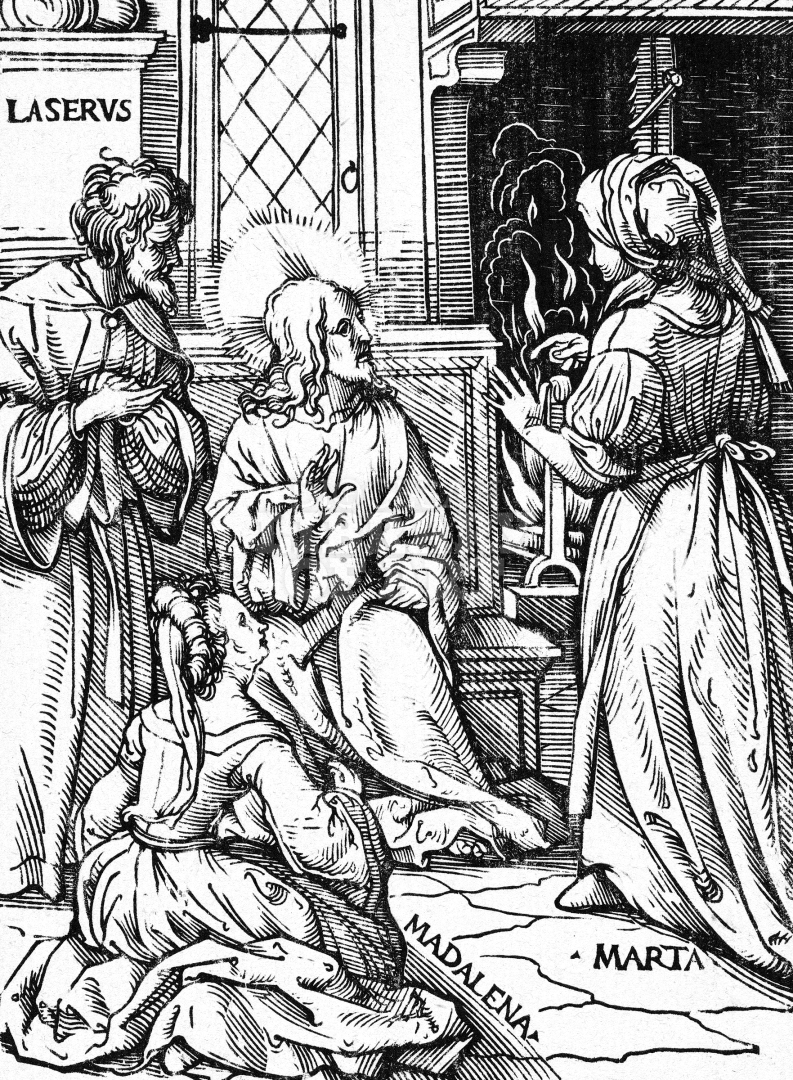
In the gospel story, we are again faced with hospitality shown to God by men, and this time it is God in the flesh, being served with His Apostles by the sisters of Lazarus. Here, S. Mary makes the choice of the contemplation of the face of God in Christ, while her sister busies herself with the housekeeping and is annoyed that she has no helper. S. Martha is indignant, but our Lord says, Mary has chosen the better way.
“In one of the villages He entered during his journey, a woman called Martha entertained Him in her house. She had a sister called Mary; and Mary took her place at the Lord’s feet, and listened to His words. Martha was distracted by waiting on many needs; so she came to His side, and asked, ‘Lord, art Thou content that my sister should leave me to do the serving alone? Come, bid her help me.’ Jesus answered her, ‘Martha, Martha, how many cares and troubles thou hast! But only one thing is necessary; and Mary has chosen for herself the best part of all, that which shall never be taken away from her.'”
Gospel of S. Luke, 10: 38-42 [link]
I have a great deal of sympathy for Martha, because I often find myself in her position, and don’t give myself enough time to take up her sister Mary’s attitude. We do tend to busy ourselves with many things, and give very little time to prayer and the study of Scripture and Tradition – of studying the face of God. There is a little bit of Mary and a little bit of Martha in all of us, but we must find our priorities and choose the better part for ourselves. For while we focus on charity to our family, friends and others (as Martha), let us not forget prayer and devotion (as Mary).
 Catholic Louth and Mablethorpe