We had readings about humility last weekend, and we spoke about how we are to take the lowest seats and allow the King of all things to lift us up higher, to greater things. All things considered, as human beings, despite our pride in being the pinnacle of life on this planet (and perhaps in this universe), we are still created beings, lesser than a host of immortal spiritual beings and far below the Lord and Creator of all things. And we are different from these spirits, for we are beings of flesh and blood as well. We shall never become angels, and they can never become human beings
This material part of our existence attaches us to the things of this world. We cannot fathom a life and existence without the food and clothing that sustain us, or indeed the means of acquiring it: money, trade and commerce. And so, as the first reading says, these tents of clay – our animal bodies – weigh down our spiritual being, preventing us from soaring heavenward.
“What God’s purpose is, how should man discover, how should his mind master the secret of the divine will? So hesitating our human thoughts, so hazardous our conjectures! Ever the soul is weighed down by a mortal body, earth-bound cell that clogs the manifold activity of its thought. Hard enough to read the riddle of our life here, with laborious search ascertaining what lies so close to hand; and would we trace out heaven’s mysteries too? Thy purposes none may know, unless Thou dost grant Thy gift of wisdom, sending out from high heaven Thy own Holy Spirit. Thus ever were men guided by the right way, here on earth, and learned to know Thy will…”
Book of the Wisdom of Solomon, 9: 13-18 [link]
The reading seems to recognise that, although with our vast imagination we reach for the stars, we are yet earth-bound. We can look at that in an astronomical or even science-fiction space travel manner, or we could consider the human heart reaching out to its Creator but unable to comprehend Him based only on His effects around us, that is, in the Creation that lies about us in every direction. He – the Creator – has to condescend to reveal Himself to us. This is the difference we find in our Catholic text-books between the knowledge we can have of God from nature and the knowledge we can have of Him from Scripture and Tradition, by which we can know of His conversations with men and women in history.
So, the reading talks about Holy Wisdom being granted from above, being gifted by the Holy Spirit. Nature can tell us that there is a God, but it is the Revelation of Himself that comes through Scripture and Tradition that tells us Who He is and what He expects of us, as the reading says. He guides us through these, and as a guide and rector, sets us a path upon which we must walk to please Him, even the narrow path Our Lord Jesus Christ so often spoke about. Humility is again key here, because we can only accept the guiding hand of the Creator by thus recognising the ultimate poverty of the human heart.
“Swiftly Thou bearest our lives away,
Psalm 89(90): 5-16 [link]
as a waking dream,
or the green grass that blooms fresh with the morning;
night finds it faded and dead.
Still Thy anger takes toll of us, Thy displeasure denies us rest,
so jealous Thy scrutiny of our wrong-doing,
so clear our hidden sins shew in the light of Thy presence.
Day after day vanishes, and still Thy anger lasts;
swift as a breath our lives pass away.
What is our span of days?
Seventy years it lasts, eighty years, if lusty folk we be;
for the more part, toil and frustration;
years that vanish in a moment, and we are gone.
Alas, that so few heed Thy vengeance,
measure Thy anger by the reverence we owe Thee!
Teach us to count every passing day, till our hearts find wisdom.
Relent, Lord; must it be for ever?
Be gracious to Thy servants.
For us Thy timely mercies,
for us abiding happiness and content;
happiness that shall atone for the time when Thou didst afflict us,
for the long years of ill fortune.
Let these eyes see Thy purpose accomplished,
to our own sons reveal Thy glory;
the favour of the Lord our God smile on us!
Prosper our doings, Lord, prosper our doings yet.“
As the psalm this weekend says, we are like the grass that springs up in the morning and withers and fades in the evening. But a psalm that speaks so dismally about this mortality of ours ends with the theme of joy that we are – and we rejoice and exult in this our fragility. And there is a glory to this fragility of ours, if we are pleased to discover it. For if there weren’t, the Eternal One, God our Lord, would not have elected to share it with us; and that is what He has done in the Incarnation of Our Lord Jesus Christ. If then He speaks to us in our gospel story today about hating our family and our very lives if we are to belong to Him, do you suppose He is being so very extreme. After all, He chose to have these, too.
If God has properly become a Man (and we’ve grown so used to the idea, that we forget how mad this would have sounded to a Roman, a Greek or even a Jew in the first century), then He has near family, a mother, cousins, friends, he had a job, leisure activities, hobbies, material fascinations. He learned to love these, just as we do. What our gospel story is treating this weekend is our attachment to the passing things of this world.
“Great multitudes bore Him company on His way; to these He turned, and said, ‘If any man comes to Me, without hating his father and mother and wife and children and brethren and sisters, yes, and his own life too, he can be no disciple of Mine. A man cannot be My disciple unless he takes up his own cross, and follows after Me. Consider, if one of you has a mind to build a tower, does he not first sit down and count the cost that must be paid, if he is to have enough to finish it? Is he to lay the foundation, and then find himself unable to complete the work, so that all who see it will fall to mocking him and saying, Here is a man who began to build, and could not finish his building? Or if a king is setting out to join battle with another king, does he not first sit down and deliberate, whether with his army of ten thousand he can meet the onset of one who has twenty thousand? If he cannot, then, while the other is still at a distance, he despatches envoys to ask for conditions of peace. And so it is with you; none of you can be My disciple if he does not take leave of all that he possesses.'”
Gospel of S. Luke, 14: 25-33 [link]
Following after Christ then obviously involves a mortification that results in our denying not only sinfulness, but other human goods that people take for granted, even family. And this is what Christ calls a cross. The degree to which we love someone or something is measured by how willing we are to give them or it up. And if we are to treasure God over every other person and thing, then we should be able to set them all aside at the drop of a hat.
Would that it were so easy! And that we could except the people we love as well from this test. This is more understandable by those of us who are converts, and have had to give up very much to be Christian and Catholic. There are religions that are intrinsically inimical to Christianity, and there are Christian communities who loathe the Catholic Church. Crossing over the bridge to Rome and the Catholic Church brings unbearable heartache to many, and the act of conversion can in a very real way involve hating parents, brothers and sisters, cousins, a whole network of friends and acquaintances, and much, much more. In some cases, the life of the convert is at risk. And Christ mentions that too, in this reading.
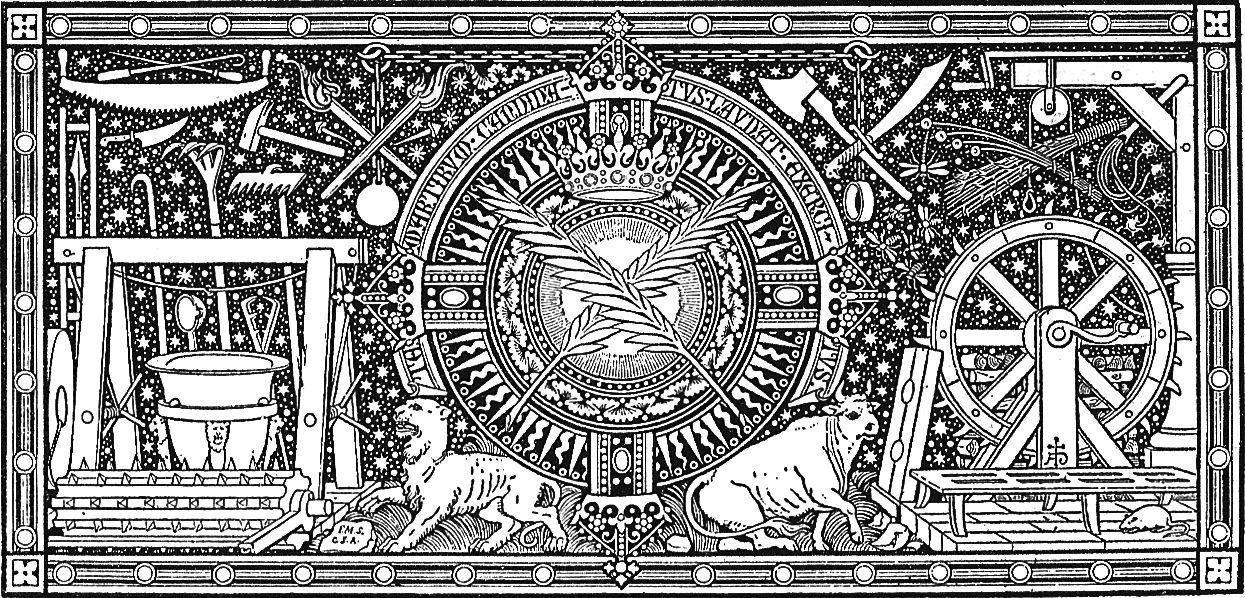
But surviving all this is more than possible. So, when we are converts, we are asked to measure out our commitment over months or years before baptism. Our readings this weekend are then ultimately about martyrdom, which is why I’ve included an image with this post of the instruments of martyrdom, and the victory palm-branches of the martyrs, crowned. The greatest of the Saints of the Church are the martyrs, men and women who have and continue to pay even the ultimate price for love of Christ and the Church. And we love them; we love them and we honour them for something they have been for choices that they have made, which we may admire but think impossible for ourselves.
Until the question is put to us as it was to them, and then perhaps we too shall be martyrs.
 Catholic Louth and Mablethorpe