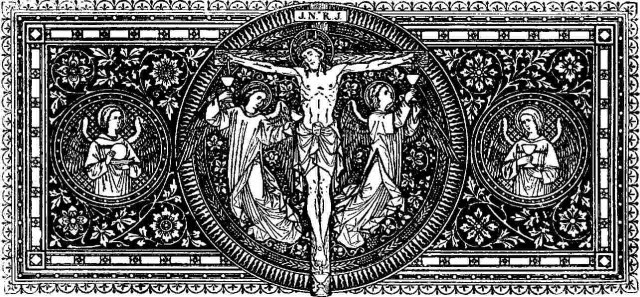
Those of you who have heard my repetitions know that I like to bring the experience of the early Israelites, following Moses out of Egypt and into the desert, closer to our own experience as Christians, following Christ out of the world and into the difficulties of our present lives. There is a real comparison here, and I want to describe our Christian lives in a treacherous and anti-Christian world as a cross. A real cross, a difficult cross. We who are old enough to remember it can tell of how being a Catholic in a protestant England was also a greater cross, perhaps greater than it is today, when Catholics and non-Catholics are more united in fighting a common enemy (or enemies).
“When they left mount Hor, they must needs march along the way that leads to the Red Sea, so as to fetch a compass round the territory of Edom. Before long, the people grew weary of this laborious march, assailing God and Moses with such complaints as these: ‘Why didst thou ever bring us away from Egypt, only to die in the desert? We have neither bread nor water here; we are sick at heart, sick of the unsatisfying food thou givest us.’ Upon this, the Lord sent serpents among them, with fire in their fangs, that struck at many and killed many of them, till they came to Moses and confessed, ‘We have sinned by making complaints against the Lord and against thee; entreat Him to rid us of the serpents.’ So Moses made intercession for the people; and the Lord bade him fashion a serpent of bronze, and set it up on a staff, bringing life to all who should look towards it as they lay wounded. And so it proved; when Moses made a brazen serpent and set it up on a staff, the wounded men had but to look towards it, and they were healed.”
Book of Numbers 21: 4-9 [link]
The first lines we have in this our first reading on this great feast day is typical of so many Christians and Catholics who have set aside the difficult cross, and have abandoned their practice of religion, and some of them their allegiance to Christ. Why did you bring us out of Egypt to die in this desert? they may say to their parents and their grandparents. Why did you baptise us as children? we wouldn’t have chosen that for ourselves, if we could have. People today are very utilitarian, and if they cannot get something material out of baptism and membership of the Church, they don’t want to even go through the motions in a superficial way. What is God’s reply to the challenges of the early Israelites to His way for them? Fiery serpents and death from venomous bites. In our time, abandoning the Church – the Way of Christ – has brought the fiery serpents of materialism, communism, exploitation by foreign ideologies and philosophies, new slaveries, fear and despair in the face of new diseases and natural calamities, and who know how much else. Fiery, fiery serpents. What was the remedy that God gave to the early Israelites, who were dying in consequence of their small acts of apostasy and rejection of Him? He asks Moses to mount a bronze serpent upon a mast and hold it aloft, and looking upon it brings healing. It becomes a visible sign of an invisible grace. In our Catholic language, Moses’ bronze serpent is a sacrament, or in some way sacramental.
“‘No man has ever gone up into heaven; but there is one who has come down from heaven, the Son of Man, Who dwells in heaven. And this Son of Man must be lifted up, as the serpent was lifted up by Moses in the wilderness; so that those who believe in Him may not perish, but have eternal life. God so loved the world, that He gave up His only-begotten Son, so that those who believe in Him may not perish, but have eternal life. When God sent His Son into the world, it was not to reject the world, but so that the world might find salvation through Him.”
Gospel of S. John, 3: 13-17 [link]
Our Lord, as we can see in our gospel reading this weekend, makes direct reference to Moses’ sacramental, raised serpent when He talks of His own being raised up as a sacrament. There was this marvellous film released some twenty-five years ago, that some of you know, called the Passion of the Christ. In that film, after the agonising and drawn-out, very realistic crucifixion of Christ while He is laid upon the cross on the ground, there is this following scene where the cross is raised up by the soldiers. The only Apostle present, S. John, is shown following the cross with his eyes, in horror and realisation. The Blessed Virgin also suddenly seems to see her Son becoming the sign of salvation…
In that moment, when S. John standing besides our Lady at the foot of the Cross saw Christ being raised up, he likely realised the theological import of it and its link with the story of the bronze serpent of Moses. Because it is he who gives us the same theology in our gospel reading this weekend. It is baptismal theology, which is why we find it in the dialogue that Our Lord has with the pharisee S. Nicodemus. To know why this extraordinary image of the crucified Christ – what we call the crucifix – has become the identification par excellence of the Christian religion, we must look for S. Paul’s wonderful hymn from the extract of his letter to the Philippians that we have for our second reading this weekend.
“His nature is, from the first, divine, and yet He did not see, in the rank of Godhead, a prize to be coveted; He dispossessed Himself, and took the nature of a slave, fashioned in the likeness of men, and presenting Himself to us in human form; and then He lowered His own dignity, accepted an obedience which brought Him to death, death on a cross. That is why God has raised Him to such a height, given Him that Name which is greater than any other name; so that everything in heaven and on earth and under the earth must bend the knee before the Name of Jesus, and every tongue must confess Jesus Christ as the Lord, dwelling in the glory of God the Father.”
Letter of S. Paul to the Philippians, 2: 6-11 [link]
We recall the pride of Adam and Eve that damned our race to sin and death – it was a desire to become gods that destroyed the original plan for humanity. A desire to stand on a level equal with God Himself and assert ourselves as having that same authority. Of being our own gods. We see that desire all around us today. The crucifix, as Paul describes here, is the termination of a long moment when God steps down – first in the Incarnation, and then further in the humiliation of the crucifixion – to give us a model of humility and service and to undo the pride that pushes against God.
To demonstrate how humiliating that torment was, quite aside from the immense physical pain and agonising death it involved, consider that it took centuries for the Church to use the crucifix in art, and when she finally did, it took even longer to show the torture of it in the detail we are now used to. The Church is the only religious community to proudly hold forth the image of a God Who suffers such a painful humiliation, and she is despised for it. S. Paul called the crucifix a scandal for the Jew – who cannot tolerate a defeated Messiah – and a foolishness to the non-Jew – who cannot tolerate a humiliated God. But, at a time when Christians around the world are tortured and killed in larger numbers than ever in the last two thousand years and more, the love and humility that they show in the extreme (so very like their Master) will always be held high by the Church, who holds higher still the Cross of her Lord, by which all things were made new.
“Here are the Jews asking for signs and wonders, here are the Greeks intent on their philosophy; but what we preach is Christ crucified; to the Jews, a discouragement, to the Gentiles, mere folly; but to us who have been called, Jew and Gentile alike, Christ the power of God, Christ the wisdom of God.”
First letter of S. Paul to the Corinthians, 1: 22-24 [link]
 Catholic Louth and Mablethorpe