One of the messages we constantly receive throughout Holy Scriptures, as well as from multiple Saints in the history of the Church, is the importance of integrity: being on the outside as we are on the inside. God our Lord, Who condemns deceit, also through the prophets and Our Lord Jesus Christ condemns hypocrisy. And hypocrisy is quite simply saying something and doing something else, not practising what one preaches. So, the prophet Amos in our first reading today preaches against the merchant class, and the nobility that supports them of observing the superficials of religion while ignoring the justice and charity that religion requires.
“Here is word for you, oppressors of the poor, that bring ruin on your fellow-citizens in their need; you that long for New Moon and sabbath to be at an end, for trading to begin and granary to be opened, so you may be at your shifts again, the scant measure, the high price, the false weights! You that for a debt, though it were but the price of a pair of shoes, will make slaves of poor, honest folk; you that sell refuse for wheat! By Jacob’s ancient renown the Lord swears it, crimes of yours shall remain for ever unforgotten.”
Prophecy of Amos, 8: 4-7 [link]
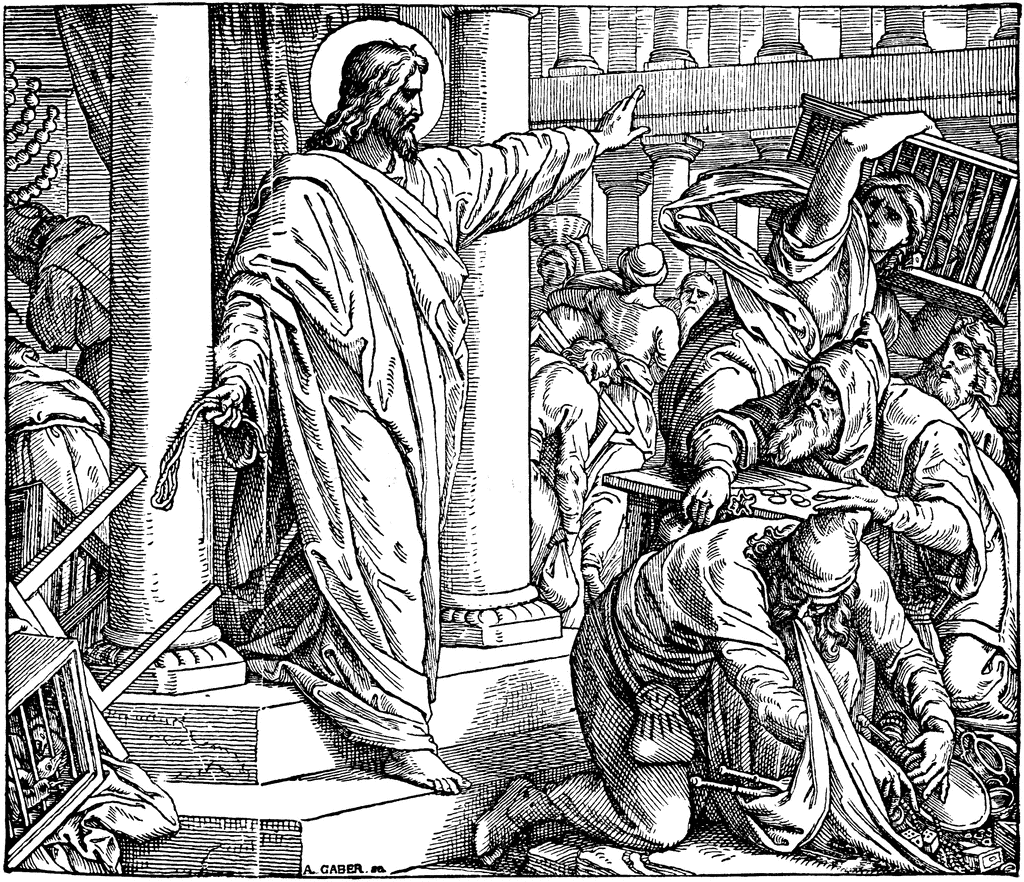
The New Moon marks the beginning of a month in the Hebrew calendar that the Jews still use today, and the new-month (new-moonth) festivities are signals of religious observance, as are the sabbaths. So there were Hebrews in Amos’ time, hundreds of years before our Lord, who attended the Temple, and simultaneously trampled on the needy, swindling money from them with tampered scales. This reminds us of gospel stories and parables, where for example a levite and a priest can process up to Jerusalem for Temple duties while leaving a good Samaritan to observe charity to the dying man on the roadside, or good pharisees can squabble about the Sabbath observance while neglecting to help ordinary Jews in the practice of the Law of Moses, or indeed when the business of buying and selling – and inevitably its tampered scales – can be brought into the very courtyards and halls of the Temple.
“And He said to His disciples, ‘There was a rich man that had a steward, and a report came to him that this steward had wasted his goods. Whereupon he sent for him, and said to him, What is this that I hear of thee? Give an account of thy stewardship, for thou canst not be my steward any longer. At this, the steward said to himself, What am I to do, now that my master is taking my stewardship away from me? I have no strength to dig; I would be ashamed to beg for alms. I see what I must do, so as to be welcomed into men’s houses when I am dismissed from my stewardship. Then he summoned his master’s debtors one by one; and he said to the first, How much is it that thou owest my master? A hundred firkins of oil, he said; and he told him, Here is thy bill; quick, sit down and write it as fifty. Then he said to a second, And thou, how much dost thou owe? A hundred quarters of wheat, he said; and he told him, Here is thy bill, write it as eighty. And this knavish steward was commended by his master for his prudence in what he had done; for indeed, the children of this world are more prudent after their own fashion than the children of the light. And My counsel to you is, make use of your base wealth to win yourselves friends, who, when you leave it behind, will welcome you into eternal habitations.”
Gospel of S. Luke, 16: 1-13 [link]
The only reason I can think that we have the gospel story of the rich man and his dishonest steward this weekend is because it has to do with buying and selling, and the cleverness that that requires. Why does the rich man praise his steward for his perfidy, and should we praise him also? That question takes us towards the end of the gospel reading, where our Lord contrasts the children of this world with the Children of Light. And that presents all of us with a very real choice. We are to choose for Christ and His Kingdom, or to choose to remain in with this passing world of sin. The Children of Light is New Testament code for the Church, for the Christians who are baptised with lighted candles, who are clothed ritually in white, and in the first centuries wore that white for a week after their baptism, are asked even today to bring that white garment unstained one day before the Lord Who called them. Not for us the ways of this world, says the New Testament in multiple places, not for us the injustice, the cheating with tampered scales, the oneupmanship of the children of this world. Rather, we are to suffer these tactics of the materialists and the worldly, who use them to gain treasures in this world of gold, silver, etc. We are to keep our eyes fixed on Christ, and to gather for ourselves treasures in heaven, to where we cannot carry our money and our property and our stocks and our shares. While praying hard for those who are still fumbling with such things…
“This, first of all, I ask; that petition, prayer, entreaty and thanksgiving should be offered for all mankind, especially for kings and others in high station, so that we can live a calm and tranquil life, as dutifully and decently as we may. Such prayer is our duty, it is what God, our Saviour, expects of us, since it is His will that all men should be saved, and be led to recognize the truth; there is only one God, and only one mediator between God and men, Jesus Christ, Who is a man, like them, and gave Himself as a ransom for them all. At the appointed time, He bore His witness, and of that witness I am the chosen herald, sent as an Apostle (I make no false claims, I am only recalling the truth) to be a true and faithful teacher of the Gentiles. It is my wish that prayer should everywhere be offered by the men; they are to lift up hands that are sanctified, free from all anger and dispute.”
First letter of S. Paul to S. Timothy, 2: 1-8 [link]
O money, that tainted thing… What shall we get out of it? What is it to have a number in the bank with multiple zeroes on the right side of it, and to desire to add further zeroes to it? It may buy us a nice house, with more rooms than we need, a car or two, maybe a nice farm or a chateau in the country. But the Bible keeps reminding us that we cannot take these things with us when we go. And go we shall, eventually, as everything that decays and corrupts. Right, let’s pass it all on to those we love, but soon government will make that harder than ever. Christ tells us anyway that money and wealth cannot be an end in itself, that it must be a means to something greater. So, how shall we use our money? We need at least some of it to live, and that too is a gift from God.
But as for the rest… we shall have to use it to secure our treasure in the heavenly places. As the materialist steward uses his master’s wealth to secure future employment by forgiving the debts his master has acquired, so we shall use our Master’s many graces and gifts in acts of faith and charity to build favour with Him. And while the worldly steward is grudgingly honoured by his worldly master for getting the better of him (but doing it shrewdly), the children of light will be honoured for a different reason by the Lord of Light. For they have used the worthless things of this world to gain life itself.
 Catholic Louth and Mablethorpe