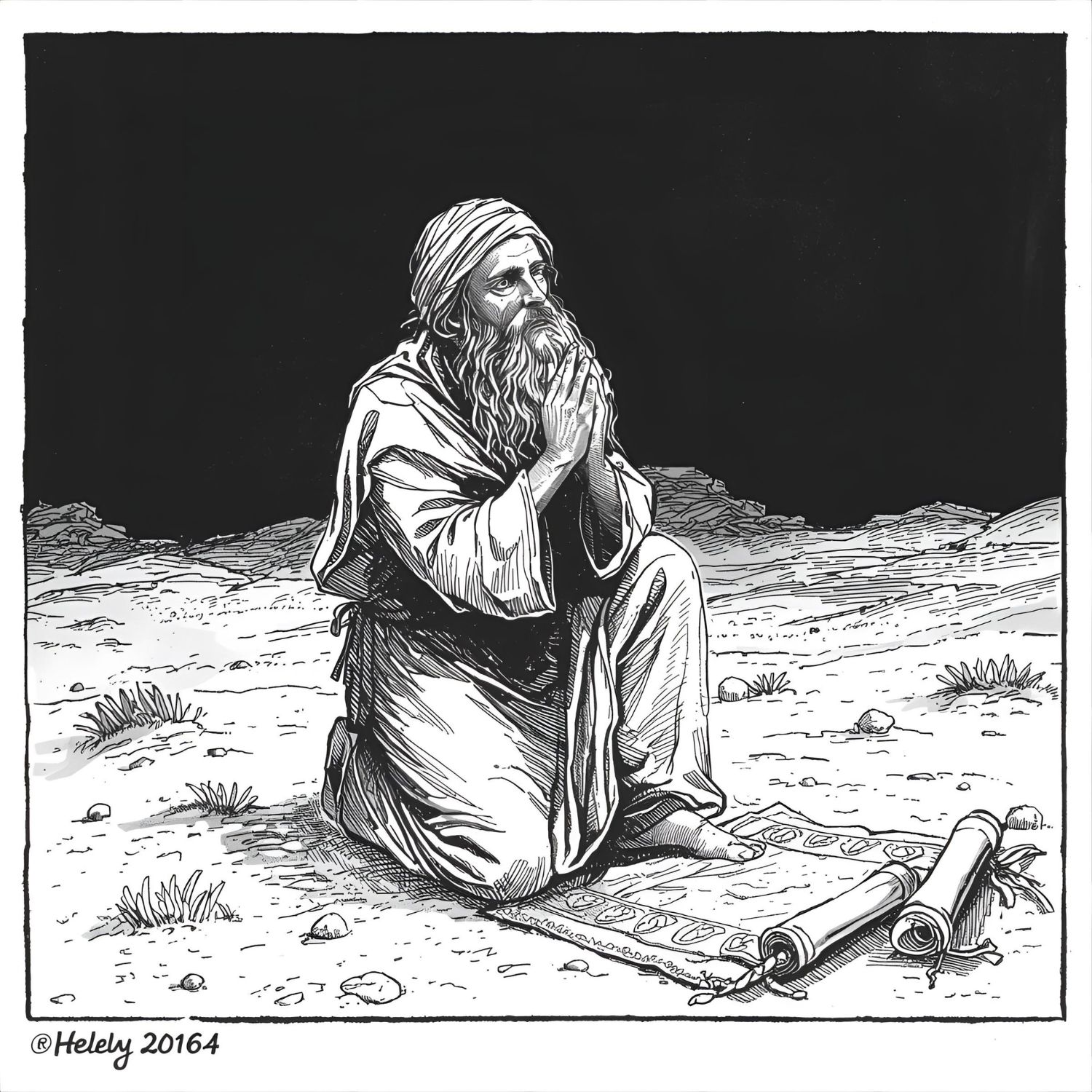
“Lord, must I ever cry out to Thee, and gain hearing never? Plead against tyranny, and no deliverance be granted me? Must I nothing see but wrong and affliction; turn where I will, nothing but robbery and oppression; pleading at law everywhere, everywhere contention raising its head? What marvel if the old teachings are torn up, and redress is never to be found? Innocence by knavery circumvented still, and false award given…! What message, then, is entrusted to me? What answer shall I make when I am called to account? Here on the watch-tower my post shall be; stand I on the battlements, and await His signal. ‘Write down thy vision,’ the Lord said, ‘on a tablet, so plain that it may be read with a glance; a vision of things far distant, yet one day befall they must, no room for doubting it. Wait thou long, yet wait patiently; what must be must, and at the time appointed for it. Foul air the doubter breathes; by his faith he lives, who lives right…'”
Prophecy of Habacuc, 1: 2-4; 2: 1-4 [link]
This is a good set of readings we have at Mass this weekend, as the amount of violence around the world increases, in spite of an apparent international cooperation and the common experience of free travel and mutual understanding between peoples. I say ‘apparent’ because there are still hostile groups spreading ideologies of death and destruction, and seeking to terrorise entire communities. We look wistfully to a time when we thought there could be a war to end all wars; how hopeful we have been about humanity. And then there was another wretched war, and another and another.
It’s no longer only about nations raising armies against nations; a matter of these Germans here, or those Russians there. In a very multicultural environment, the whole world is on our doorstep, or down our streets, as much in the big cities as in our provincial towns. And that can be a beautiful thing, and it often is. But it also brings foreign wars and the accompanying violence within close proximity. Communal tensions that we used to hear about on the television as happening half a world away, we now hear happening in Leicester, or most recently Manchester. And we see the pictures of the recently dead in the media, and weeping family members online, and we may remember the beatitudes of Christ from the gospels of S. Matthew and S. Luke.
We may have deceived ourselves in the West into thinking that a more secular, atheist and humanist environment could lead to endless peace, although most of the world is still on fire with people killing other people, and that a soup of cultures stirred together may not of necessity bring only good things. In a time of relatively more strife, in the first century of this era, the Lord said, Blessed are the poor in spirit, the humble, those who strive for righteousness before God, who moan in the absence of justice, who are peace-makers in the midst of war, and finally who suffer and die for the cause of Christ, for the cause of love, for holding up the standard of the Cross in a world that despises the Cross. How long, o Lord! cries the prophet in our first reading today. Habakkuk is our prophet as we stare wistfully at news reports of seemingly endless destruction (because that’s what news reporters love to report about, but even so)… Why is man so anxious to hurt man, why can’t people just get along? The prophet didn’t have to look beyond the borders of the Israel he knew and loved, for as people fell away from the Law of God (‘old teachings torn up,’ in the reading above), communal strife was inevitable, envies and jealousies were everywhere, and every man sought selfishly for his own well-being. Contention and discord…
Habakkuk speaks for those of us who just want peace and an abundance of righteousness. I think most people in this world would say they want peace. Nobody really wants war. But why then, during peace-time, do people in the most prosperous cities of the world make war, commit crime? It’s not only the impoverished who enter systems of crime. When will justice come? God replies in the first reading to say, Wait and watch, be patient, justice will come… the situation of the world causes us distress when we are so surrounded by it, thanks to the news media. How does God permit these evils? we say, is there even a God? some of us find ourselves daring to ask. But, faith! Be patient, justice will come. The Jews in the first century received this same message. They were used to violence, the Romans being far worse than the governments we know, the family of Herod being no better. And the Jews come up to the Lord in our gospel story to say, Increase our faith.
“The apostles said to the Lord, ‘Give us more faith.’ And the Lord said, ‘If you had faith, though it were like a grain of mustard seed, you might say to this mulberry tree, Uproot thyself and plant thyself in the sea, and it would obey you. If any one of you had a servant following the plough, or herding the sheep, would he say to him, when he came back from the farm, Go and fall to at once? Would he not say to him, Prepare my supper, and then gird thyself and wait upon me while I eat and drink; thou shalt eat and drink thyself afterwards? Does he hold himself bound in gratitude to such a servant, for obeying his commands? I do not think it of him; and you, in the same way, when you have done all that was commanded you, are to say, We are servants, and worthless; it was our duty to do what we have done.'”
Gospel of S. Luke, 17: 5-10 [link]
His message to them is the same as His message to Habakkuk: do your duty, your work of charity, and do it well. The reference to commands here we may associate with the commandments of the Law of Moses, as made clearer by the Gospel of Christ. If we do all that was thus commanded, we are but doing our duty as good Jews and/or good Christians. And we must do it well, and with the right intentions. And having finished it, in humility we must then declare that we have only done as we should, and not seek any glory in it or any reward from it. The world is always falling to pieces around us, but we are the stewards of this world. Be good stewards, as Paul says in the second reading, inspired by the Spirit of action, love, self-control, proudly Christian with a vocation to holiness, waiting for the Lord.
“That is why I would remind thee to fan the flame of that special grace which God kindled in thee, when my hands were laid upon thee. The spirit He has bestowed on us is not one that shrinks from danger; it is a spirit of action, of love, and of discipline. Do not blush, then, for the witness thou bearest to our Lord, or for me, who am His prisoner; share all the tribulations of the gospel message as God gives thee strength. Has He not saved us, and called us to a vocation of holiness? It was not because of anything we had done; we owe it to His own design, to the grace lavished on us, long ages ago, in Christ Jesus. Now it has come to light, since our Saviour Jesus Christ came to enlighten us; now He has annulled death, now He has shed abroad the rays of life and immortality, through that gospel which I have been appointed to herald, as an apostle and a teacher of the Gentiles. This is what I have to suffer as the result; but I am not put to the blush. He, to whom I have given my confidence, is no stranger to me, and I am fully persuaded that he has the means to keep my pledge safe, until that day comes. With all the faith and love thou hast in Christ Jesus, keep to the pattern of sound doctrine thou hast learned from my lips. By the power of the Holy Spirit who dwells in us, be true to thy high trust.”
Second letter of S. Paul to S. Timothy, 1: 6-14 [link]
 Catholic Louth and Mablethorpe