
October is the month of the Rosary, and I haven’t said anything about that yet, so I shall for a bit this weekend. And it helps that the readings this weekend concern persistence in prayer. What may our continual prayers for peace and for justice (in a world that seems to want anything but) be if not persistent and hopeful, like those of the widow of the gospel story…
“And He told them a parable, shewing them that they ought to pray continually, and never be discouraged. ‘There was a city once,’ He said, ‘in which lived a judge who had no fear of God, no regard for man; and there was a widow in this city who used to come before him and say, Give me redress against one who wrongs me. For a time he refused; but then he said to himself, Fear of God I have none, nor regard for man, but this widow wearies me; I will give her redress, or she will wear me down at last with her visits.’ ‘Listen,’ the Lord said, ‘to the words of the unjust judge, and tell me, will not God give redress to His elect, when they are crying out to Him, day and night? Will He not be impatient with their wrongs? I tell you, He will give them redress with all speed. But ah, when the Son of Man comes, will He find faith left on the earth?'”
Gospel of S. Luke, 18: 1-8 [link]
So, would Christ find faith left even in His Church today? I think He would. Would He find trust among His faithful people that justice will return. In every soul that still prays to Him, who looks aloft in hope… yes, He would.
The Rosary or coronet of our Lady is a string of 150 Aves or Hail Marys that historians suggest were meant to allow ordinary people in the medieval period to accompany the monks who recited the whole of the 150 psalms of the Book of Psalms regularly, either through a week or through a day. How do you keep track of 150 Aves, and how unwieldy do you suppose a string of 150 beads can get?
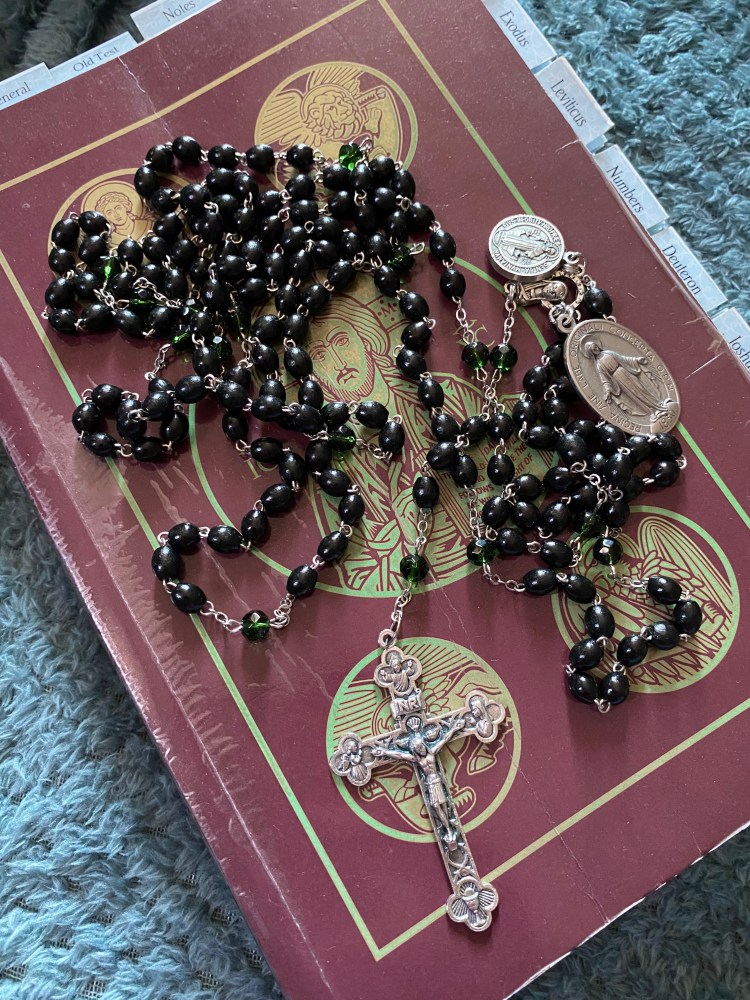
So, holy prudence reduced the strings most of our holy Religious – the monks and nuns – to 50 beads (which is what we are used to), which could be used three times. At some point also, the 150 Aves were divided into the fifteen mysteries in three batches – the Joyful, Sorrowful and Glorious Mysteries – of the Holy Rosary, that we know so well. After some clamour in the middle of the twentieth century for more rosary still (because we Catholics couldn’t get enough rosary), the Holy Father John Paul II – a great devotee of our Lady and her Rosary – suggested the five optional-extra mysteries that we call the Luminous Mysteries. So there you have it; a little potted history of the Rosary.
But what is the glory of the Rosary? Not that we necessarily get something material out of it, although our dear Lady may arrange that for us. After all, she helps us in our difficulties in this life, and she asked us to pray the Rosary for peace. But it’s not the important bit, it’s only a secondary, if welcome benefit. The glory of the Rosary is what is hidden within it: the mysteries of our Catholic Faith, in the life, death, resurrection and glory of Our Lord Jesus Christ, and also of His mother. For their fates are intertwined, and in saying the rosary and attempting to enter those mysteries, we hope to intertwine our own eternal fates with theirs. For we want heaven, we want Christ, and if saying a few hundred Aves a week can help that, we should do our best.
‘Blessed be that monotony of Aves,’ said S. Josemaria Escriva, ‘that purifies the monotony of your sins.’ So, the heart of the rosary – this great prayer of ours – is meditation on the life, death and resurrection of Christ, walking through these in the company of His mother. And who better can help us to understand Him, and to grow nearer to Him each day. If you say only 50 Aves a day, or if you go the full monty and say all 150, she will draw you inexorably along the narrow path and through the narrow gate, leaving behind the filth of this world and its rebellion against the Holy One and meeting at long last the Greatly Desired, the Lord of our Hearts.
But the Rosary recited regularly wants commitment, and that wants effort, and if you think about it it is the effort of it – of struggling with a good work – that is crowned in the end with glory. And so let us do our best.
Speaking of effort… in our first reading today, we find that old man Moses, long past his eightieth year, has discovered that the success of the first battle the nation of Israel has with their long-term enemies the Amalekites depends on him holding his arms up in the air for hours.
“And while they were at Raphidim, the Amalecites came and offered the Israelites battle. So Moses said to Josue, ‘Muster me an army, and go out to fight against Amalec; I will take my stand to-morrow on the hill top, with the miraculous staff in my hand.’ And Josue did as Moses bade him, going out to do battle with Amalec, while Moses, Aaron and Hur went up to the hill top. Whenever Moses lifted up his hands, Israel had the better of it; only when he rested for a little did the victory go to Amalec. But now Moses’ arms grew weary; so they found him a stone to sit on and bade him be seated on it; then, one on each side, Aaron and Hur kept his hands lifted up. In this way, the strength of his arms held out until set of sun, while Josue routed Amalec, and all the forces Amalec could rally, at the sword’s point.”
Book of Exodus, 17: 8-13 [link]
There is a comic element to this, almost a slapstick with Moses raising and lowering his arms and Joshua struggling with this down on the plain. But think of Our Lady asking us at the tail end of the first World War to pray our Rosaries for peace. And then, a couple of decades, later the Germans are at it again. Shall we ever have peace? The Holy Father has just asked us this very month to pray the Rosary again for peace. And so… out with our beads, our arms are heavy… with laziness or reticence, or with the cares of life, which exhaust us and distract us, and there is no time for any prayer, certainly not the toil of the Rosary.
Moses had Aaron and Hur to hold his up, we should find our own assistance in these evil days. The Church has given us many weapons for spiritual warfare in our times. I’ve said something about the Rosary already. S. Paul gives us two more in our second reading: Scripture, our great inheritance from the Jewish nation, and the tradition Timothy has had from the Church, and from his mother and grandmother, both of whom Paul knew well.
“It is for thee to hold fast by the doctrine handed on to thee, the charge committed to thee; thou knowest well, from whom that tradition came; thou canst remember the holy learning thou hast been taught from childhood upwards. This will train thee up for salvation, through the faith which rests in Christ Jesus. Everything in the scripture has been divinely inspired, and has its uses; to instruct us, to expose our errors, to correct our faults, to educate us in holy living; so God’s servant will become a master of his craft, and each noble task that comes will find him ready for it. I adjure thee in the sight of God, and of Jesus Christ, Who is to be the judge of living and dead, in the name of His coming, and of His kingdom, preach the word, dwelling upon it continually, welcome or unwelcome; bring home wrong-doing, comfort the waverer, rebuke the sinner, with all the patience of a teacher.”
Second letter of S. Paul to S. Timothy, 3: 14 – 4: 2 [link]
With these weapons – Scripture, tradition, and the devotions that are ours – we shall snatch away our souls and those of the people we love from the enemy, the lord of this world, and entrust them to Our Lord Jesus Christ through His good Mother. And we shall not cease to pray, like the persistent widow of the gospel, for this world of men and women, made in the likeness of God, for their solace in this world, and for their eternal welfare.
For evil must inevitably rule this world, but evil will never have the last word, and Justice will come at last.
 Catholic Louth and Mablethorpe