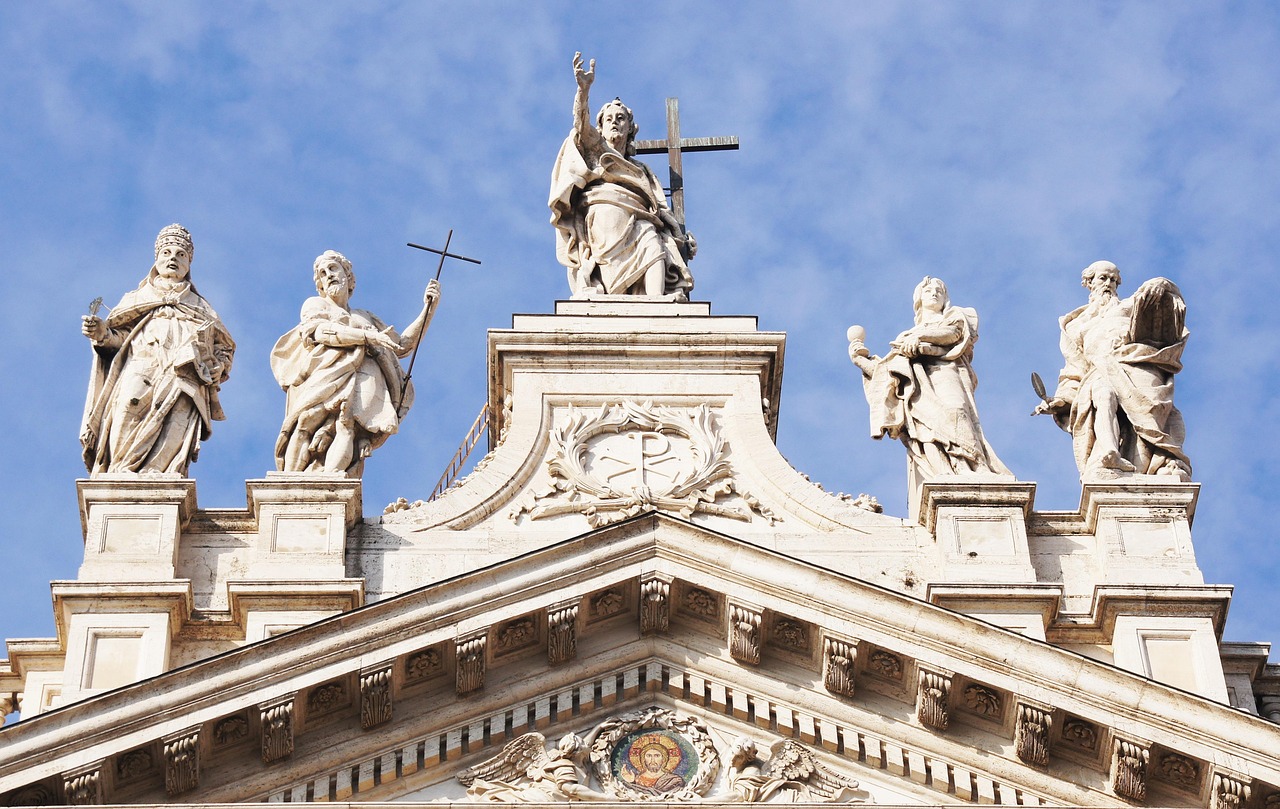
Image by annaklein from Pixabay
The thirty-second Sunday of Ordered (or Ordinary) time was suppressed again, as last weekend (with the Solemnity of All Saints), this time because of the feast day of the dedication of the Holy Father’s own cathedral in Rome, the arch-basilica of the Most Holy Saviour, called after its location in the far east of the Holy City – the Lateran basilica (the tympanum on its façade pictured above). So, our readings at Mass were all to do with temple and church buildings, and the theological meaning of these. But this is still England, and the nation has marked this Sunday as Remembrance Sunday, when she rallies around her Armed Forces community to remember the Fallen of the great Wars of the last century and their great Sacrifice.
So, let’s spend a little time talking about Remembrance Day. I don’t quite understand this grief I personally feel for these soldiers, for I am a foreigner and indeed several generations from them, I don’t share their belonging to this country, their desire to leave everything behind to fight to preserve what they loved. Looking back at the absolute butchery of the First War – which made our countries desire it to be the War to end all wars – and the greater savagery of the Second War, we can perhaps recognise a certain futility in the personal offering of the men who went to battle. Thanks to all the rather realistic films and documentaries that have been produced in the last few decades, I think of these brave men more often in their helplessness in the trenches and on the endless fields than in ‘victory’ at the end, and I remember the videos of traumatised soldiers trying to deal with ordinary life again after they survived the ordeal. So much wasted life…
Was their sacrifice worth it…? Well, of course it was. Because, for all the fear and uncertainty with which Christian men marched out to death, they acted in love. If not the greater love for their nation and people, and perhaps with the lofty ideals of freedom and opposition to tyranny, they went out of love for their families and their local communities. And love always has the last word. Love doesn’t remain buried under foreign soil, or behind plaques and inscriptions in churches and public memorials. Because Love Himself died upon a cross, and promised resurrection and eternal life to those who could empty themselves out like He did.
That may be why so many of us (and even of us well-meaning immigrants) still grieve for them all these years later, when our values have changed to the point where we debate constantly about what ‘British values’ actually are and to the point when old veterans appear on television and weep for what our countries have become, how different they are from what they had fought to preserve. We grieve for them because we know that they loved to the point of death, and (in the words of the famous poem), they gave their today so that we could have a tomorrow. That should touch the coldest of hearts. We might live in a post-Christian world here in the West, but we are still resting upon the strong foundations of a Christian past, and we know how to value sacrifice, and I hope we have not forgotten how to fight today for the things we love as men and women did in the past.
Thanks to the great hearts of the last century, we don’t have to look too far back in history to find witnesses, to find Christian men and women – military and civilian – willing to give everything up for the people they loved. The Wars were won – so we are told – tyranny has been delayed, millions died to achieve that, their love lives on, and we must treasure or learn to treasure the things they loved. Nation, town, village, family, friends, the way things were…
The readings we have for the dedication of the Lateran basilica speak of resurrection, and they may be apt for this time of Remembrance and prayer for the Fallen dead. The first reading from Ezechiel the prophet speaks in great detail of a new Temple in Jerusalem. Or so he thinks. Within Ezechiel’s lifetime, the Neo-Babylonian empire attacked Judea and Jerusalem, destroying the city and razing the Temple to the ground, in an effort to destroy the unity of the remainder of the Hebrew nation. They went on to scatter the rallying forces of the nation to the far corners of their empire, while refugees ran towards places like Egypt. Ezechiel, already in exile in Babylon, comforted the Jews there and told them that their fortunes would recover and the Temple would be rebuilt. This did happen – there was a second Temple – but not according to his detailed vision, some of which we have here…
“And last, he took me to the door of the temple itself, and shewed me where a stream of water flowed eastwards from beneath the threshold of it. Eastward the temple looked, and eastward these waters flowed, somewhat to the temple’s right, so as to pass by the southern side of the altar. Through the northern gate he led me, and round the walk that passed the outer gate, taking the eastern sun; and here, to the right of the gate, the water gushed out. Eastward then he faced, the man of the measuring-rod; measured a thousand cubits, and led me across a stream that reached my ankles. Another thousand, and when I crossed the stream it reached my knees; another thousand, and it was up to my waist, another thousand, and now it had become a torrent I might not cross any longer, so high the waters had swelled, out of my depth. Mark it well, son of man, said he; and with that he brought me out on to the bank again; when I reached it, I found that there were trees growing thick on either hand. This stream, he told me, must flow eastward to the sand-dunes, and so fall into the desert; pass into the Dead Sea and beyond it, cleansing those waters by its passage. Wherever it flows, there shall be teeming life once again; in the Dead Sea itself there will be shoals of fish, once this stream has reached it, this stream that heals all things and makes all things live. Fisher-folk will line the shores of it, and there will be drying of nets all the way from Engaddi to Engallim, and fish there will be in great shoals, varied in kind as the ocean fish are. Only the swamps and marshes about it there is no cleansing; these shall turn into salt-pits. And on either bank of the stream fruit-trees shall grow of every kind; never leaf lost, never fruit cast; month after month they shall yield a fresh crop, watered by that sanctuary stream; fruit for man’s eating, and medicinal leaves.“
Prophecy of Ezechiel, 47: 1-12 [link]
Or did Ezechiel’s vision actually come true in full, just not in a way that the nation expected it? Because the Apostle S. John uses these very images at the very end of the book of Apocalypse/Revelation. This is the same Apostle S. John who, in the extract we had from his Gospel this weekend, was anxious to tell us that the it is the Body of Christ that is the Temple, or Shrine. In the Book of Apocalypse, John shows the Church of Christ descending from on high, founded on Twelve Apostles, and with Twelve doors representing the Twelve Tribes of Israel. And, as with Ezechiel’s angel with a measuring rod, John too has an angel with a measuring rod. But here’s the last chapter of the Bible, when the John who saw a soldier open the side of the Body of Christ on the cross and blood and water flowing from the wound now tells of Ezechiel’s river gushing from the side of the Temple…
“He shewed me, too, a river, whose waters give life; it flows, clear as crystal, from the throne of God, from the throne of the Lamb. On either side of the river, mid-way along the city street, grows the tree that gives life, bearing its fruit twelvefold, one yield for each month. And the leaves of this tree bring health to all the nations. No longer can there be any profanation in that city; God’s throne (which is the Lamb’s throne) will be there, with His servants to worship Him, and to see His face, His Name written on their foreheads. There will be no more night, no more need of light from lamp or sun; the Lord God will shed His light on them, and they will reign for ever and ever. Then the angel said to me, ‘These words are sure and true. The Lord God who inspires His prophets has sent His angel to tell His servants what must soon find its due accomplishment. Patience, I am coming soon.'”
Book of Apocalypse (aka. Revelation), 22: 1-7 [link]
The basis of the readings for the dedication of churches is to remind us that the true Temple of God is to be the heart of man or woman who permits Him to live within. Christ once said that whoever is thirsty must needs come to Him, and from that person would gush forth living water. The living water of the Holy Ghost, of God’s presence within us. That eternal Life flowing through us will ensure that, though we shall all go into the grave, we shall not die forever. It is why the Church takes care to bury our bodies with great solemnity.
“You are a field of God’s tilling, a structure of God’s design; and we are only His assistants. With what grace God has bestowed on me, I have laid a foundation as a careful architect should; it is left for someone else to build upon it. Only, whoever builds on it must be careful how he builds. The foundation which has been laid is the only one which anybody can lay; I mean Jesus Christ. But on this foundation different men will build in gold, silver, precious stones, wood, grass, or straw, and each man’s workmanship will be plainly seen. It is the day of the Lord that will disclose it, since that day is to reveal itself in fire, and fire will test the quality of each man’s workmanship. He will receive a reward, if the building he has added on stands firm; if it is burnt up, he will be the loser; and yet he himself will be saved, though only as men are saved by passing through fire. Do you not understand that you are God’s Temple, and that God’s Spirit has His dwelling in you? If anybody desecrates the Temple of God, God will bring him to ruin. It is a holy thing, this Temple of God which is nothing other than yourselves.”
First letter of S. Paul to the Corinthians, 3: 9-17 [link]
I thought I should add a quick summary of the readings for the 32nd Sunday of Ordered time (that we could have had this weekend). The first reading tells us about the Maccabean martyrs, faithful Jews who lived about one hundred and fifty years before Christ and under a severe persecution of the Greeks gave their lives for the love of God, nation and tradition. Perhaps that sounds familiar, on this Remembrance Sunday. These were not soldiers, but they died in turn in this story, seven brothers and their mother, each right before the others remaining. They resisted the Greek tyranny, because it threatened to extinguish Judaism once and for all. How did they answer the Greek tyrant?
“‘God sees true,’ said they, ‘and will not allow us to go uncomforted. Did not Moses prophesy as much, even in his song of remonstrance, He will comfort His servants?’ So died the first, and now the second must make sport for them. When the hair was torn from his head and the skin with it, they asked, ‘Would he eat, or must his whole body pay for it, limb by limb?’ And he answered in good round Hebrew, eat he would not; whereupon he, in his turn, suffered like the first. ‘Ay, miscreant,’ he said with his last breath, ‘of this present life it lies in thy power to rob us; but He, Who is ruler of the whole world, He, for Whose laws we perish, will raise us up again, and to life everlasting.’ And now they had their will with the third, who was no sooner bidden than he put forth tongue and hands very courageously; ‘Heaven’s gift these be,’ he said, ‘and for God’s law I make light account of them, well assured He will give them back to me.’ Well might they marvel, king and courtiers both, at one so young that recked so little of his sufferings.”
Second book of the Maccabees, 7: 6-12 [link]
Not with us, they said, we shall die good Jews. Not too much later, Christian martyrs said similar things to the Romans, and the Persians, and the Arabs, and everybody else.
In the gospel story, Christ is approached by the Sadducees, who belonged to a school of theology that denied resurrection and eternal life. What Christ says to them in reply to their query about the life beyond this world should help us to understand not just Jewish martyrs and Christian martyrs, but indeed all those who suffer so that others might live. Christ often compares the children of this world (those who oppose Him) and the children of Light (the Christians). The children of this world attach themselves to the good things of this world, and the children of the Light are otherworldly. They give the good things of this world up for others, give them up for Love, and – in the words of the Maccabean – are raised us again, and to life everlasting.
“Then He was approached with a question by some of the Sadducees, men who deny the Resurrection; ‘Master,’ they said, ‘Moses prescribed for us, If a man has a married brother who dies without issue, the surviving brother must marry the widow, and beget children in the dead brother’s name. There were seven brethren, the first of whom married a wife, and died without issue. So the next took her, and also died without issue, then the third, and so with all the seven; they left no children when they died, and the woman herself died last of all. And now, when the dead rise again, which of these will be her husband, since she was wife to all seven?’ Jesus told them, ‘The children of this world marry and are given in marriage; but those who are found worthy to attain that other world, and resurrection from the dead, take neither wife nor husband; mortal no longer, they will be as the angels in heaven are, children of God, now that the Resurrection has given them birth. But as for the dead rising again, Moses himself has told you of it in the passage about the burning bush, where he calls the Lord the God of Abraham and the God of Isaac and the God of Jacob. It is of living men, not of dead men, that He is the God; for Him, all men are alive.”
Gospel of S. Luke, 20: 27-38 [link]
 Catholic Louth and Mablethorpe