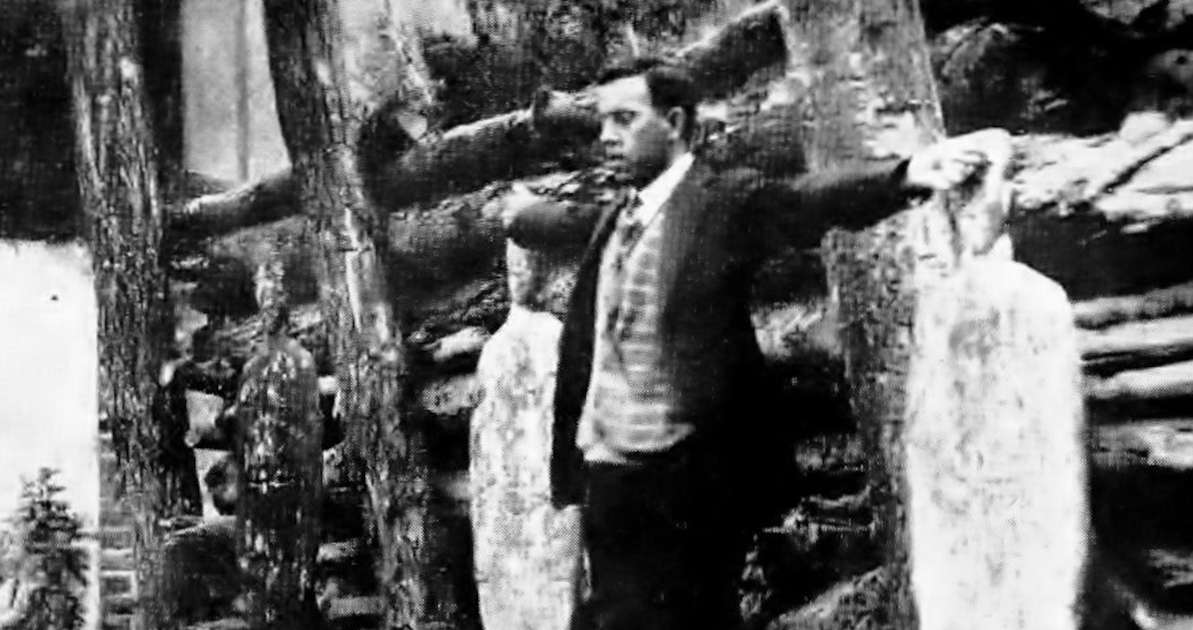
One of the lasting memories of my recent trip to Mexico City for a pilgrimage to Guadalupe is the story of the Mexican martyrs of the 1920s, who were fighting to protect their country from the ravages of the anti-Catholics and the anti-clericalists after the Mexican revolution. Many of these martyrs were priests, not all of them were. After the Holy Father Pius XI released his encyclical affirming the sovereign reign of Christ the King, and instituting the feast day that we have observed this Sunday, the Mexicans took up the rallying cry against the revolution: Viva Cristo Rey!, which is to say, Long live Christ the King! Pictured above is the Jesuit Father Miguel Pro, arrested for providing the Sacraments in defiance of the law, and executed by firing squad. His last words were… Viva Cristo Rey!
I shall once more give you my own particular understanding of the relationship of God to humanity, as a relationship not of domination but of mutual self-giving. A marital relationship, as you’ve heard me say so very often. This is why He gives us free will – the ability to choose Him. A tyrant or dictator attempts to remove free will, at first with legislation, then with force. Although we talk about the Law of God and the Law of Moses in the Old Testament, with all the penalties and rewards that are associated with law, there is behind all of it a question, based on free will: who is your Lord? Who rules your life, whom will you serve?
The Christian heart in a world of distraction wants to say, Christ! Christ rules my heart! But if He truly did, the gospel message would not sound to us as difficult as it often does, even to those of us who are devout in our practice of religion. In the beginning, God offered to rule our hearts, but our first parents Adam and Eve in their innocence were convinced by the serpent that they could rule their own hearts, that they could decide for themselves about the world and about their relationship with God. The darkness arrived, and God replied as always, I will show you light, and you must choose it for yourselves. We must choose Him for our Lord, our King.
In the course of time, Abraham the Syrian made a definite bid for God, and he is forever called by us Faithful, our father in faith. He and in various ways his son and grandson made the covenant with God: the Creator God would be their lord, it is He who would rule their lives. The Holy One does not forget covenants, and in due course He called to Himself the descendants of these men – the twelve tribes of Israel – who had fallen into idolatries during their exile in Egypt. He called them out of those idolatries to declare themselves once more for Him, as their ancestors had done. Under the guidance of Moses the lawgiver, they assured Him that He would be their lord. But time tests loyalty, and as we see in our first reading this weekend they yearned for a human lord – a human king – and were given this man David.
“After this, all the tribes of Israel rallied to David at Hebron; ‘We are kith and kin of thine,’ they said. ‘It is not so long since Israel marched under thy orders, when Saul was still reigning; and the Lord has promised thee that thou shouldst be its shepherd and its captain.’ And so the elders of Israel went to his court at Hebron; and there, at Hebron, in the Lord’s presence, David made a covenant with them, and they anointed him king of Israel.”
The second book of the Kings (aka. the second book of Samuel), 5: 1-3 [link]
David was a flawed man, but a man nevertheless ‘after God’s own heart,’ as the Hebrew bible delights in telling us. But David must go to his grave, and the loyalties of his descendants will be tested and for the most part found wanting. The Hebrew heart nevertheless remembered the days in the desert, under the leadership of Moses, and in the midst of the secularism of later centuries continued to cry out to the Lord Whom the nation had claimed for her own Lord in that wilderness. And prophets told them that David would return, a son of David, another man ‘after God’s own heart,’ who would resolve the question not only for them but for every tribe of mankind: who is your Lord?
That question the Son of David from the Cross asks every age of man that has followed His life on earth. Here is not only the human form of David hanging in torment, but the ancient One Who called Adam and Eve to obedience, risking everything by giving them the ability to choose disobedience. But remedy for disobedience He would provide also, by crucifying disobedience to that cross.
“The people stood by, watching; and the rulers joined them in pouring scorn on Him; ‘He saved others,’ they said; ‘if He is the Christ, God’s chosen, let Him save Himself.’ The soldiers, too, mocked Him, when they came and offered Him vinegar, by saying, ‘If Thou art the King of the Jews, save Thyself. (A proclamation had been written up over Him in Greek, Latin and Hebrew, ‘This is the King of the Jews.’) And one of the two thieves who hung there fell to blaspheming against Him; ‘Save Thyself,’ he said, ‘and us too, if Thou art the Christ.’ But the other rebuked him; ‘What,’ he said, ‘hast thou no fear of God, when thou art undergoing the same sentence? And we justly enough; we receive no more than the due reward of our deeds; but this man has done nothing amiss.’ Then he said to Jesus, ‘Lord, remember me when Thou comest into Thy kingdom.’ And Jesus said to him, ‘I promise thee, this day thou shalt be with Me in Paradise.'”
Gospel of S. Luke, 23: 35-43 [link]
There were two men crucified with Him on that hill outside Jerusalem, which He had called the City of the Great King. His City, the City of His ancestor David. One of the thieves – the secularist – has chosen for this world, will have human rulers, spiritual ones in the high priests of Jerusalem (the rulers, above), secular ones in the Roman governors. Save yourself, and us as well, he says, so that we can continue to submit to men. The other man we call ‘the thief who stole heaven’ – he was a very good thief for that – for he has a foot in another world, a world where God is Lord, and not worldly men. He resolves the question for the Church by choosing God as Lord, Christ as King. Remember me, when You come into Your Kingdom.
Our feast day today is called Our Lord Jesus Christ King of the all things. Much of the universe will submit to its Creator without question, even rebellious angels will reluctantly bow; it is the human heart that wavers, that thinks too hard, that wants desperately to rule itself. But in its better moments it knows to confess that it is Christ Who is King.
 Catholic Louth and Mablethorpe