How may we summarise the work of Christ our Lord? In one word, restoration. You’ve heard me begin very often with Adam and Eve, and how God Almighty placed them in the Garden of His love. When they rejected that love, they were ejected from the Garden.
There is a fault in man, and that is his (and her) desire to be independent of God. And experience tells us that that is quite impossible. We cannot be truly independent, we choose our own lords. If Christ is not lord, there will be somebody else, or something else. Just about anything can be turned into a cult/religion. So the shoot springs out of Jesse, as the prophet says in our first reading. Jesse, or Yishai, was the father of King David. What are the marks of this Son of David to come? Wisdom, power, knowledge and fear of the Lord.
“From the stock of Jesse a scion shall burgeon yet; out of his roots a flower shall spring. One shall be born, on whom the spirit of the Lord will rest; a spirit wise and discerning, a spirit prudent and strong, a spirit of knowledge and of piety, and ever fear of the Lord shall fill his heart. Not his to judge by appearances, listen to rumours when he makes award; here is judgement will give the poor redress, here is award will right the wrongs of the defenceless. Word of him shall smite the earth like a rod, breath of him destroy the ill-doer; love of right shall be the baldric he wears, faithfulness the strength that girds him. Wolf shall live at peace with lamb, leopard take its ease with kid; calf and lion and sheep in one dwelling-place, with a little child to herd them! Cattle and bears all at pasture, their young ones lying down together, lion eating straw like ox; child new-weaned, fresh from its mother’s arms, playing by asp’s hole, putting hand in viper’s den! All over this mountain, my sanctuary, no hurt shall be done, no life taken. Deep as the waters that hide the sea-floor, knowledge of the Lord overspreading the world! There he stands, fresh root from Jesse’s stem, signal beckoning to the peoples all around; the Gentiles will come to pay their homage, where he rests in glory.”
Prophecy of Isaias, 11: 1-10 [link]
This fear of the Lord is not necessarily a shake-in-my-boots fear, as when a beast of prey is stalking us. It is that ancient respect for the Holy One that our first parents set aside for the moment that it took for them to commit that first act of pride: We shall be like God, we shall rule our own lives. The shoot that springs out of the stock of Jesse, and so of Abraham, and so of Adam… this very human (and yet very divine) shoot will reform humanity, restore it, and return all men and women to the bosom of the Father God.
With the fear of the Lord comes the wisdom and integrity to govern His fellow men and to bring about this legendary peace, by which calf and lion cub feed together, on straw. God’s holy mountain here is the lost Garden of Eden, where there is no war and strife, injustice and inequity, no man preying upon his neighbour. We see something of this messianic peace in the idealism of S. Paul’s instructions to the Roman Church in our second reading this weekend, for he talks of tolerance in love among Christians, friendship in the midst of difference.
“See how all the words written long ago were written for our instruction; we were to derive hope from that message of endurance and courage which the scriptures bring us. May God, the author of all endurance and all encouragement, enable you to be all of one mind according to the mind of Christ Jesus, so that you may all have but one heart and one mouth, to glorify God, the Father of our Lord Jesus Christ. You must befriend one another, as Christ has befriended you, for God’s honour. I would remind those who are circumcised, that Christ came to relieve their needs; God’s fidelity demanded it; he must make good his promises to our fathers. And I would remind the Gentiles to praise God for his mercy. So we read in scripture, I will give thanks to thee for this, and sing of thy praise, in the midst of the Gentiles…”
Letter of S. Paul to the Romans 15: 4-9 [link]
Paul and the other Apostles were constantly dealing with the strife that had been created with the social and religious opposition between Jew and Gentile, Jew and non-Jew, often even within the Church. While the prophet Isaiah talks about all the tribes of mankind streaming towards Jerusalem at the beginning of the messianic age, there were still Jews sneering at Greeks and Romans, and everybody else. They were the chosen ones, the people of the Covenant. So Paul says at the end of this second reading that God made Himself subject to Jews in Christ for their own good, but also in order that non-Jews may eventually give glory to God for His mercy to them.
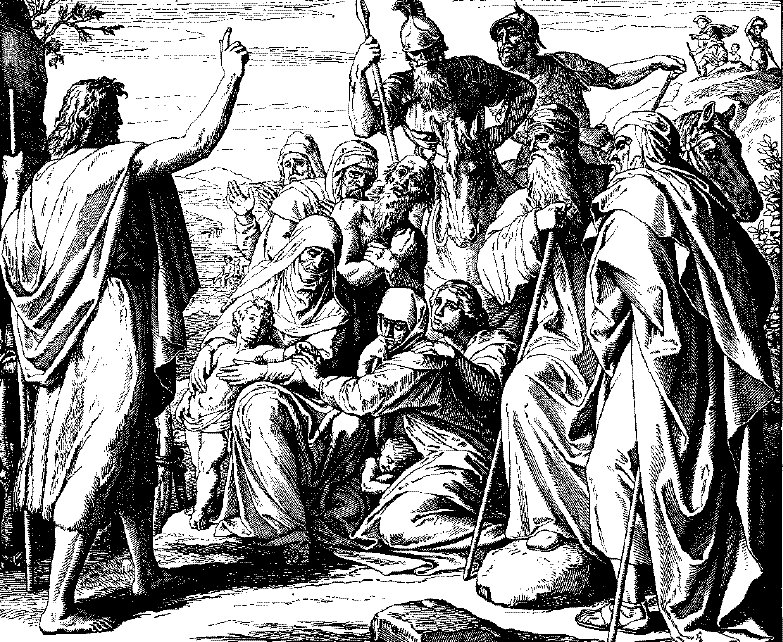
The gospel story brings to us S. John the Baptist, who is working to establish the beginnings of the Messianic age by drawing hearts back to God, to declare that the Church of Christ is at hand – a community of both Jews and Gentiles. John cut a fine figure indeed, dressed and acting in the exact manner as the prophet Elijah, a Jewish hero. And his hearers looked upon him and said, Is this the Christ? Or, is this the Elijah who is to precede the Christ? Let’s go and see…
“In those days John the Baptist appeared, preaching in the wilderness of Judaea; ‘Repent,’ he said, ‘the kingdom of heaven is at hand.’ It was of him that the prophet Isaias spoke, when he said, There is a voice of one crying in the wilderness, Prepare the way of the Lord, straighten out his paths. And he, John, wore a garment of camel’s hair, and a leather girdle about his loins, and locusts and wild honey were his food. Thereupon Jerusalem and all Judaea, and all those who dwelt round Jordan, went out to see him, and he baptised them in the Jordan, while they confessed their sins. Many of the Pharisees and of the Sadducees came to his baptizing; and when he saw these, he asked them, ‘Who was it that taught you, brood of vipers, to flee from the vengeance that draws near? Come, then, yield the acceptable fruit of repentance; do not presume to say in your hearts, We have Abraham for our father; I tell you, God has power to raise up children to Abraham out of these very stones. Already the axe has been put to the root of the trees, so that every tree which does not shew good fruit will be hewn down and cast into the fire. As for me, I am baptising you with water, for your repentance; but One is to come after me Who is mightier than I, so that I am not worthy even to carry His shoes for Him; He will baptise you with the Holy Ghost, and with fire. He holds His winnowing-fan ready, to sweep His threshing-floor clean; He will gather the wheat into His barn, but the chaff He will consume with fire that can never be quenched.”
Gospel of S. Matthew, 3: 1-11 [link]
The gospel story this weekend also demonstrates some of the pride of some of the Jewish authorities in their heritage: the Pharisees who gloried in observing every small injunction of the Law of Moses and called themselves good and righteous for that, and the Sadducees who rejoiced in the Temple cult and so in precision in ritual worship, and called themselves justified before God for that. Purity before God was as important for them as it is for us Catholics today, but they were so self-assured, as they approached the holy man in the desert to be baptised.
John is quite blunt with them, and seems to say something similar to what Paul says in his letters: we must work out our salvation with fear and trembling. With humility, that is to say. If God can raise children of Abraham – our father in the faith – out of the stones in the desert, it doesn’t matter at all that we may be Jews, or indeed that we are of any race, that our families have been Christian and Catholic for x number of centuries, or decades or years.
What matters is humility before God, the sincere seeking after Him, the cultivating of the good fruit of love in our hearts, even for the enemies we might have. It is that humility and fear of God that undoes the pride of Adam, and finally brings about peace.
 Catholic Louth and Mablethorpe