What is it to be Christian? Most people these days seem to be repelled by the idea of religion, to begin with. But after centuries of anti-Catholicism, and in the last two centuries anti-Christian rhetoric, there is a gloom that arises in the typical Western mind about the Church. But the oldest sentiment of the Christian religion was similar to that of the Hebrew mindset of the old testament: Christianity was about belonging to God. And that Object of the Christian religion was the God of Israel, the God of the Hebrews and the Jews.
In the time of the Apostles in the first century, there were several non-Jews who attended Jewish Temple ritual and synagogue services – whom scholars sometimes call god-fearers. They were among the torrents who who flowed into the Church after that first Pentecost in Jerusalem. Being non-Jews like us, they delighted in being able to belong to the God of Israel in Jesus Christ, to belong in a way that they couldn’t when they were simply hangers-on, attending in the back row of the synagogues, and in the outer courtyard of the Gentiles in the Temple complex in Jerusalem.
When I think of these men and women – these early gentile Christians – I feel a rush of sympathy. And I hope that they pray for us gentile Christians in our own time, fighting against the tide of anti-Christian and anti-religious sentiment of today, even as they bore up with the anti-Jewish and anti-Christian sentiments of the Roman Empire, whose secular religion was anathema to both the Church and to the Jews. They were Romans and Greeks, and Armenians, and Copts, etc. and they were strongly bonded to the Hebrew God, Who had showed His face to men in Christ and had called them to belong to Him.
“Listen, remote islands; pay heed to me, nations from far away. Ere ever I was born, the Lord sent me His summons, kept me in mind already, when I lay in my mother’s womb. Word of mine is sword of His, ready sharpened, under cover of His hand; arrow He has chosen out carefully, hidden yet in His quiver. ‘Thou art My servant,’ He whispers, ‘thou art the Israel I claim for My own.’ To me, all my labour seemed useless, my strength worn out in vain; His to judge me, He, my God, must reward my work as He would. But now a new message He sends me; I am His servant, appointed ever since I lay in the womb, to bring Jacob back to Him. What if Israel will not answer the summons? None the less, the Lord destines me to honour; nonetheless, He, my God, protects me. Use thee I will, He promises, nor with thy service be content, when the tribes of Jacob thou hast summoned, brought back the poor remnant of Israel; nay, I have appointed thee to be the light of the Gentiles, in thee I will send out My salvation to the furthest corners of the earth.”
Prophecy of Isaias, 49: 1-6 [link]
Centuries earlier, God had spoken through the prophet Isaiah (our first reading this weekend, above) to say, You are my servant, Israel, in whom I shall be glorified. This is a continuation of the Suffering Servant verses of Isaias that refer to Christ, and in so far as the Church continues the mission of Christ, it refers to her also. As Christ’s strength was worn out in service, in suffering, in sacrifice, so also the Church has worked in her time to return the tribes of Jacob to God, to bring back what remains of believing Israel, and moreover to be a light to the Gentiles – the non-Jewish tribes who today form the great majority of all Christians.
Today, Christ would say to the Successor of the Apostle S. Peter in Rome, You are Peter, and upon You have I built My Church. Just as the faithfulness of the patriarch Israel (aka. Jacob, the grandson of Abraham) had lent his name to the entire nation, the faithful humility of the Fisherman has anchored us to Christ, Who will be glorified in us. Faithfulness and commitment are greatly wanting in our time, and in so far as they are recovered or rediscovered, the hearts of men and women will be inspired once more by those who have gone before them, who have made extraordinary sacrifices in the past to belong to various concentric realities: family, community, nation, Church. For God will have nothing less than commitment, and that that commitment is made ever more perfect and permanent every day. The Church rejoices in that commitment, rejoice in belonging to Christ, as S. Paul obviously does in the beginning of his first letter to the Corinthians, which we are given as our second reading this weekend:
“Paul, whom the will of God has called to be an apostle of Jesus Christ, and Sosthenes, who is their brother, send greeting to the Church of God at Corinth, to those who have been sanctified in Christ Jesus, and called to be holy; with all those who invoke the name of our Lord Jesus Christ, in every dependency of theirs, and so of ours. Grace and peace be yours from God, who is our Father, and from the Lord Jesus Christ.”
First letter of S. Paul to the Corinthians, 1: 1-3 [link]
It is a great temptation for us, when things get difficult, to run away, to try and get away from the difficulties and challenges that life throws at us. To undo intimate relationships of belonging. Our greatest institutions of this type have seemingly impossible ideals these days. The best example is marriage. We all know the promises that are made there somehow, and many of us know how difficult they can be to be true to. Faithfulness for better or for worse, in sickness and in health. We smile when we attend the few marriages that are still conducted, we wish couples the best, we don’t want to think of the ‘for worse’ and the ‘in sickness,’ etc. We struggle when these eventually arrive, and we can often then feel the nails in the hands and feet of the Crucified, and the multiple thorns in His scalp. For we must suffer for the sake of the beloved, just as He suffered for the sake of His Church.
How many are abandoned by their spouses in grave need; how many are betrayed otherwise by carers, who may even be family members. We all want to be loved for better or for worse, not all of us are so blessed, but we are assured by Holy Church that there is One Who is always present, although veiled, Who views our suffering with compassion and bids us suffer with Him. He glorified His Father on that Cross, and in our sufferings He says to us (per Isaiah), You are My servant, in whom I shall be glorified; persevere now, be faithful until the end.
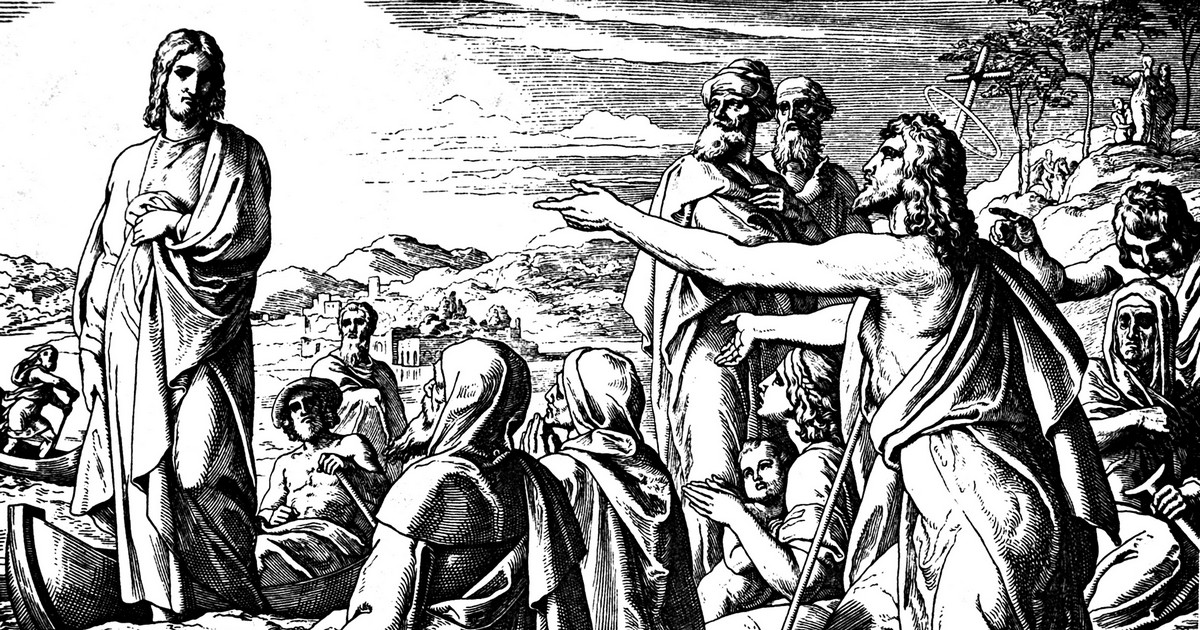
If John the Baptist saw a dove rest upon Christ at the Baptism, John being a prophet saw the great doom of the Cross (for he speaks of Christ as the Lamb of God, the sacrificial paschal Lamb of God), and he perhaps looked further and saw the Triumph the faithfulness brought afterwards.
“Next day, John saw Jesus coming towards him; and he said, ‘Look, this is the Lamb of God; look, this is He who takes away the sin of the world. It is of him that I said, One is coming after me who takes rank before me; he was when I was not. I myself did not know Who He was, although the very reason why I have come, with my baptism of water, is to make Him known to Israel.’ John also bore witness thus, ‘I saw the Spirit coming down from heaven like a dove, and resting upon Him. Till then, I did not know Him; but then I remembered what I had been told by the God Who sent me to baptise with water. He told me, The Man who will baptise with the Holy Spirit is the Man on Whom thou wilt see the Spirit come down and rest. Now I have seen Him, and have borne my witness that this is the Son of God.'”
Gospel of S. John, 1: 29-34 [link]
 Catholic Louth and Mablethorpe