
One of the three great commands of Lent, besides fasting (voluntary self-deprivation) and alms-giving (material charity), is prayer. And we should not forget it. I don’t have to tell you how difficult prayer is, how futile it seems because of its apparent one-sidedness, how the enforced business of daily life makes it difficult to assign time for prayer.
And, more than everything else, once we have assigned time for prayer… what to do with that time? I tell people to set aside at least fifteen minutes daily, but even that can seem like a long, long time to modern minds accustomed to radio, television and (these days) endlessly-scrolling social media. Members of the teaching profession tell us how young people this day find it hard to hold a book, and that many infants swipe at the pages of books in distress. We could laugh at that, or shake our heads at the absurdity of our times, etc., but we adults are often not far different. We have made endless distraction a hobby.
So, Lent gives us a moment to set such things aside. That can be harder than giving up sweeties and drinks. We can find alternatives to sweeties and drinks. But how can we do at least fifteen minutes of nothing but sitting quietly with the Holy One? We are not supernatural beings – we are all too human, and we need to use our senses, we need to use our rational power and our ability to will and to love, and we need to use the resources that Holy Mother Church has placed in our laps. We shall always be as children before her, we should look for her instructions. Let’s begin with basics…
What’s that thing we do with our fingers at the start of the Gospel at Mass? We cross our foreheads, we cross our lips, we cross our hearts. What is the Gospel? The Word of God. The Church finds the Holy One both within the Scriptures and more substantially within the Blessed Sacrament. So, what can we learn from this old tradition for welcoming the Gospel at Mass? Let’s say that as we are doing this, we say inwardly, Christ be upon my mind, upon my lips, and within my heart as I listen to His holy Gospel. So, we are not to be standing aimlessly as the priest or deacon drones out a story we’ve heard hundreds of times during our lives. We are using a human power to love and lifting our hearts to Christ before we even begin to use our senses of sight and hearing to discover the Gospel story anew from the reader. We are promising to use our lips to repeat that story to ourselves or perhaps to others in a spirit of evangelisation, and by crossing our hearts we are (as we so often do) reconsecrating our whole selves to the Holy One Whose story the reading contains, Whose words it sometimes gives, Who looks upon us within our minds eye as we hear yet again of the love He bears to His Church and to the world.
Now, shall we use all those very human abilities again in our fifteen-minutes-or-more of prayer every day, together with Scripture, images, statues…?
“Meanwhile, the Lord said to Abram, ‘Leave thy country behind thee, thy kinsfolk, and thy father’s home, and come away into a land I will shew thee. Then I will make a great people of thee; I will bless thee, and make thy name renowned, a name of benediction; those who bless thee, I will bless, those who curse thee, I will curse, and in thee all the races of the world shall find a blessing.’ So Abram went out, as the Lord bade him, and with him went his nephew, Lot. Abram was seventy-five years old at the time when he left Haran, took his wife Sarai and his nephew Lot with him, all the possessions they had acquired in Haran, and all the retainers born in their service there, and set out for the land of Chanaan.”
Book of Genesis, 12: 1-5 [link]
We’re not supposed to be settled, are we? Spiritually, I mean. Here are a set of readings about being on the move and living in tents, but with the blessing of God. So Abram is asked to leave a life of comfort in the Mesopotamia and go off to the discomforts of Palestine. And that land, much quarreled-over that it is, is a constant labour. To live in Palestine, especially before the period of modern industry, has meant to keep your face turned to heaven, looking for blessing, depending upon divine Providence. S. Paul talks about hardships in the work of the Church in our second reading, but with the grace of God and with a hope for a joy to come. Listen to Him, God our Father says to us from the cloud, Listen to My Son. And does Christ bring us only good and comfortable things? A few thousand voices will call out to us from present-day Nigeria to tell us that He doesn’t.
“Do not blush, then, for the witness thou bearest to our Lord, or for me, who am his prisoner; share all the tribulations of the gospel message as God gives thee strength. Has He not saved us, and called us to a vocation of holiness? It was not because of anything we had done; we owe it to His own design, to the grace lavished on us, long ages ago, in Christ Jesus. Now it has come to light, since our Saviour Jesus Christ came to enlighten us; now He has annulled death, now He has shed abroad the rays of life and immortality, through that gospel which I have been appointed to herald, as an apostle and a teacher of the Gentiles.”
Second letter of S. Paul to S. Timothy, 1: 8-10 [link]
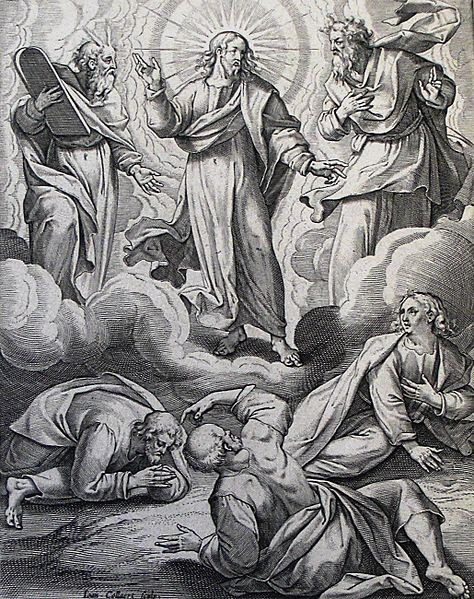
Now here’s a nice image to have in mind during our prayer, and its all about Scripture again, so let’s use it. It’s the story of the Transfiguration. Those of us who know our bibles know that the Bible has three big portions for the purposes of Christian theology: the Law (the first five books), the Prophets (Isaiah, Jeremiah, Ezekiel, Daniel, and the others), and the Gospel. If we set aside for a moment the historical books, the poetry and hymnody, and the letters of the Apostolic Fathers and bishops, we find these great portions of Scripture in the gospel story. Moses stands for the Law, Elijah stands for the Prophets, and Christ stands for the Gospel. The Gospel thus stands upon the foundation of the Law and the Prophets.
Now we can keep this image in our minds for our daily prayer, together with a copy of the Bible perhaps, and we can sign our foreheads, lips and hearts (as before) and say to the Holy One in the silence, May you be in our minds, upon our lips and within our hearts as we seek to find you in this time of prayer. We just may end up doing what S. Peter affects to do in the story: build a tabernacle for God to dwell in our hearts not only during this Lent, but for the rest of our lives…
“Six days afterwards Jesus took Peter and James and his brother John with Him, and led them up on to a high mountain where they were alone. And He was transfigured in their presence, His face shining like the sun, and His garments becoming white as snow; and all at once they had sight of Moses and Elias conversing with Him. Then Peter said aloud to Jesus, ‘Lord, it is well that we should be here; if it pleases thee, let us make three arbours in this place, one for thee, one for Moses and one for Elias.’ Even before he had finished speaking, a shining cloud overshadowed them. And now, there was a Voice which said to them out of the cloud, ‘This is My beloved Son, in Whom I am well pleased; to Him, then, listen.’ The disciples, when they heard it, fell on their faces, overcome with fear; but Jesus came near and roused them with His touch; ‘Arise,’ He said, ‘do not be afraid.’ And they lifted up their eyes, and saw no man there but Jesus only. And as they were coming down from the mountain, Jesus warned them, ‘Do not tell anybody of what you have seen, until the Son of Man has risen from the dead.'”
Gospel of S. Matthew, 17: 1-9 [link]
 Catholic Louth and Mablethorpe