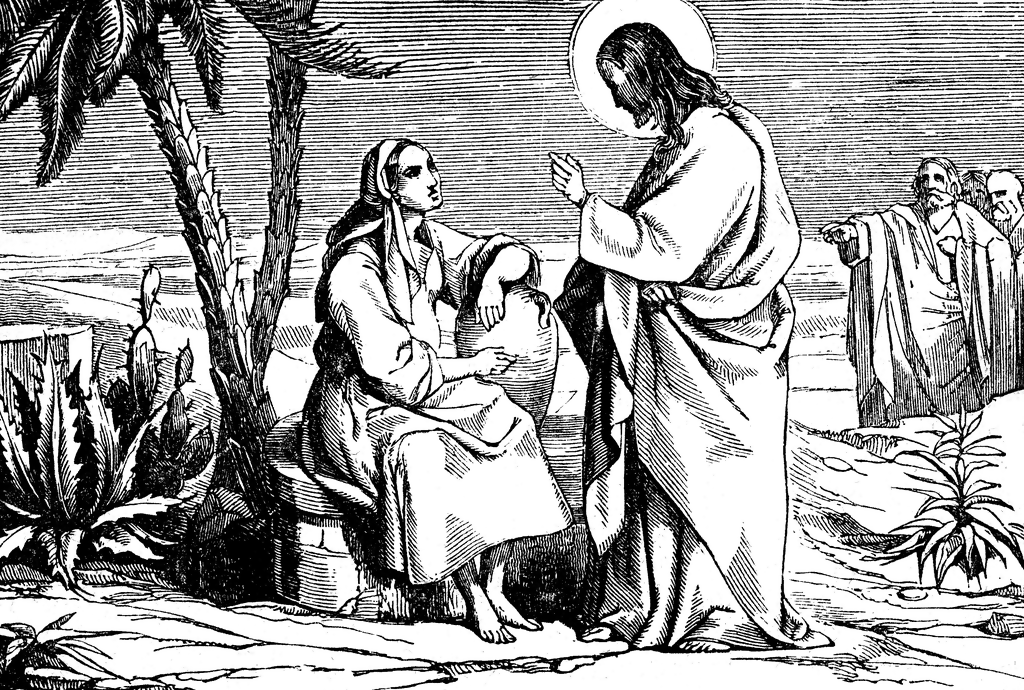
We have readings about thirst this weekend, and when this occurs in Sacred Scripture, the real thirst of the Israelites in the desert can speak also of a spiritual thirst of that same people. And then there is the story of the Samaritan woman at the well.
“Then the whole people of Israel left the desert of Sin, moving on from stage to stage as the Lord directed them, and encamped at Raphidim. But here they had no water to drink, so they turned upon Moses crying out, ‘We have nothing to drink; find water for us.’ ‘Why do you turn upon me?’ asked Moses. ‘Will you challenge the Lord?’ But the people, thirsting for lack of water, grew loud in their complaints against Moses; ‘Didst thou bring us away from Egypt,’ they said, ‘only to let as die here, with our children and our cattle, of thirst?’ Moses had recourse to the Lord; ‘What can be done with them?’ he asked. ‘A little more of this, and they will begin stoning me.’ So the Lord bade Moses march out at the head of the people, taking some of the elders of Israel with him; and as he went, he was to carry in his hand the staff which he had used to smite the river. ‘I will meet thee,’ He said, ‘at the rock of Horeb; thou hast but to smite that rock, and water will flow out of it, to give the people drink.’ All this Moses did, with the elders of Israel to witness it; and the name he gave to that place was Challenge, because it was there the Israelites turned on him and challenged the Lord, by asking whether the Lord still went with them or not.”
Book of Exodus, 17: 1-7 [link]
This first reading this weekend tells of an episode in the story of the desert wandering of the children of Israel that was between their escape from Egypt and their arrival at the mountain of Sinai. So… no commandments yet, no special new covenant with God yet. Just a promise – a promise that on the other side of the desert was a land flowing with milk and honey. But getting across the desert is not easy, and the complaint in the story is repeated several times before the people arrive at the Jordan river and their entry point into the Land: we’re thirsty, there’s no water, there was lots of water in Egypt, God and Moses have deceived us, let’s go back to Egypt.
There is a lack of trust there, a lack of faith, both in God and in Moses. Let us not look down upon them. In the desert of this life, so many of us Christians and Catholics flounder in our faith, finding it hard to trust God and His promises. This spiritual thirst for a God which so many of us cannot satisfy, because we have not the faith that will allow us to give ourselves entirely to God, because we either cannot or will not accept the message of His Church – this spiritual thirst is quenched by Christ. Too many people are discouraged by the ministers of the Church or by other church-goers, and their unlikely behaviour, and they fall away. But priests are men and will fail, other churchgoers may be rude or cold and not what we expect them to be. But the great power in our churches is not they, but the Holy One Who dwells there hidden.
And that can take us to the story of the Samaritan woman. There are many features of interest here. First of all, she is not a Jew – as a Samaritan, she belonged to a separate religious community, which had defined itself in enmity and rivalry to the Jews. They claimed to be the children of Abraham and that their religion was older and purer than the religion of Jerusalem, the Jews denied these claims. As far as Jerusalem was concerned, the Samaritans were Gentiles, Jews wouldn’t associate with them, certainly not Jewish men with Samaritan women. It’s no wonder that the Apostles are surprised when they return at the end of the story and find their very orthodox Rabbi doing just that.
But Christ has a message for both Jew and Gentile, and that is that (as He says) Salvation comes from the Jews, from Jerusalem, from the Successor of David, but that that Salvation once arrived will allow all nations (and not only the Jewish) to worship the Creator God, not on Mount Sion in Jerusalem only (as Jews did), or on Mount Gerizim only (as Samaritans did), but everywhere. How is that possible? Well, the New Testament tells us that it is Christ Who is the Temple on the Mountain, the Shrine of true worship, from Whose side flows the tide of cleansing water that ends dryness, that brings life even to the dead. At another point in John’s Gospel, Christ calls out and says, Come to Me all ye who thirst, springs of water shall burst forth from within you. He says something similar in this reading also. That certainly indicates a spiritual thirst, and the water is the Holy Spirit of God.
“Thus He came to a Samaritan city called Sichar, close by the plot of ground which Jacob gave to his son Joseph; and there was a well there called Jacob’s well. There, then, Jesus sat down, tired after his journey, by the well; it was about noon. And when a Samaritan woman came to draw water, Jesus said to her, ‘Give me some to drink.’ (His disciples were away in the city at this time, buying food.) Whereupon the Samaritan woman said to Him, ‘How is it that Thou, Who art a Jew, dost ask me, a Samaritan, to give Thee drink? (The Jews, you must know, have no dealings with the Samaritans.) Jesus answered her, ‘If thou knewest what it is God gives, and Who this is that is saying to thee, Give me drink, it would have been for thee to ask Him instead, and He would have given thee living water.’ ‘Sir,’ the woman said to Him, ‘Thou hast no bucket, and the well is deep; how then canst Thou provide living water? Art Thou a greater man than our father Jacob? It was he who gave us this well; he himself and his sons and his cattle have drunk out of it.’ Jesus answered her, ‘Anyone who drinks such water as this will be thirsty again afterwards, the man who drinks the water I give him will not know thirst any more. The water I give him will be a spring of water within him, that flows continually to bring him everlasting life.’ ‘Then, Sir,’ said the woman, ‘give me water such as that, so that I may never be thirsty and have to come here for water again.’ At this, Jesus said to her, ‘Go home, fetch thy husband, and come back here. I have no husband, answered the woman;’ and Jesus told her, ‘True enough, thou hast no husband. Thou hast had five husbands, but the man who is with thee now is no husband of thine; thou hast told the truth over this.’ The woman said to him, ‘Sir, I perceive that Thou art a prophet. Well, it was our fathers’ way to worship on this mountain, although you tell us that the place where men ought to worship is in Jerusalem.’ ‘Believe me, woman,’ Jesus said to her, ‘the time is coming when you will not go to this mountain, nor yet to Jerusalem, to worship the Father. You worship you cannot tell what, we worship knowing what it is we worship; salvation, after all, is to come from the Jews; but the time is coming, nay, has already come, when true worshippers will worship the Father in spirit and in truth; such men as these the Father claims for His worshippers. God is a spirit, and those who worship Him must worship Him in spirit and in truth.’ ‘Yes,’ said the woman, ‘I know that Messias (that is, the Christ) is to come; and when He comes, He will tell us everything.’ Jesus said to her, ‘I, Who speak to thee, am the Christ.’ With that, His disciples came up, and were surprised to find Him talking to a woman; but none of them asked, What meanest thou? or Why art thou talking to her? And so the woman put down her water-pot, and went back to the city, to tell the folk there, ‘Come and have sight of a man who has told me all the story of my life; can this be the Christ?’ So they left the city, and came out to find Him.”
Gospel of S. John, 4: 5-31 [link]
Shall we play the Samaritan woman ourselves – this sinful, Gentile woman who admits adultery in this story? She and her people had not received the grace of God given the Jews in their Scripture, in their ritual worship, in the promises given them of Salvation through a successor of their King David. Our own fathers, before they were baptised, would have been as helpless as the Samaritans were, in their inability to slake a spiritual thirst that would have been far deeper than the thirst that the Jews had for union with God.
Christ, physically thirsty, can see the spiritual thirst of the Samaritan woman, and He can probably see ours. Anyone who drinks this water that I shall give will never be thirsty again. Standing in church this weekend, we are already being filled with these waters of life through the Sacraments we have received, through the Sacrament that we receive at every Mass. But we must remember those who are still wandering in the desert, freed from the Egypt of this world (per the first reading) and feeling their way towards Christ, discouraged often, tempted to return to the world, even our own fellow Christians and Catholics. Spare them a prayer this Lent, pray for their conversion, for their return to Christ, for their eternal life and inheritance. For them and for ourselves, we hope…
“Nor does this hope delude us; the love of God has been poured out in our hearts by the Holy Spirit, whom we have received. Were that hope vain, why did Christ, in His own appointed time, undergo death for us sinners, while we were still powerless to help ourselves? It is hard enough to find anyone who will die on behalf of a just man, although perhaps there may be those who will face death for one so deserving. But here, as if God meant to prove how well He loves us, it was while we were still sinners that Christ, in His own appointed time, died for us. All the more surely, then, now that we have found justification through His blood, shall we be saved, through Him, from God’s displeasure.”
Letter of S. Paul to the Romans, 5: 5-9 [link]
 Catholic Louth and Mablethorpe