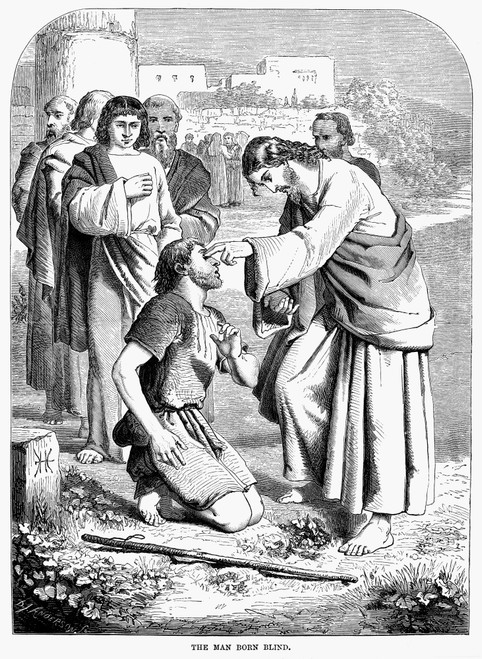
“…[the man born blind now seeing] answered [some of the Pharisees], ‘I have told you already, and you would not listen to me. Why must you hear it over again? Would you too become His disciples?’ Upon this, they covered him with abuse; ‘Keep His discipleship for thyself, we are disciples of Moses. We know for certain that God spoke to Moses; we know nothing of this Man, or whence He comes.’ ‘Why,’ the man answered, ‘here is matter for astonishment; here is a Man that comes you cannot tell whence, and He has opened my eyes. And yet we know for certain that God does not answer the prayers of sinners, it is only when a man is devout and does His will, that his prayer is answered. That a man should open the eyes of one born blind is something unheard of since the world began. No, if this man did not come from God, He would have no powers at all.’ ‘What,’ they answered, ‘are we to have lessons from thee, all steeped in sin from thy birth?’ And they cast him out from their presence. When Jesus heard that they had so cast him out, He went to find him, and asked him, ‘Dost thou believe in the Son of God?’ ‘Tell me Who He is, Lord,’ he answered, ‘so that I can believe in Him.’ ‘He is One Whom thou hast seen,’ Jesus told him. ‘It is He Who is speaking to thee.’ Then he said, ‘I do believe, Lord,’ and fell down to worship Him. Hereupon Jesus said, ‘I have come into this world so that a sentence may fall upon it, that those who are blind should see, and those who see should become blind.’ Some of the Pharisees heard this, such as were in His company, and they asked him, ‘Are we blind too?’ ‘If you were blind, Jesus told them, you would not be guilty. It is because you protest, We can see clearly, that you cannot be rid of your guilt.'”
Gospel of S. John, 9: 27-41 [link]
So… there are some who see who will lose sight with regard to Christ… With another one of S. John’s long readings from his gospel, this weekend we are given the story of the man who was blind from birth. In the gospels – and this is the key to that last speech of Christ above – blindness is usually associated with faith, and that is not a difficult connection to make. Until recently, we used to prayer for the Jewish community to come to faith in Christ, asking God to pull the veil of unbelief from over their eyes. Now that sentiment comes from that famous Jew, S. Paul, in one of his letters to the Corinthians.
In our more ecumenical times, when Catholic Missions are not what they were and we struggle to find politically correct ways to bring non-Christians to Christ, such a blindness is difficult to call out. But we must. And we must carefully work with the Bishop and his new Mission Plan and be bold, bolder than we have ever been for some time. For we live in a time of profound unbelief, when formerly Christians lands are not very Christian anymore, when un-Christian governments withdraw financial support from church properties, when people marvel when they are told that (say) twenty percent of a Catholic population goes to Mass regularly. And that would be in a modern Catholic country. Most people are happy to say that Christianity has had some good effect on Western culture – that is, a culture that makes no real sense without its vanishing Christian Church. And intelligent people will appear on television and say that they are culturally Christian, which I suppose means that they like the sound of church bells and would prefer to talk of ‘Christmas’ decorations rather than ‘winter holiday’ decorations. They want the tokens of a religious community their parents or grandparents belonged to, but will refuse to belong to that community themselves.
There is a very real blindness here, and thanks to the protracted secularisation of our countries (often from as far back as Victorian times, but with growing velocity since the 60s, and accelerated since the 90s), our young people may very well have been born blind with regard to this gospel story. And the Apostles ask our Lord, Who sinned, this man or his parents, that he be born blind? There is often this thought, even in the minds of honest Christians, that every sickness and affliction is some type of of divine punishment for sin, and perhaps that they may be responsible for the afflictions of their children and grandchildren, so we can understand this question. But as the books of Job and of Ecclesiastes in the Old Testament tell us, and as the story of our Lord Himself tells us, bad things can certainly happen to good people. Again children and grandchildren will go their way, despite the best efforts of their parents and grandparents. The answer to the question of the Apostles that we have here from Christ is then excellent: suffering will always come, and it is not why we suffer, but how we suffer that matters. If we learn well from the Man on the Cross, we shall suffer and die patiently and faithfully, and when we find deliverance from it (in the words of the gospel reading) the works of God will be displayed in us.
Consider the blindness of the man in terms of unbelief, and his receiving sight for the first time as a conversion to Christ. When he is healed the change in him is so magnificent that his physical aspect changes and the people who knew him before cannot recognise him. No, he only looks like him, they say. So also a new Christian, or perchance a new Catholic, whose own family may or may not like the change come over him.
Then there is the religious authority – the Pharisees – who are surprised and outraged because our Lord has broken the Sabbath rule to perform the healing. In our cultural status quo, the conversion to Christianity or even Catholicism if not already an offence is often seen as the result of imbecility. Society has progressed away from that medievalism, and this person is going back? Converts can become outcasts in their own families, strangers at family gatherings, and they can become social outcasts. How boldly the man protests for his Saviour, his Rescuer, and he suffers for it, being ostracised by the Pharisees (who run the synagogues) and probably by his parents (who don’t want to be expelled themselves from the synagogue).
But where he lost a home through conversion, as at the end of the story he finds a new one in Christ and His Church.
 Catholic Louth and Mablethorpe