We’re quite near now to Holy Week and Easter, and we can permit ourselves to look beyond the grimness of suffering and death to the glory of the resurrection beyond. There is always a light at the end of the tunnel with the Hebrew religion.
In the days of the prophet Ezekiel, all was darkness for the Israelite nation. Reduced from the heights of the united kingdom of Kings David and Solomon a few hundred years before to only the southern province of Judea now, and that only in a state of vassalage to the new power in Babylon, in Ezekiel’s own lifetime Judea was finally extinguished, Jerusalem reduced to ruins, and the people dispersed across the former Assyrian and the neo-Babylonian empire.
Is there any greater disaster, any deeper darkness possible for a people that proudly considered themselves the People of God, who remembered how their God had humiliated the power of Egypt in the days of Moses and given them possession of that beloved Land in the days of Joshua and the Judges? But Ezekiel with his prophetic vision can see the light at the end of the tunnel. In the prophecy of Ezekiel, the Holy One professes His continued love for His people, and in this reading we have today He declares His determination to restore that people.
“Then he told me, ‘Son of man, in these bones here thou seest the whole race of Israel. They are complaining that their very bones have withered away, that all hope is lost, they are dead men. It is for thee to prophesy, giving them this message from the Lord God: I mean to open your graves and revive you, my people; I mean to bring you home to the land of Israel. Will you doubt, then, the Lord’s power, when I open your graves and revive you? When I breathe my spirit into you, to give you life again, and bid you dwell at peace in your own land? What the Lord promises, the Lord performs; you will know that, he tells you, at last.'”
Prophecy of Ezekiel, 37, 11-14 [link]
And this becomes a magnificent bit of fuel for the messianic expectation that built up in the next six hundred or so years before the arrival of Christ. The restoration of the nation in the Jewish mind is always, always associated with the Land, hence the so-called ‘zionist’ movements of our own times. Ezekiel’s resurrection in this reading is accompanied by a restoration of the Land, and the messianic fulfilment of the Church equates this possession of the Land with the mystical union with God that is a foretaste in this life of the fuller union with Him that we call heaven. This possession of the human heart by God which Ezekiel mentions is also described in the second reading, where S. Paul associates it with a powerful belonging to God, whereby a sinful – and so a dead – body can be renewed and revivified by the inhabitation of that Holy Spirit of God.
“Those who live the life of nature cannot be acceptable to God; but you live the life of the spirit, not the life of nature; that is, if the Spirit of God dwells in you. A man cannot belong to Christ unless he has the Spirit of Christ. But if Christ lives in you, then although the body be a dead thing in virtue of our guilt, the spirit is a living thing, by virtue of our justification. And if the Spirit of Him Who raised up Jesus from the dead dwells in you, He Who raised up Jesus Christ from the dead will give life to your perishable bodies too, for the sake of His Spirit Who dwells in you.”
Letter of S. Paul to the Romans, 8: 8-11 [link]
Once more then, the theme of resurrection is had – the theme of a light burning in the darkness, and the darkness being unable to comprehend it – S. John’s synopsis of the life of Chris at the beginning of his gospel. The psalm that we have – one of the seven penitential psalms of Catholic tradition – is also a psalm of waiting for resurrection.
“Out of the depths I cry to Thee, O Lord;
Psalm 129 (130) [link]
Master, listen to my voice;
let but Thy ears be attentive to the voice
that calls on Thee for pardon.
If Thou, Lord, wilt keep record of our iniquities,
Master, who has strength to bear it?
Ah, but with Thee there is forgiveness;
be Thy Name ever revered.
I wait for the Lord,
for His word of promise my soul waits;
patient my soul waits,
as ever watchman that looked for the day.
Patient as watchman at dawn,
for the Lord Israel waits,
the Lord with whom there is mercy,
with whom is abundant power to ransom.
He it is that will ransom Israel from all his iniquities.”
We could call it the psalm of Lazarus, for in our gospel story, this good friend of our Lord’s waits in the darkness of his tomb for life to return to him. As the psalm goes, he cries out to the Lord of Life out of the depths of the earth. We could call it our own psalm – the psalm of sinners – for many of us, trapped as we are in habits of sin, wait in the darkness and misery of slavery and cry out for a Saviour God, a Redeemer Who may bring light to the darkness, life to death.
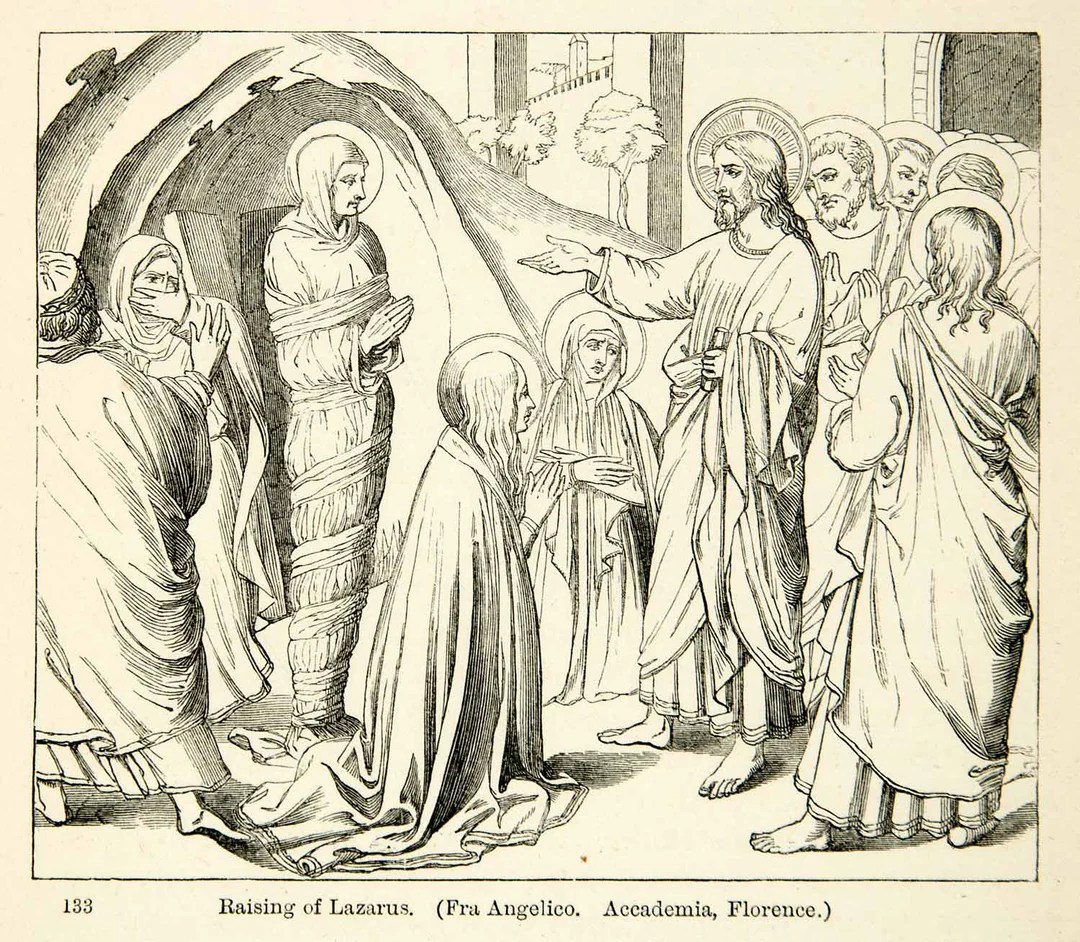
“…and so the Jews who were in the house with Mary, comforting her, when they saw how quickly she rose up and went out, followed her; ‘She has gone to the grave,’ they said, ‘to weep there.’ So Mary reached the place where Jesus was; and when she saw Him, she fell at His feet; ‘Lord,’ she said, ‘if Thou hadst been here, my brother would not have died.’ And Jesus, when He saw her in tears, and the tears of the Jews who accompanied her, sighed deeply, and distressed Himself over it; ‘Where have you buried him?’ He asked. ‘Lord,’ they said to Him, ‘come and see.’ Then Jesus wept. ‘See,’ said the Jews, ‘how He loved him;’ and some of them asked, ‘Could not He, Who opened the blind man’s eyes, have prevented this man’s death?’ So Jesus, once more sighing to Himself, came to the tomb; it was a cave, and a stone had been put over the mouth of it. ‘Take away the stone,’ Jesus told them. And Martha, the dead man’s sister, said to Him, ‘Lord, the air is foul by now; he has been four days dead.’ ‘Why,’ Jesus said to her, ‘have I not told thee that if thou hast faith, thou wilt see God glorified?’ So they took the stone away; and Jesus lifted His eyes to heaven, ‘Father,’ He said, ‘I thank thee for hearing My prayer. For myself, I know that Thou hearest me at all times, but I say this for the sake of the multitude which is standing round, that they may learn to believe it is Thou Who hast sent Me.’ And with that He cried in a loud voice, ‘Come out, Lazarus, to My side.’ Whereupon the dead man came out, his feet and hands tied with linen strips, and his face muffled in a veil. ‘Loose him,’ said Jesus, ‘and let him go free.'”
Gospel of S. John, 11: 31-44 [link]
I have heard many good priests speak about the purpose of our gospel stories as permitting us to enter into them and find as good friends the characters of these stories. We have three wonderful characters here: the dead man Lazarus, and his two sisters Martha and Mary. We know from other stories of the practicality of Martha and the mysticism of Mary, and even that comes across here, although both sisters say the same thing to Christ: if you had been here, our brother would not have died.
The long description of the death and resurrection of Lazarus and the sorrowful devotion of his sisters to their Friend, Whose presence they well knew could have prevented their brothers death – this story gives us much scope for our pursuit of Christ. Not only are many of us Lazaruses caught in the mire of our sins, still others of us are Marthas and Marys and have to endure watching family members and friends floundering in destructive lifestyles, when nothing that we can say or do seems to make any difference. If Christ would make His presence felt, our beloved would be saved from their afflictions.
But where is Christ in all of it? Is He four days away from bringing us relief, or four months, or four years? And is He keeping away a little longer for His own reasons, which we cannot see and so cannot understand. Or has He been here all along? In the story, He is certainly aware of His friends illness and death, and although a distance away is not quite absent. Our Lord in the end is not without feeling, His Sacred Heart is still very human indeed, He weeps for His friend and for the distress of his sisters and the others present.
He knows our misery and He will weep for it; and angels will say, See how much He loved them… and then He will move, and how He will move! And in the darkness of our hearts we shall hear Him say to us, Lazarus, here! Come on out!
 Catholic Louth and Mablethorpe