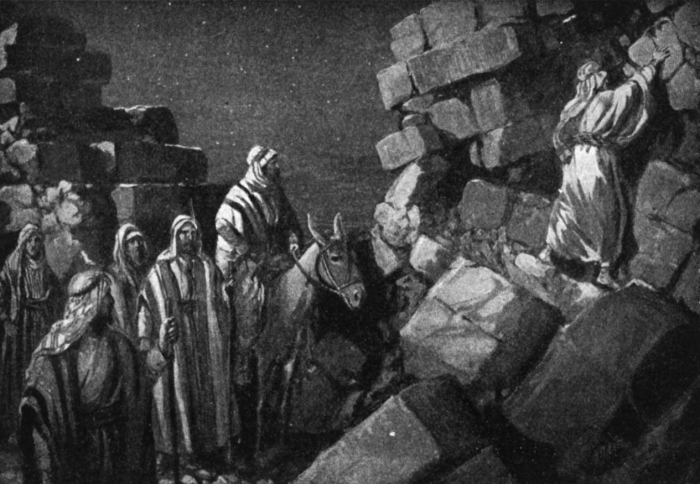
Nechemyahu son of Helchiyah was a Jewish governor, sent by the Persian emperor to help rebuild and secure Jerusalem, a little over seventy years after the neo-Babylonians had viciously flattened the Holy City and carried her strength away into exile. Nechemyah had heard of how badly the small community of Jews, who had been permitted by the Persians to return to Juda and rebuild, were faring. Let’s have a look at the first chapter of the book of Nechemyah (aka. II Esdras in old Catholic Bibles), which you will find in your Bibles. The book goes on to describe how the governor was successful and helped Jerusalem to arrive at a new prosperity in the following years. But in this post, I want to focus on his heartfelt prayer to the Holy One to restore His people after their sins had resulted in the calamity mentioned above.
“These are the memoirs of Nehemias, son of Helchias. One day in the month of Casleu, the year, the twentieth of Artaxerxes, in the royal city of Susa, I was visited by a kinsman of mine, Hanani, who brought with him certain travellers just come from Juda. So I asked them how it went with Jerusalem, and with the Jews still left there, survivors of the exiles who returned. ‘Survivors there are,’ said they, ‘in various parts of the province, left over from the days of the exile. But they are in great distress, and count for nothing; Jerusalem is but broken walls and charred gates.’ For a long time after hearing this news I kept my house, all tears and lament; I fasted, and sought audience with the God of heaven in prayer.”
The Church is not what she once was. We should be able to compare the situation of the forlorn Hebrews of Nechemyah’s time, and consider how they berated themselves for ignoring the warnings of their prophets. In our days, after decades of dissipation, the Latin Church in the West has succeeded in auto-demolishing her strength. We hear how a small fraction of the baptised can be bothered to attend Mass at all, let alone be part of the local community. The stories of the foolishness of the Hebrews in the last years of the monarchy of the House of David are often our own stories. Survivors there are, living in the ruins of the grand designs of Catholic men and women of the past, visible in the great churches that we gape at today, wondering at the ingenuity that built them. Can we build as they did? Can we rebuild? Ingenuity! Faith it was that built those walls! Let us pray in repentance as Nechemyah the governor prayed, for the foolishness of our forebears and for our own foolishness…
“‘Mercy,’ I cried, ‘Thou God of heaven, the strong, the great, the terrible! Thou Who ever keepest Thy gracious promises to the souls that love Thee, and are true to Thy commandments! Let Thy ears be attentive, Thy eyes watching still; listen to the prayer I offer Thee now, Thy servant, interceding day and night for my fellow-servants, the men of Israel. Listen to the confession I make of our sins; they, the men of Israel, have sinned, I and my father’s race have sinned; led away by false aims, we have neglected decree and observance and award of Thine, enjoined on Thy servant Moses. But do not forget that this servant of Thine, Moses, had a promise of Thee too. Far and wide though Thou shouldst scatter us among the nations, when we disobeyed Thee, yet if we came back to Thee, if we kept Thy bidding in mind and performed it, then wouldst Thou reunite us, though the furthest corner of earth were our place of banishment, and bring us home to that city which is the chosen shrine of Thy Name. Are they not Thy own servants, Thy own people, won for Thee by Thy great deeds, by Thy constraining power? Let not Thy ears be deaf, Lord, I beseech Thee, to Thy servant’s prayer, to the prayer of all these servants of Thine who love to hold Thy Name in reverence. Speed Thy servant well this day, and win for him the pity of a human heart.’
“It was of the king I spoke; I was the royal cup-bearer.”
We are still people who live in this world, even if we do not belong to this world (for our home is in heaven). As people in this world – as Nechemyah was the cup-bearer, and so had the ear of the Persian emperor and could intercede for his people – we are practical and we know or we must find ways to rebuild, to get earthly powers to assist us in our work.
We must establish a mission, we must work with the Bishops. We are not building heaven on earth. We are building lifts and escalators, to elevate people from the wickedness around them and onwards and upwards, towards the God Who loves them. Let us return to the Commandments, by keeping which we show our love for Christ. Teach the commandments to family and friends, and intercede as priests day and night for them. This is the New Evangelisation. It starts with us, and it goes out towards others. The God Who watches us destroy ourselves is ever ready to restore and rebuild us, if we are willing.
That’s what Divine Mercy Sunday is all about – restoration and renewal. For are we not servants of the Holy One, His own people, won for Him by the extraordinary sacrifice on the Cross?
So, storm heaven. The Church is not yet finished. Let us mend the walls.
Nehemiah is seen as a Saint by the Catholic Church (memorial day July the 13th, if I’m not mistaken). S. Nehemiah, pray for us!
 Catholic Louth and Mablethorpe