At the very beginning of Holy Week, I had said that I wanted to talk about Marian devotion, and I introduced the Blessed Virgin as the Davidic queen-mother, the advocate who traditionally sat on the right hand side of the King of Judah. When we approach our Lady in prayer, asking for her intercession and for her assistance, we may keep this image of the royal court of Christ in mind.
It reminds me of that episode in the gospels, when two of our Lord’s cousins, the Apostles S. James and S. John, brothers and sons of Zebdai/Zebedee, asked for places one on the left and the other on the right of Christ in His glory. Considering Christ’s reply that they didn’t know what they were asking for – because His glory arrived upon the Cross on Good Friday – and that those places belonged to others, we remember that James was the first of the Apostles to be martyred, and we remember that John suffered the pain of standing at the foot of the Cross, as he supported the Blessed Virgin in her great distress as Our Lady of Sorrows. And she, standing at the foot of the Cross, is usually pictured on the right of her Son, and S. John on the left.
Most of us men whose mothers still live (and those of us who remember our mothers) know the power they have over us. For my part, although my mother died many years ago… the mother of the parish priest often has a powerful presence in his parish, if she chances to live there. The mother of a bishop would be more powerful still. Because anybody who wanted something from me would have a better chance going to my mum about it. There is that interesting episode in the legend of King Solomon, when one of his (older) half-brothers, a man called Adoniyah, seeking to supplant Solomon, sought the indulgence of the queen mother. He ultimately failed, but he made his best try – he tried to get her on his side. The king listens to his mother…
“As for Adonias, son of Haggith, he gained access to Bethsabee, king Solomon’s mother, telling her that he came on a peaceful errand; there was a matter he would confide to her. So she bade him speak out, but still he hesitated; ‘Once,’ said he, ‘the throne was mine, and all Israel had chosen me for their king; now the royal power has changed hands, and gone to my brother; it was God’s will. There is only one request now that I would make of thee; pray do not disappoint me.’ And still she bade him speak out. ‘My request is,’ said he, ‘that thou wouldst say a word for me to king Solomon; there is nothing he can refuse thee. Bid him give me Abisag the Sunamite for my wife.’ ‘Why, yes,’ answered Bethsabee, ‘I will speak to the king on thy behalf.’ Bethsabee, then, made her way to king Solomon, to prefer Adonias’ request; the king rose to meet her and bowed low, then he sat down on his throne again, and a throne was brought for her, the king’s mother, to sit down at his right hand. ‘There is a light request,’ she told him, ‘that I would make of thee; pray do not disappoint me.’ ‘Make thy request, mother,’ said he; ‘I will not turn a deaf ear to it.’“
Third book of the Kings (aka. I Kings), 2: 13-20 [link]
We are all of us sinners, some of us greater sinners than others. We cannot do much better than to approach the Lady standing at the foot of the Cross, who received us as her children as her Son was in great distress and dying. For His sake she will hear us and present our case to Him.
In the next few weeks, I shall speak about the Holy Rosary and one or two other Marian devotions. Since May is the month of our Lady, that would be most appropriate.
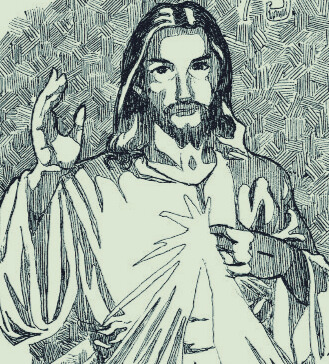
This second Sunday of Easter the Holy Father John Paul II named for us Divine Mercy Sunday, and this year we would do well to lean against that promise of Divine Mercy, for it is a Jubilee year, and from the most ancient times in the Old Testament, jubilees was connected with restitution, with restoration. We are best restored as Christians when we regularly undergo the rites of holy religion, by receiving the Sacraments. The two Sacraments we regularly receive are Confession and Holy Communion. Unless, of course, we are very ill and have received the Sacrament of the Sick often.
If we are going to Confession very irregularly or not at all, we really must do something about it; it is precisely through regular confession that we lay our sinful behaviours and habits before the throne of the Holy One and remake our commitment to Him – our commitment in love to do good and avoid evil. And it is this that restores us regularly, not only in jubilee years. But jubilee years do serve to focus our minds further upon restoration in Christ.
In our gospel reading this weekend, S. John gives us the origins of the Sacrament of Reconciliation, as Christ gives His Apostles the authority to forgive sin, an authority they later handed down to their bishops, and the bishops to their priests.
“And now it was evening on the same day, the first day of the week; for fear of the Jews, the disciples had locked the doors of the room in which they had assembled; and Jesus came, and stood there in their midst; ‘Peace be upon you,’ He said. And with that, He shewed them His hands and His side. Thus the disciples saw the Lord, and were glad. Once more Jesus said to them, ‘Peace be upon you; I came upon an errand from My Father, and now I am sending you out in My turn.’ With that, He breathed on them, and said to them, ‘Receive the Holy Spirit; when you forgive men’s sins, they are forgiven, when you hold them bound, they are held bound.’“
Gospel of S. John, 20: 19-23 [link]
We see the authority of the Apostles to forgive sins in the first reading, where the very shadow of the Apostle S. Peter was sought as a means of curing illness.
“And there were many signs and miracles done by the Apostles before the people. They used to gather with one accord in Solomon’s porch. No one else dared to join them, although the people held them in high honour, and the number of those who believed in the Lord, both men and women, still increased; they even used to bring sick folk into the streets, and lay them down there on beds and pallets, in the hope that even the shadow of Peter, as he passed by, might fall upon one of them here and there, and so they would be healed of their infirmities. From neighbouring cities, too, the common people flocked to Jerusalem, bringing with them the sick and those who were troubled by unclean spirits; and all of them were cured.”
Acts of the Apostles, 5: 12-16 [link]
In the Jewish mind, we know that physical illness was connected with sin, so that a sick person was thought to be suffering the consequences of sin. We might as well say that the people being laid before the Apostles in the streets of Jerusalem for healing were penitents who were looking not only for physical healing but for the forgiveness of Christ and His healing, administered through these Twelve ordained men.
So, let us meditate today on the power of Divine Mercy, Christ’s call to repentance, the agency of the Christian priesthood in this, and the endless love of the heart of God our Lord.
 Catholic Louth and Mablethorpe