It’s the month of May and I thought I would talk a little about the Rosary. I shall use the contents of a book called the Secret of the Rosary by the French priest S. Louis-Marie de Montfort. We don’t always remember why this great prayer of the Church is called ‘the rosary.’ It has also been called a coronet or crown, so our strings of beads may also be called coronets. And we traditionally crown our Lady with flowers in the month of May, don’t we? At least, we used to. Some parishes still do.
S. Louis-Marie called the beads of the rosary ‘roses,’ and his book is built from 53 sections, just like the 53 beads on our coronets with which we say the Ave Maria (Hail Mary). The Rosary as a prayer focuses upon the life of Christ as it was shared with our Lady, and S. Louis-Marie therefore called the Rosary a mystical rose tree. Mysticism involves spiritual union with the Holy One, acquired through prayer and meditation. The Rosary, you see, is not only about saying strings of Paters (Our Fathers) and Aves (Hail Marys), but more importantly about meditating on and imitating the lives of Christ and His mother, and to thus acquiring salvation through lives of virtue. Specifically, we are taught through the regular use of the Rosary the virtues of humility, obedience and charity.
Our Saint is determined to show us, through a quick history, both the divine origins of the Rosary and the beneficial effect it has had in the lives of Christian men and women, especially when it was recited in community. Because of the grace of God that flows through the Rosary from the lives of our Lord and His holy Mother, the Rosary then becomes a ‘battering ram’ against sin and temptation, and brings with it conversion and sanctification. Those of us who say the Rosary regularly know that it is a rather simple prayer, quickly learnt, and that is a great blessing, for it allows every type of person to make use of it, from the eminent scholastic to the humble labourer. What is more difficult than the words and the system of the Rosary is establishing the regular commitment of time and building the focus required to best say the Rosary.
We may remember how as children when the world seemed too large and frightening, we felt a great comfort in holding on to Mum’s hand, or indeed Dad’s. And here, we do the same again, for as we go through the difficulties of this life on earth, we have the comforting presence of the holy Mother.
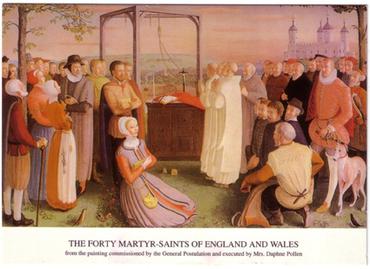
Today is the memorial day of the English Martyrs. In these countries, when the Catholic Church came under enormous attack from the sixteenth century onwards, it is interesting to see how the Saints hung on to their rosaries. The rosary became one of the principal ways by which the government could arrest our priests and basically smoke out secret Catholics. When the Irish were attacked by their anti-Catholic rulers, men like Cromwell would talk about being unable to pry the rosaries out of the hands of the stubborn Catholics.
“…and they brought [the Apostles] in and bade them stand before the Council, where the high priest questioned them. ‘We warned you in set terms,’ he said, ‘not to preach in this Man’s Name, and you have filled all Jerusalem with your preaching; you are determined to lay this Man’s death at our door.’ Peter and the other Apostles answered, ‘God has more right to be obeyed than men. It was the God of our fathers that raised up Jesus, the Man you hung on a gibbet to die. It is God that has raised Him up to His own right hand, as the Prince and Saviour Who is to bring Israel repentance, and remission of sins. Of this, we are witnesses; we and the Holy Spirit God gives to all those who obey Him.’ On hearing this they were cut to the quick, and designed to kill them… so they sent for the Apostles and, after scourging them, let them go with a warning that they were not on any account to preach in the Name of Jesus. And they left the presence of the Council, rejoicing that they had been found worthy to suffer indignity for the sake of Jesus’ Name.”
Acts of the Apostles, 5: 27-33, 40-41 [link]
In this first reading of ours this weekend, we see the Apostles being harangued by the high-priest Caiaphas, who had thought that he was finished with this annoying Jewish sect when he had got the Roman governor to execute our Lord a few weeks earlier. Now, he was unable to contain even His Apostles, who had suddenly become very bold indeed. He couldn’t pry their rosaries from out of their hands, so to speak. For they answered, as our glorious martyrs did during the Reformation, Obedience to God comes before obedience to men. S. Thomas More had an excellent variant on this when he said, I die the king’s good servant, but God’s first.
We shall have newer and newer opportunities to say similar things in our own times, for it is never comfortable to be a Catholic in this world. We too, like the Apostles and the English and Irish martyrs, should be glad to have the honour to suffer humiliation and indignity for the sake of the Name of Christ. For there are always people in this world who will ask us to bow down to them and their new ideas, but as in the second reading, we Christians are ranged around the throne of God, rosaries in hand, crying out…
“Then I heard, in my vision, the voices of a multitude of angels, standing on every side of the throne, where the living figures and the elders were, in thousands of thousands, and crying aloud, ‘Power and Godhead, wisdom and strength, honour and glory and blessing are His by right, the Lamb that was slain.’ And every creature in heaven and on earth, and under the earth, and on the sea, and all that is in it, I heard crying out together, ‘Blessing and honour and glory and power, through endless ages, to Him Who sits on the throne, and to the Lamb.’ Then the four living figures said, ‘Amen;’ and the twenty-four elders fell prostrate, worshipping Him Who lives for ever and ever.”
Book of Apocalypse (aka. Revelation), 5: 11-14 [link]
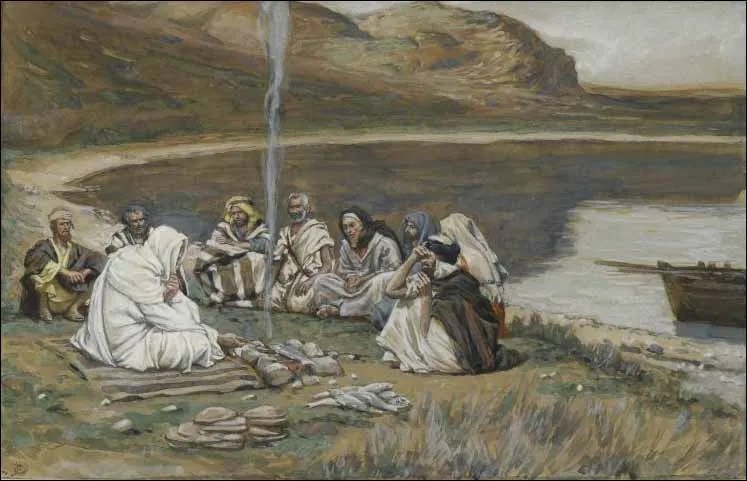
Our gospel story as well as being a post-Resurrection appearance of Christ is also a type of parable, even a Eucharistic parable. Because there are the golden shores of Holy Mass, where we are often fed by Christ after a long and seemingly futile struggle. If Holy Church is the barque of Peter, as we still say, and we are all in the boat with the Apostles, sailing the choppy waters of this world with difficulty, and with little reward (catching nothing all night), we still see the Holy One beckoning to us from the sacred shores of an eternal morning, where we shall one day wearily reach, and hear with joy the words, ‘Come and have breakfast.’
“Jesus appeared to His disciples again afterwards, at the sea of Tiberias, and this is how He appeared to them. Simon Peter was there, and with Him were Thomas, who is also called Didymus, and Nathanael, from Cana of Galilee, and the sons of Zebedee, and two more of His disciples. Simon Peter told them, ‘I am going out fishing;’ and they said, ‘We, too, will go with thee.’ So they went out and embarked on the boat, and all that night they caught nothing. But when morning came, there was Jesus standing on the shore; only the disciples did not know that it was Jesus. ‘Have you caught anything, friends,’ Jesus asked them, ‘to season your bread with?’ And when they answered ‘No,’ He said to them, ‘Cast to the right of the boat, and you will have a catch.’ So they cast the net, and found before long they had no strength to haul it in, such a shoal of fish was in it. Whereupon the disciple whom Jesus loved said to Peter, ‘It is the Lord.’ And Simon Peter, hearing him say that it was the Lord, girded up the fisherman’s coat, which was all he wore, and sprang into the sea. The other disciples followed in the boat (they were not far from land, only some hundred yards away), dragging their catch in the net behind them. So they went ashore, and found a charcoal fire made there, with fish and bread cooking on it…”
Gospel of S. John, 21: 1-9 [link]
 Catholic Louth and Mablethorpe