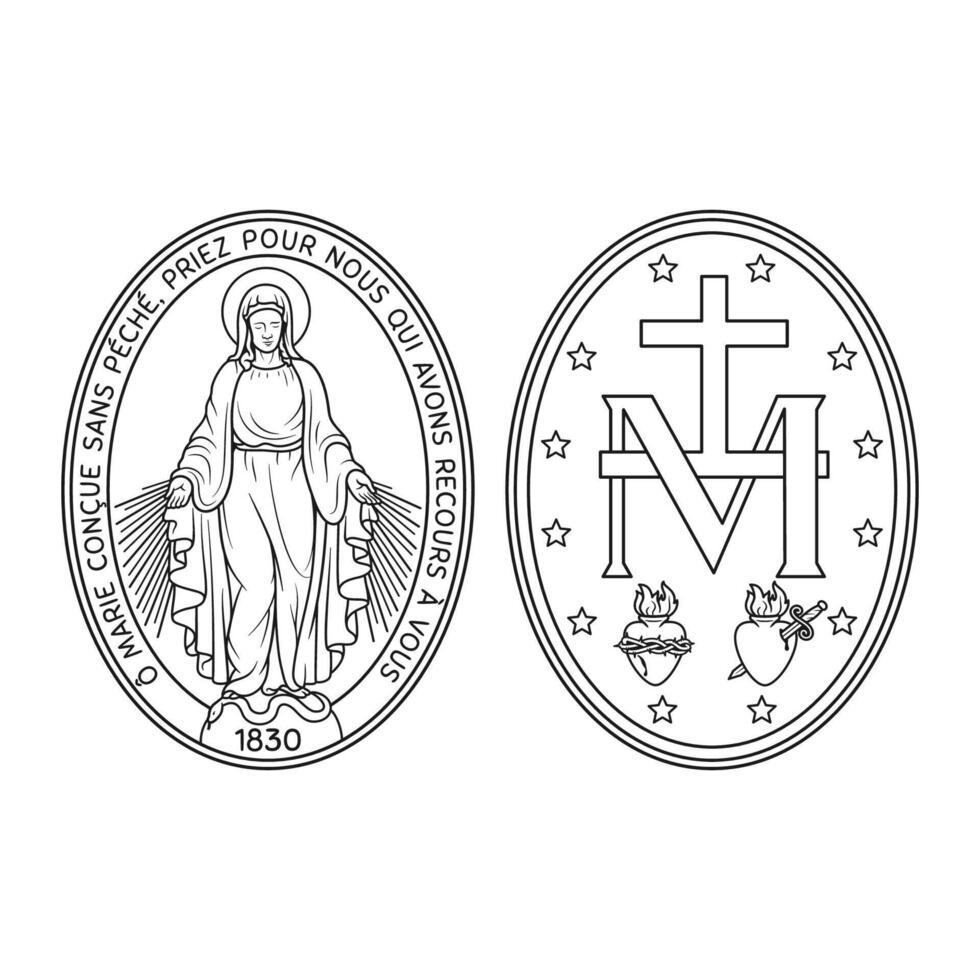
With one last Sunday of May, I wondered if I should end my survey of Marian devotions with the Brown Scapular of the Carmelites, or with the Miraculous Medal of S. Catherine Labouré. I thought I’d spend more time with the Scapular in October and remain this weekend with the Medal, because of the complex of imagery that this rather simple device includes.
It was in the 1830s that the Charity Sister, S. Catherine, saw the visions of Our Lady in the chapel of her community house on the Rue de Bac, near central Paris. She saw a vision of the Immaculate standing upon a globe, with rays of light streaming from her hands. And she saw the words, O Mary, conceived without sin, pray for us who have recourse to thee. She was to put this image onto a cast medal, and you can see how the typical medal looks from the picture above. All who wear this medal are to receive signal graces through the hands of OL. It is my belief that the figure on the medal is a very pregnant Lady, and the graces that flow from her hands have their source in the Child Who lives within her.
When the promises associated with this medal began to be fulfilled, the French began calling it the Miraculous Medal, and the name has stuck. Those words (above) associated with the medal are similar to the Hail Mary, and are reputedly very powerful. On the reverse side of the medal, we find that the intercession of our Lady for us is intertwined as a great letter M with the cross of her Son. Her ministry is intertwined with His. Below this symbol we see the Sacred Heart of our Lord – which demonstrates the intense love of God for mankind – set beside the Immaculate Heart of our Lady – which brought that Sacred Heart into this world, and works together with it to bring about our eternal salvation. The twelve stars that enclose this whole refer to the vision of S. John in the book of Apocalypse, when the Lady appeared to him crowned with twelve stars. This medal is a compact summary of the mission of OL within the Church, upon which we as Catholics wonderfully rely. I recommend it for wide use, as I recommend also the Rosary of our Lady.
Our readings at Mass this weekend give us a picture of the Apostolic ministry of the early Church, which has come down to us through the work of the bishops of the Church. The second reading from the book of Apocalypse demonstrates the holy city of Jerusalem, which I shall call a temple of living stones – the Church – descending from heaven.
“And he carried me off in a trance to a great mountain, high up, and there shewed me the holy city Jerusalem, as it came down, sent by God, from heaven, clothed in God’s glory. The light that shone over it was bright as any precious stone, as the jasper when it is most like crystal; and a great wall was raised high all round it, with twelve gates, and twelve angels at the gates, and the names of the twelve tribes of Israel carved on the lintels; three gates on the east, three on the north, three on the south, three on the west. The city wall, too, had twelve foundation-stones; and these, too, bore names, those of the Lamb’s twelve Apostles. The angel who was speaking to me had a rod of gold for a rule, to measure the city, and its gates, and its wall. The city lies foursquare, the same in its length as in its breadth, and when he measured it with his rod, he counted twelve thousand furlongs. Length and breadth and height are everywhere equal. And when he measured its wall, he counted a hundred and forty-four cubits, reckoned by the measure of a man, that is, of an angel. The fashioning of its wall was of jasper, but the city itself was pure gold, that seemed to have the purity of glass. And the foundations of the city wall were worked in every kind of precious stone. The first foundation was a jasper, the second a sapphire, the third a chalcedony, the fourth an emerald; the fifth a sardonyx, the sixth a sardius, the seventh a chrysolite, the eighth a beryl; the ninth a topaz, the tenth a chrysoprase, the eleventh a jacynth, the twelfth an amethyst. And the twelve gates were twelve single pearls, one pearl for each gate; and the street of the city was of pure gold, that seemed like transparent glass. I saw no temple in it; its temple is the Lord God Almighty, its temple is the Lamb. Nor had the city any need of sun or moon to shew in it; the glory of God shone there, and the Lamb gave it light.“
Book of Apocalypse, 21: 10-23 [link]
This city has no temple, as S. John says, for its temple is God and the Lamb – the city is the temple, where God dwells. There are twelve gates to access the city and those are the twelve tribes of Israel. When we are baptised, we are joined to the twelve tribes of the Hebrews. There are twelve foundations stones upon which the Church here described stands, and those are the twelve apostles, minus Judas, plus S. Matthias. It is a marvellous picture of the Church, and we can see in the first reading today something of the ministry of the Apostles, for when some renegades went around places like Antioch without the Apostolic authority, suggesting that all of us should become Jews before we can be baptised Christians, the Apostles and the other leaders of the Church in Jerusalem had a bit of a council and decided that, No, Christians need not be inducted into Judaism before they are baptised.
“Thereupon it was resolved by the Apostles and presbyters, with the agreement of the whole church, to choose out some of their own number and despatch them to Antioch with Paul and Barnabas; namely, Judas who was called Barsabas, and Silas, who were leading men among the brethren. And they sent, by their hands, this message in writing; ‘To the Gentile brethren in Antioch, Syria and Cilicia, their brethren the Apostles and presbyters send greeting. We hear that some of our number who visited you have disquieted you by what they said, unsettling your consciences, although we had given them no such commission; and therefore, meeting together with common purpose of heart, we have resolved to send you chosen messengers, in company with our well-beloved Barnabas and Paul, men who have staked their lives for the name of our Lord Jesus Christ. We have given this commission to Judas and Silas, who will confirm the message by word of mouth. It is the Holy Spirit’s pleasure and ours that no burden should be laid upon you beyond these, which cannot be avoided; you are to abstain from what is sacrificed to idols, from blood-meat and meat which has been strangled, and from fornication. If you keep away from such things, you will have done your part. Farewell.'”
Acts of the Apostles, 15: 22-29 [link]
Notice how the Apostles and bishops boldly declare in this apostolic exhortation that this decision of their Council was both of the Holy Spirit and theirs too. This is the authority of Christ the Head of the Church, being exercised by the men He appointed to do it. Interestingly, also, we see in this fifteenth chapter of the Acts of the Apostles some more of the organisation of the early hierarchy: (i) the Apostle S. Peter stepping aside to allow the council to be chaired by the bishop of Jerusalem, S. James, (ii), the missionary priests S. Paul and S. Barnabas needing the Apostolic authority to secure their own work in the north, in Antioch, (iii) and this last requiring the Apostles in Jerusalem to send delegates (or envoys, legates, ambassadors) along with Paul and Barnabas, named here as Judas Barsabbas and Silas.
And as we get closer to Pentecost, we shall consider more and more the work of the Holy Spirit within the Church, exercising His divine power through the appointed men, our bishops and priests. The gospel story tells of the promise of Christ, that the Holy Spirit would continue to teach the Apostles (and by extension their successors the bishops), remind them of the gospel message which they are to bring to the rest of us, and pour out peace and unity within the body of the Church. I am going, Christ seems to say, but I’m not really going at all, for you shall have My Holy Spirit.
“Jesus answered him, ‘If a man has any love for Me, he will be true to My word; and then he will win My Father’s love, and We will both come to him, and make our continual abode with him; whereas the man who has no love for Me, lets My sayings pass him by. And this word, which you have been hearing from Me, comes not from Me, but from My Father Who sent Me. So much converse I have held with you, still at your side. He who is to befriend you, the Holy Spirit, Whom the Father will send on My account, will in His turn make everything plain, and recall to your minds everything I have said to you. Peace is My bequest to you, and the peace which I will give you is Mine to give; I do not give peace as the world gives it. Do not let your heart be distressed, or play the coward. You have heard Me say that I am going away and coming back to you. If you really loved Me, you would be glad to hear that I am on My way to My Father; My Father has greater power than I. I have told you of this before it happens, so that when it happens you may learn to believe.”
Gospel of S. John, 14: 23-29 [link]
 Catholic Louth and Mablethorpe