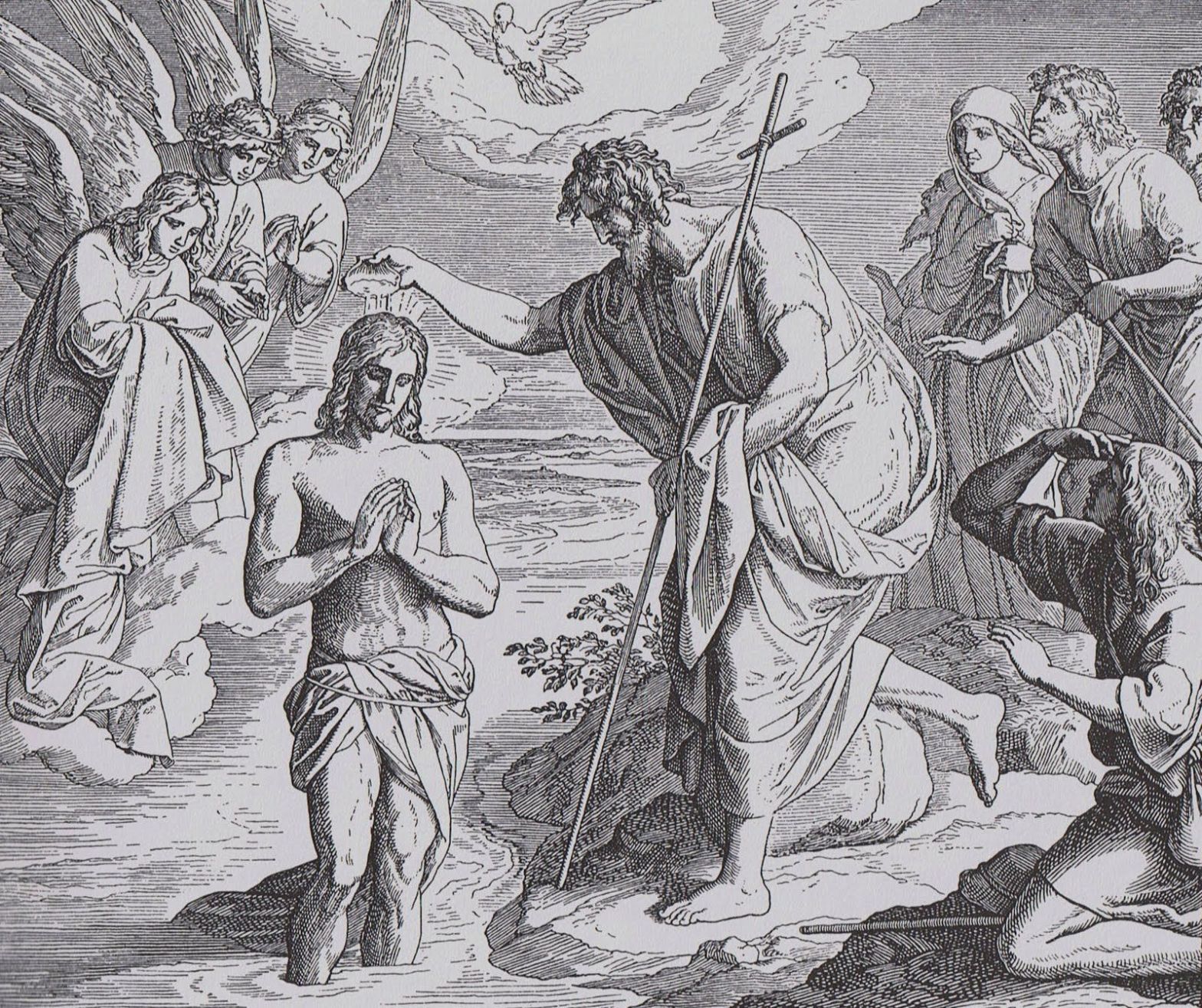
“Then Jesus came from Galilee and stood before John at the Jordan, to be baptized by him. John would have restrained Him; ‘It is I,’ he said, that ought to be baptized by Thee, and dost Thou come to me instead?’ But Jesus answered, ‘Let it be so for the present; it is well that we should thus fulfil all due observance.’ Then John gave way to Him. So Jesus was baptised, and as He came straight up out of the water, suddenly heaven was opened, and he saw the Spirit of God coming down like a dove and resting upon Him. And with that, a Voice came from heaven, which said, ‘This is My beloved Son, in Whom I am well pleased.’“
Gospel of S. Matthew, 3: 13-17 [link]
Here is another epiphany or manifestation of the Lord. Remembering the story of the Nativity, and how the Messiah (chosen king) of the Jews appeared unknown in a stable-cave in Bethlehem, manifesting Himself through angels to some shepherds in the Judaean hill-country, and then through a star to the wise men of the East… we can discern a progressive unfolding and unveiling of the Holy One in the flesh.
So we speak of the epiphany to the shepherds, and the big-E Epiphany to the wise men. On this feast day, we discover a super epiphany to the holy man S. John the Baptist. This is a big, big one, because not only is John confirmed in his prophecies about the Messiah soon-to-come (the strap of Whose sandals he is not worthy to undo, etc.), but because all of a sudden he discovers the most blessed and Holy Trinity. For when the Lord emerges from the waters of repentance heaven is thrown open and John sees a physical manifestation of the Holy Ghost, in the form (Matthew tells us) of a dove. And the faceless Father of all things sounds forth to say, Behold, this is My beloved Son. If an epiphany is a discovery about the reality of the Godhead, then this is significant, comparable to a later epiphany to the three cardinal Apostles just before the Passion of the Christ, on the mountain of the Transfiguration.
“And now, here is My servant, to whom I grant protection, the man of my choice, greatly beloved. My spirit rests upon him, and he will proclaim right order among the Gentiles. He will not be contentious or a lover of faction; none shall hear his voice in the streets. He will not snap the staff that is already crushed, or put out the wick that still smoulders; but at last he will establish right order unfailingly. Not with sternness, not with violence; to set up right order on earth, that is his mission. He has a law to give; in the far-off islands men wait for it eagerly. Thus says the Lord God, He Who created the heavens and spread them out, Craftsman of the world and all the world affords, He Who gives being and breath to all that lives and moves on it: True to My purpose, I, the Lord, have summoned thee, taking thee by the hand and protecting thee, to make, through thee, a covenant with My own people, to shed, through thee, light over the Gentiles: to give sight to blinded eyes, to set the prisoner free from his captivity, from the dungeon where he lies in darkness.“
Prophecy of Isaias, 42: 1-7 [link]
Our reading from Isaiah this weekend is perhaps given to us because the voice of God here sounds very like the voice that John heard in the river Jordan. Isaiah presents to us in these later readings from his prophecy the figure of the so-called Suffering Servant of God, introduced in our reading today but in later chapters (such as chapter 53) presented very much as vicariously suffering for the nation.
Jewish sages of the past and Jews communities today think of these lines in the prophecy of Isaiah as representing the suffering nation of Israel, always so badly treated, mocked and persecuted by other tribes. But as we Christians read through these suffering-Servant passages, we find less of a corporate person – the Jewish nation – and more of a single magnified Person, a gentle Teacher (does not break a crushed reed) and a quiet witness to the Law of God (does not cry or make his voice heard).
With what a thrill must the Apostle S. Matthew have put in that last line in our gospel reading this weekend, about the Voice from heaven, Matthew’s own mind certainly on this reading from Isaiah’s prophecy, which first-century observant Jews would have known by heart. Faithfully he will bring justice, he will neither waver in his dedication nor be crushed by injustice, says Isaiah. Faithfully He has brought justice, He has not wavered in His mission, declares the evangelist S. Matthew in retrospect. The Light has shone in the darkness, says the evangelist S. John, and the darkness has not been able to extinguish it.
Faithfulness, constancy and perseverance until the end our Lord Himself has taught us.
The word messiah refers to anointing with oil, and so indicates kingship and priesthood. First century Jews (and wise men from the east) would have been looking in their Messiah for a successor of David certainly – a king – but this was to be a special type of king. A priest-king, said King David in the psalms, according to the order of Melchisedech. This would not necessarily be a political king, who would chase away Greek and Roman and reestablish the Jewish commonwealth. Rather, says Isaiah in our first reading, the priest-king’s primary responsibility would be establishing righteousness, that is, restoring the right relationship of mankind with God which had been lost in the sin of Adam and Eve.
Yes, He would be preaching and teaching by word and example, and so quietly opening the eyes of the blind and freeing captives, etc., but that would all serve the greater mission, which was to establish a new covenant community – which we call the Church – of those united in mind and heart to the Creator God. All of that is in the short reading from Isaiah we have this weekend, and the Apostle S. Peter narrates in summary to S. Cornelius in our second reading how Christ completed this mission, above all in curing spiritual and physical illness, but first by bringing purification and the ability to stand in confidence before the Fire of holiness that is God.
And that’s what baptism is all about. Purification. Reaching back in history behind sin and death to remove mankind from the tyranny of the devil, and put them back into the Garden of Eden from which they were once expelled.
“Thereupon Peter began speaking; ‘I see clearly enough,’ he said, ‘that God makes no distinction between man and man; He welcomes anybody, whatever his race, who fears Him and does what piety demands. God has sent His word to the sons of Israel, giving them news of peace through Jesus Christ, Who is Lord of all. You have heard the story, a story which ran through the whole of Judaea, though it began in Galilee, after the baptism which John proclaimed; about Jesus of Nazareth, how God anointed Him with the Holy Spirit and with power, so that He went about doing good, and curing all those who were under the devil’s tyranny, with God at His side.”
Acts of the Apostles, 10: 34-38 [link]
 Catholic Louth and Mablethorpe