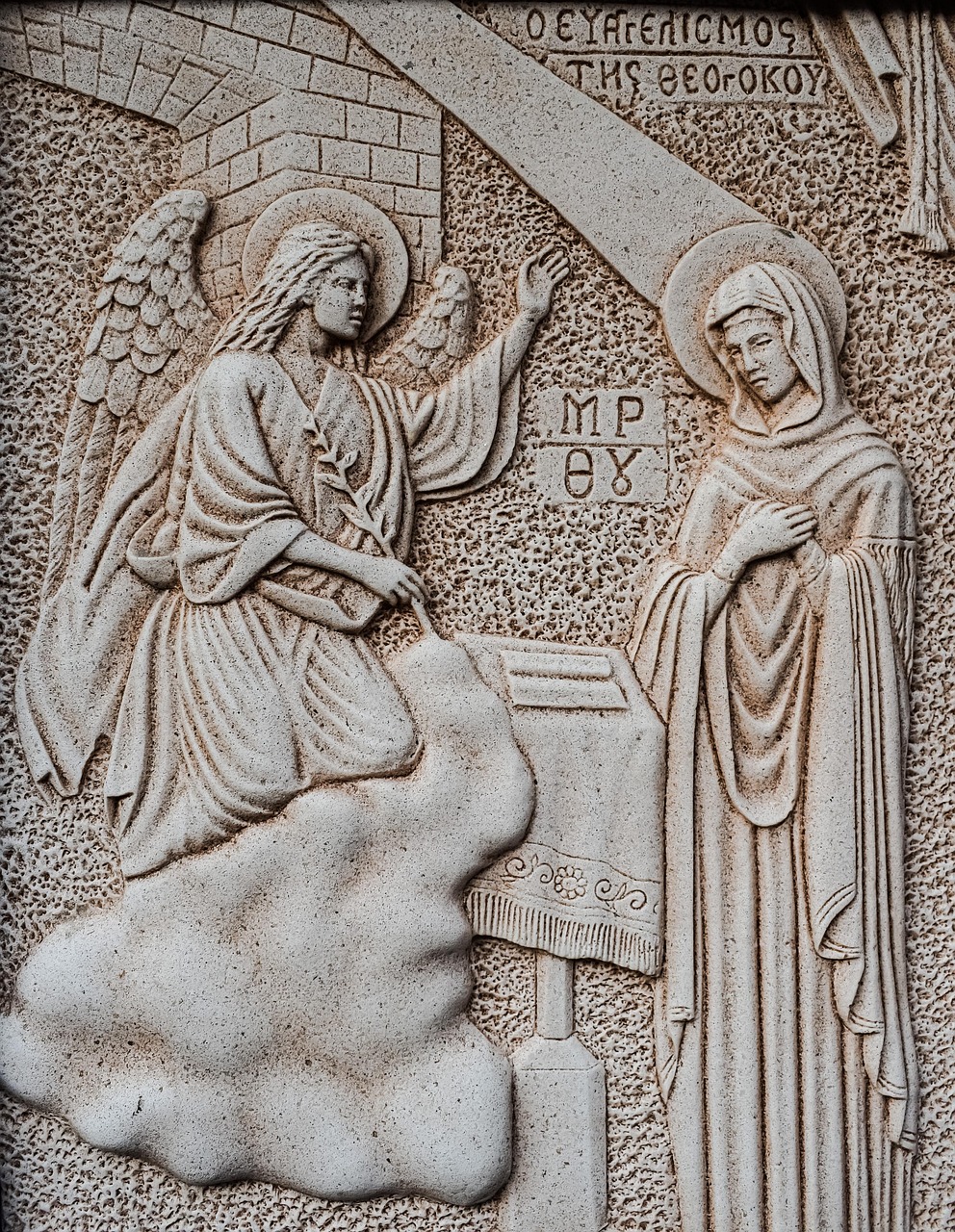
Image by Dimitris Vetsikas from Pixabay
A very significant feast day today, now precisely nine months before Christmas Day. I thought I’d put out a few capsules of wisdom from the Saints of the Church, with the assistance of Biblia Clerus…
“To the virgin Mary was sent, not any one of the angels, but the archangel Gabriel; for upon this service it was meet that the highest angel should come, as being the bearer of the highest of all tidings. He is therefore marked by a particular name, to signify what was his effectual part in the work. For Gabriel is interpreted ‘the strength of God.’ By the strength of God then was He to be announced Who was coming as the God of strength, and mighty in battle, to put down the powers of the air.”
Holy Father S. Gregory the Great
“Scripture has rightly mentioned that she was espoused, as well as a virgin, a virgin, that she might appear free from all connection with man; espoused, that she might not be branded with the disgrace of sullied virginity, whose swelling womb seemed to bear evident marks of her corruption. But the Lord had rather that men should cast a doubt upon His birth than upon His mother’s purity. He knew how tender is a virgin’s modesty, and how easily assailed the reputation of her chastity, nor did He think the credit of His birth was to be built up by His mother’s wrongs. It follows therefore, that the holy Mary’s virginity was of as untainted purity as it was also of unblemished reputation. Nor ought there, by an erroneous opinion, to be left the shadow of an excuse to living virgins, that the mother of our Lord even seemed to be evil spoken of. But what could be imputed to the Jews, or to Herod, if they should seen to have persecuted an adulterous offspring? And how could He Himself say, I came not to abolish the law, but to fulfill it, if He should seem to have had his beginning from a violation of the law, for the issue of an unmarried person is condemned by the law? Not to add that also greater credit is given to the words of Mary, and the cause of falsehood removed? For it might seem that unmarried becoming pregnant, she had wished to shade her guilt by a lie; but an espoused person has no reason for lying, since to women child-birth is the reward of wedlock, the grace of the marriage bed. Again, the virginity of Mary was meant to baffle the prince of the world, who, when he perceived her espoused to a man, could cast no suspicion on her offspring.”
The bishop S. Ambrose of Milan
“For God the almighty and merciful, Whose nature as goodness, Whose will is power, Whose work is mercy: as soon as the devil’s malignity killed us by the poison of his hatred, foretold at the very beginning of the world the remedy His piety had prepared for the restoration of us mortals: proclaiming to the serpent that the seed of the woman should come to crush the lifting of his baneful head by its power, signifying no doubt that Christ would come in the flesh, God and man, Who born of a Virgin should by His uncorrupt birth condemn the despoiler of the human stock. Thus in the whole and perfect nature of true man was true God born, complete in what was His own, complete in what was ours.”
Holy Father S. Leo the Great, sermon XXII on the Nativity
“Hail, full of grace, the Lord is with thee; blessed art thou among women. (Lc 1,28)
Note that between the words ‘full of grace’ and ‘blessed art thou among women’ come the words ‘the Lord is with thee’; because the Lord Himself both keeps the fullness of grace inwardly, and works the blessing of fruitfulness (that is, holy operation) outwardly. Rightly, too, after the words ‘full of grace’ comes ‘the Lord is with thee’, because just as without God we can do and we have nothing, so also without him we can keep nothing we have. Therefore after grace it is necessary that the Lord be with us and keep what he alone has given. While he goes before us in giving grace, we are his co-workers in keeping it. He will not watch over us unless we ourselves watch with him. It is clear that our own diligence is needed, when he says to the Apostles:
How shall this be done, because I know not man. (Lc 1,34)
This means, ‘I am fully resolved not to know.’ She is called ‘of the desert’ because she was infertile, a virgin before, during and after giving birth. ‘Send forth,’ I repeat, ‘to the mountain’, to the excellence of the daughter of Sion, the Church which is the daughter of the heavenly Jerusalem.”
S. Anthony of Lisbon (aka. of Padua)
“Mary leaves everything to the Lord’s judgement. At Nazareth she gave over her will, immersing it in the will of God: “Here am I, the servant of the Lord; let it be with me according to your word” (Lc 1,38). And this continues to be her fundamental attitude. This is how she teaches us to pray: not by seeking to assert before God our own will and our own desires, however important they may be, however reasonable they might appear to us, but rather to bring them before Him and to let Him decide what He intends to do. From Mary we learn graciousness and readiness to help, but we also learn humility and generosity in accepting God’s will, in the confident conviction that, whatever it may be, it will be our, and my own, true good.”
Holy Father Benedict XVI, homily, 11-Sep-2006


I thought this piece is excellent! Paul Rudd
LikeLike