Our readings this weekend give us the some of the origins of the apostolic ministry of the bishops and priests. Let’s begin with the Gospel reading, which is a resurrection appearance given by S. John in his gospel.
“And now it was evening on the same day, the first day of the week; for fear of the Jews, the disciples had locked the doors of the room in which they had assembled; and Jesus came, and stood there in their midst; ‘Peace be upon you,’ He said. And with that, He shewed them His hands and His side. Thus the disciples saw the Lord, and were glad. Once more Jesus said to them, ‘Peace be upon you; I came upon an errand from My Father, and now I am sending you out in My turn.‘ With that, He breathed on them, and said to them, ‘Receive the Holy Spirit; when you forgive men’s sins, they are forgiven, when you hold them bound, they are held bound.‘”
Gospel of S. John, 20: 19-25 [link]
Notice the setting: the Apostles know Christ is risen and they are still (as John says) in fear of the Jews. What a hold this miserable reign of the Sadducean priesthood had on hearts of the men and women of Jerusalem… Into the misery of this steps Christ, and He comes now to give the authority that once belonged to the Temple priests to His own Apostles.
Remember how once He had said in the gospels that the pharisees and the scribes were sitting in the chair of Moses; He had said (Matthew 23) that His disciples were to do as these teachers taught, but not follow their actions, for many of them were unable to practise what they preached. In another place (Matthew 21), He had condemned the Temple priesthood for their corruption and had said that the Kingdom of God would be taken from them and given to others who would bring better results. The teaching authority is now to be transferred, and in our Gospel story today. He first identifies Himself, by demonstrating the scars of the crucifixion, with the God-man Who had died on Good Friday. He then says that He had been sent with the teaching authority of God the Father, and that He now intends to send these eleven men with that same teaching authority.
But it’s not only about teaching, is it? It is about moral government also, for He goes on to say, Those whose sins you forgive are forgiven, those whose sins you retain are retained. Here we see the beginnings of the Sacrament of reconciliation, aka. penance or confession. What is this authority, that the Apostles handed on to bishops, and bishops hand on still to priests? Are we to believe in it? John, whose gospel this is, certainly thinks we should, for he gives us another resurrection appearance immediately, to shore the idea up. See, hear, touch, and receive the ability to teach, to bless, to forgive…
“There was one of the tTwelve, Thomas, who is also called Didymus, who was not with them when Jesus came. And when the other disciples told him, ‘We have seen the Lord,’ he said to them, ‘Until I have seen the mark of the nails on His hands, until I have put my finger into the mark of the nails, and put my hand into His side, you will never make me believe.’ So, eight days afterwards, once more the disciples were within, and Thomas was with them; and the doors were locked. Jesus came and stood there in their midst; ‘Peace be upon you,’ He said. Then He said to Thomas, ‘Let me have thy finger; see, here are My hands. Let me have thy hand; put it into My side. Cease thy doubting, and believe.’ Thomas answered, ‘Thou art my Lord and my God.’ And Jesus said to him, ‘Thou hast learned to believe, Thomas, because thou hast seen Me. Blessed are those who have not seen, and yet have learned to believe.'”
Gospel of S. John, 20: 24-29 [link]
The Apostle S. Thomas wasn’t there the first time, and Thomas is a bit of a scientist, as we all like to think we are these days. I won’t believe any of it, he says, until I’ve seen the Man myself felt those hole made by those abominable nails in His hands. And Christ comes around again to find Thomas. Thomas, Thomas, do you believe? You believe because you have seen, because you have touched. Blessed are those men and women living in 2026 who will not have seen, heard, touched, but somehow believe.
What is the effect of this new authority that the eleven Apostles have, that overcomes the authority the Temple priests used to have? We see a little of it in our first reading from Acts today, when we find that the order of nature submits to the Apostles now in the absence of the visible Christ, and miracles and signs abound and are noted.
“These [early Christians] occupied themselves continually with the Apostles’ teaching, their fellowship in the breaking of bread, and the fixed times of prayer, and every soul was struck with awe, so many were the wonders and signs performed by the Apostles in Jerusalem. All the faithful held together, and shared all they had, selling their possessions and their means of livelihood, so as to distribute to all, as each had need. They persevered with one accord, day by day, in the Temple worship, and, as they broke bread in this house or that, took their share of food with gladness and simplicity of heart, praising God, and winning favour with all the people. And each day the Lord added to their fellowship others that were to be saved.”
Acts of the Apostles, 2: 42-47 [link]
And we hear again in the second reading about a greater miracle than physical healings – and this echoes the exchange between Christ and S. Thomas – the attachment to Christ in the midst of great suffering (for the early Christian communities suffered greatly under numerous Roman governments) of souls who had never seen or heard Him.
“Blessed be that God, that Father of our Lord Jesus Christ, Who in His great mercy has begotten us anew, making hope live in us through the resurrection of Jesus Christ from the dead. We are to share an inheritance that is incorruptible, inviolable, unfading. It is stored up for you in heaven; and meanwhile, through your faith, the power of God affords you safe conduct till you reach it, this salvation which is waiting to be disclosed at the end of time. Then you will be triumphant. What if you have trials of many sorts to sadden your hearts in this brief interval? That must needs happen, so that you may give proof of your faith, a much more precious thing than the gold we test by fire; proof which will bring you praise, and glory, and honour when Jesus Christ is revealed. You never saw Him, but you learned to love Him; you may not see Him even now, but you believe in Him; and, if you continue to believe in Him, how you will triumph! How ineffable your joy will be, and how sublime, when you reap the fruit of that faith of yours, the salvation of your souls!”
First letter of the Apostle S. Peter, 1: 3-9 [link]
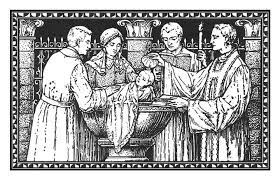
This second Sunday of Easter – Low Sunday, and these days Divine Mercy Sunday – is sometimes called Quasimodo Sunday, because the first words of the Mass (from the first letter of S. Peter) are ‘Like newborn infants, you must long…’ and in the Latin that is ‘Quasi modo geniti infantes concupiscite…’
“You must put aside, then, every trace of ill-will and deceitfulness, your affectations, the grudges you bore, and all the slanderous talk; you are children new-born, and all your craving must be for the soul’s pure milk, that will nurture you into salvation, once you have tasted, as you have surely tasted, the goodness of the Lord.”
First letter of the Apostle S. Peter, 2: 2 [link]
But let’s not look patronisingly at our new Catholics and neophytes and say to them, You newborn infants, etc., as far advanced in religion. I think there are many among us who will recognise that we are all of us like young infants before the Holy One, and that spiritual maturity though much desired is not easily had. We could say that the truly spiritually mature are the Saints of God, and perhaps the living saints who walk among us, but about whom we do not always know about.
We must seek maturity, but also remember to always be like little children before our Father God. So, back to the Quasimodo line of the Mass… S. Peter would have us yearn for the pure and spiritual feeding – milk, he says – from God, so that in the providence of the Holy One, we all of us – Catholics of seventy years, of fifty years, of ten years, or perhaps of a week… so that we may all of us may grow spiritually to salvation and embrace the eternal life promised to us.
 Catholic Louth and Mablethorpe