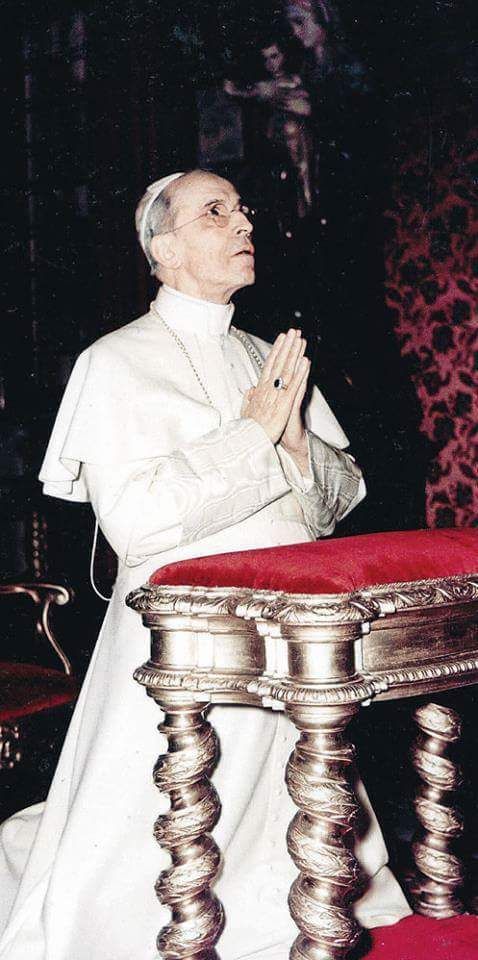
This good and holy man guided the Church through the turmoil of the second World War. Much careful guidance he has left us, for example in his letter of the sacred liturgy, Mediator Dei. Some excerpts…
“It is unquestionably the fundamental duty of man to orientate his person and his life towards God. ‘For He it is to whom we must first be bound, as to an unfailing principle; to whom even our free choice must be directed as to an ultimate objective. It is He, too, whom we lose when carelessly we sin. It is He whom we must recover by our faith and trust.’ (S. Thomas Aquinas) But man turns properly to God when he acknowledges His Supreme majesty and supreme authority; when he accepts divinely revealed truths with a submissive mind; when he scrupulously obeys divine law, centering in God his every act and aspiration; when he accords, in short, due worship to the One True God by practicing the virtue of religion.
“This duty is incumbent, first of all, on men as individuals. But it also binds the whole community of human beings, grouped together by mutual social ties: mankind, too, depends on the sovereign authority of God.”
Pius XII, Mediator Dei, #13-14
“The worship rendered by the Church to God must be, in its entirety, interior as well as exterior. It is exterior because the nature of man as a composite of body and soul requires it to be so. Likewise, because divine Providence has disposed that ‘while we recognize God visibly, we may be drawn by Him to love of things unseen.’ (Roman Missal) Every impulse of the human heart, besides, expresses itself naturally through the senses; and the worship of God, being the concern not merely of individuals but of the whole community of mankind, must therefore be social as well. This obviously it cannot be unless religious activity is also organized and manifested outwardly. Exterior worship, finally, reveals and emphasizes the unity of the mystical Body, feeds new fuel to its holy zeal, fortifies its energy, intensifies its action day by day: ‘for although the ceremonies themselves can claim no perfection or sanctity in their won right, they are, nevertheless, the outward acts of religion, designed to rouse the heart, like signals of a sort, to veneration of the sacred realities, and to raise the mind to meditation on the supernatural. They serve to foster piety, to kindle the flame of charity, to increase our faith and deepen our devotion. They provide instruction for simple folk, decoration for divine worship, continuity of religious practice. They make it possible to tell genuine Christians from their false or heretical counterparts.’ (Giovanni Cardinal Bona, De divina psalmodia)
But the chief element of divine worship must be interior. For we must always live in Christ and give ourselves to Him completely, so that in Him, with Him and through Him the heavenly Father may be duly glorified. The sacred liturgy requires, however, that both of these elements be intimately linked with each another. This recommendation the liturgy itself is careful to repeat, as often as it prescribes an exterior act of worship. Thus we are urged, when there is question of fasting, for example, ‘to give interior effect to our outward observance.’ (Roman Missal)”
Pius XII, Mediator Dei, #23-24
“The august sacrifice of the altar, then, is no mere empty commemoration of the passion and death of Jesus Christ, but a true and proper act of sacrifice, whereby the High Priest by an unbloody immolation offers Himself a most acceptable victim to the Eternal Father, as He did upon the cross. ‘It is one and the same victim; the same person now offers it by the ministry of His priests, who then offered Himself on the cross, the manner of offering alone being different.’ (Council of Trent)
“The priest is the same, Jesus Christ, whose sacred Person His minister represents. Now the minister, by reason of the sacerdotal consecration which he has received, is made like to the High Priest and possesses the power of performing actions in virtue of Christ’s very person. (S. Thomas Aquinas) Wherefore in his priestly activity he in a certain manner ‘lends his tongue, and gives his hand’ to Christ. (S. John Chrysostom)
“Likewise the victim is the same, namely, our divine Redeemer in His human nature with His true body and blood. The manner, however, in which Christ is offered is different. On the cross He completely offered Himself and all His sufferings to God, and the immolation of the victim was brought about by the bloody death, which He underwent of His free will. But on the altar, by reason of the glorified state of His human nature, ‘death shall have no more dominion over Him,’ (Romans 6: 9) and so the shedding of His blood is impossible; still, according to the plan of divine wisdom, the sacrifice of our Redeemer is shown forth in an admirable manner by external signs which are the symbols of His death. For by the ‘transubstantiation’ of bread into the body of Christ and of wine into His blood, His body and blood are both really present: now the eucharistic species under which He is present symbolize the actual separation of His body and blood. Thus the commemorative representation of His death, which actually took place on Calvary, is repeated in every sacrifice of the altar, seeing that Jesus Christ is symbolically shown by separate symbols to be in a state of victimhood.”
Pius XII, Mediator Dei, #68-69
“The august sacrifice of the altar is, as it were, the supreme instrument whereby the merits won by the divine Redeemer upon the cross are distributed to the faithful: “as often as this commemorative sacrifice is offered, there is wrought the work of our Redemption.” (Roman Missal) This, however, so far from lessening the dignity of the actual sacrifice on Calvary, rather proclaims and renders more manifest its greatness and its necessity, as the Council of Trent declares. Its daily immolation reminds us that there is no salvation except in the cross of our Lord Jesus Christ (Galatians 6: 14) and that God Himself wishes that there should be a continuation of this sacrifice ‘from the rising of the sun till the going down thereof,’ (Malachy 1: 11) so that there may be no cessation of the hymn of praise and thanksgiving which man owes to God, seeing that he required His help continually and has need of the blood of the Redeemer to remit sin which challenges God’s justice.”
Pius XII, Mediator Dei, #79
“Now it is clear that the faithful offer the sacrifice by the hands of the priest from the fact that the minister at the altar, in offering a sacrifice in the name of all His members, represents Christ, the Head of the Mystical Body. Hence the whole Church can rightly be said to offer up the victim through Christ. But the conclusion that the people offer the sacrifice with the priest himself is not based on the fact that, being members of the Church no less than the priest himself, they perform a visible liturgical rite; for this is the privilege only of the minister who has been divinely appointed to this office: rather it is based on the fact that the people unite their hearts in praise, impetration, expiation and thanksgiving with prayers or intention of the priest, even of the High Priest himself, so that in the one and same offering of the victim and according to a visible sacerdotal rite, they may be presented to God the Father. It is obviously necessary that the external sacrificial rite should, of its very nature, signify the internal worship of the heart. Now the sacrifice of the New Law signifies that supreme worship by which the principal Offerer himself, who is Christ, and, in union with Him and through Him, all the members of the Mystical Body pay God the honour and reverence that are due to Him.”
Pius XII, Mediator Dei, #93
“Therefore, let us all enter into closest union with Christ and strive to lose ourselves, as it were, in His most holy soul and so be united to Him that we may have a share in those acts with which He adores the Blessed Trinity with a homage that is most acceptable, and by which He offers to the eternal Father supreme praise and thanks which find an harmonious echo throughout the heavens and the earth, according to the words of the prophet, ‘All ye works of the Lord, bless the Lord.’ (Daniel 3: 57) Finally, in union with these sentiments of Christ, let us ask for heavenly aid at that moment in which it is supremely fitting to pray for and obtain help in His name. For it is especially in virtue of these sentiments that we offer and immolate ourselves as a victim, saying, ‘make of us thy eternal offering.’ (Roman Missal)
“The divine Redeemer is ever repeating His pressing invitation, ‘Abide in Me.’ (John 15: 4) Now by the sacrament of the Eucharist, Christ remains in us and we in Him, and just as Christ, remaining in us, lives and works, so should we remain in Christ and live and work through Him.”
Pius XII, Mediator Dei, #127-128

