“And seeing the multitudes, He had compassion on them, because they were distressed, and lying like sheep that have no shepherd. Then He saith to His disciples, ‘The harvest indeed is great, but the labourers are few. Pray ye therefore the Lord of the harvest, that He send forth labourers into His harvest.'”
Gospel of S. Matthew, 9: 36-38 [link]
It’s all about spiritual authority and spiritual guidance this weekend. For what else could be meant about a religious people long under the guidance of the puritan and self-declared ‘pious’ Pharisees being as sheep without a shepherd. It must be that the leadership of the scribes and Pharisees was rather shallow and superficial, and Christ has decided to begin a process of deep spiritual as well as physical healing, and the sequel to this reading above is the appointment of the Twelve, who are promptly given authority over every kind of illness. And a simultaneous mandate to teach and guide.
A quick aside.
One of the things I remember well from the days that I was applying for seminary was one of the priests of the Diocese on the selection panel asking me what I thought of the Real Presence. This you may know refers to the actual physical presence of Christ in every one of our churches, in the Most Holy Sacrament of the Altar, preserved in the tabernacle. The answer I gave the priest that day is one I have sometimes offered to the young men and women I have since prepared to receive their first Holy Communions. I said that our churches and sanctuaries are like throne-rooms, with the Holy One enthroned within the tabernacle.
Well, of course we cannot see Him in His human form, unless we are great mystics and visionaries with an unusual ability to see. The rest of us ‘see’ by faith, based on what Christ, the Apostles, and the Church of all times has told us. I ask the children to picture a visit to Buckingham Palace, to see the king of England. We may find him sat upon his throne, or we might find a curtain drawn across the highest part of the room, but we know from the attitude of the courtiers in the room that HM the king is sat upon his throne. We cannot see him, we nonetheless observe that he is there.
I hope we can see a parallel. And now, what shall we do about this? Not only must we acknowledge that the King is here present in our churches in the tabernacle, and more evidently during Adoration in the monstrance, but we must behave appropriately when we have entered the church building. I have not wanted to put up signs in the churches demanding silence, as is done elsewhere, for I want to think such signs are unnecessary. Nevertheless, we must make an argument for silence. I once heard say that people who speak unnecessarily in church commit a series of sins, including (i) an immodesty with regard to right behaviour (we wouldn’t be having conversations in the throne room at Buckingham, either, would we? That would be a grave affront to the king); (ii) an injustice towards God, because of the redirection of attention to the person talking, when this attention in church belongs primarily to God (and secondarily to our Lady and the Saints); and I shall add (iii) the injustice to our neighbours, who are often trying to say their prayers and failing. It was not too long ago that people generally stopped in church for a few minutes before Mass to say prayers of preparation and after to make prayers of thanksgiving (for the gift of Holy Communion).
In the next few weeks, I want to talk successively about prayer, and how we can build this very important part of our devotional lives, and I shall speak repeatedly about the crucial element of silence.
Back to our readings this weekend. I can summarise them under the title spiritual/moral guidance and authority, which thank heaven we have in the Catholic Church. The magisterial authority of the bishops and the Holy Father in Rome is not optional for Catholics. When the Holy Father issues an encyclical on the ethics relating to modern technology, we don’t quite have the choice of looking the other way. It is at the very least useful to know what the Church teaches about modern problems.
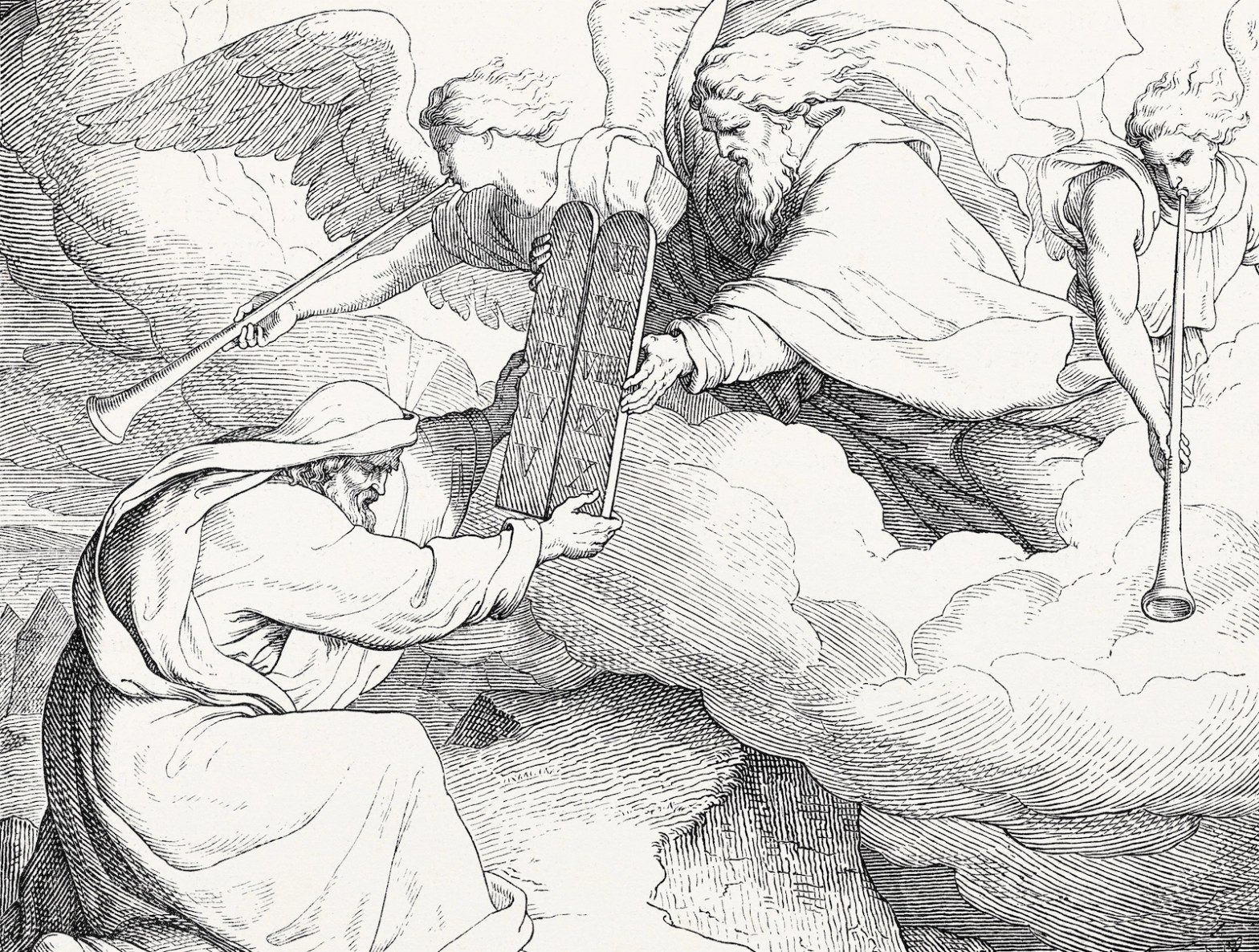
“For departing out of Raphidim, and coming to the desert of Sinai, they camped in the same place, and there Israel pitched their tents over against the mountain. And Moses went up to God: and the Lord called unto him from the mountain, and said, ‘Thus shalt thou say to the house of Jacob, and tell the children of Israel: you have seen what I have done to the Egyptians, how I have carried you upon the wings of eagles, and have taken you to Myself. If therefore you will hear My voice, and keep My covenant, you shall be My peculiar possession above all people: for all the earth is Mine. And you shall be to Me a priestly kingdom, and a holy nation. Those are the words thou shalt speak to the children of Israel.'”
Book of Exodus, 19: 2-6 [link]
There is a prevalence in our society of free thought and self-direction – I am my own person, I don’t need anybody to tell me what is right and wrong. We see it among Catholics also, we find the sentiment whispered into our hearts often enough. It is that wretched serpent from the Garden again. God responds to the problem of temptation and sin by giving a Law/guidance to the people, and, as in the Exodus reading, above enjoins that Law upon them in a covenant of belonging: obey the commandments and they have a relationship with God. Christ provided an extended set of commandments related directly to the old Law, and established His own covenant of belonging: obey His commandments and we Christians have a relationship of belonging with Christ.
The greatest of the Saints will tell us that in spiritual matters and in moral matters it is far better to be guided and directed (by somebody wiser) than to guide and direct ourselves. In the Religious Life, monks and nuns will do this as a matter of course. The rest of us are advised to find spiritual directors, although really good ones are rare. In that first reading from Exodus above, God gives the people Moses as spiritual director and judge, to enforce God’s own law for them. In the gospel story, God (now in the human form of Christ) gives the Church the Twelve Apostles – carefully named – as spiritual directors, them and their successors. They have extraordinary authority given them, the same type of juridical authority that Moses once had.
“And having called His Twelve disciples together, He gave them power over unclean spirits, to cast them out, and to heal all manner of diseases, and all manner of infirmities. And the names of the Twelve apostles are these: The first, Simon who is called Peter, and Andrew his brother, James the son of Zebedee, and John his brother, Philip and Bartholomew, Thomas and Matthew the publican, and James the son of Alpheus, and Thaddeus, Simon the Cananean, and Judas Iscariot, who also betrayed Him.”
Gospel of S. Matthew, 10: 1-4 [link]
Commandments are crucial guidance, for obedience and humility will save our souls. They are presented to us not by words in a book, but by appointed men.

