Last week I began to speak about prayer again, and I spoke first of silence as a mark of respect for Him Who dwells in the silence, and again of silence as a requisite for a healthy prayer life. Prayer is not only about us repeating the formulae of the Church which have been hallowed by time and author, it’s also about simply being able to sit in the quiet with God. We can, of course, do that in the quiet of our homes, but the Church has recommended sitting in the quiet of the church, before the tabernacle, and certainly the point of these holy half-hours before the Sunday Masses is to allow for silent prayer before the Sacrament exposed.
Today, I want to talk about order in prayer, and that means regularity and an approach to the sanctification of the hours. Order is something God brings about, and something mankind and especially the Church is tasked with maintaining. The Church has always had a system for order in prayer, which gained popularity through the ministrations of the Benedictine Fathers from the time of their foundation. It is called the Divine Office, or (these days) the Liturgy of the Hours. I say that the Church has always had this because the Church was born of the Temple and the synagogue, and both these institutions of the ancient religion of the Hebrews were marked by regularity. The morning sacrifice and evening sacrifice were crucial to the Temple, and seven appointments of prayers in the course of the day is sung about in the psalms (specifically Psalm 118(119), towards the end). The Acts of the Apostles tells us that the early Christians continued with their Temple observance, and they would have done so until the Temple was destroyed in AD 70. But there is no indication after this devastating blow to both Jews and Christians that the Church lost her prayer schedule. And she continued to use the old prayerbook of the Hebrews: the book of Psalms.
Now, I don’t mean that every one of us should or could pray seven times a day, as the priests do and the Religious in their monasteries and convents, but I do want to recommend a degree of regularity of prayer. Many of us already have a morning prayer, and an evening prayer, and/or (perhaps) a night prayer. I will recommend to you also the Liturgy of the Hours for these appointed moments in the day, because it was the desire of the Fathers at and after the Second Vatican Council that all Catholics be able to use this arrangement, which is why they went to the time and expense of not just simplifying the system of this Divine Office, but of translating it from the Latin and into our many languages. It’s nice to have a morning prayer (attached to breakfast), an evening prayer (attached to dinner) and a night prayer (attached to switching off your night-light).
It is very easy to fall away from resolutions, and even resolutions to prayer. There are so many distractions these days. So regular prayer must be built as a habit, and it should then become as second-nature as brushing our teeth or perhaps catching our favourite television show. Habits of prayer can be rewarding. If we can slot into the day our habitual daily rosary, so much the better and our Lady’s desire.
Many long millennia ago, God brought order out of chaos, and established the rhythm of the cosmos, then he built Mankind and put us into His Garden, to till and keep it. To advance it, to further that order. The Catechism still calls ‘disorder’ everything that militates against the divine Will. Every one of us who keeps a garden knows that the work of it is bringing order out of the chaos that continually threatens to engulf our work. Adam failed the original mandate, but Christ succeeded wonderfully in renewing mankind and remaking the primary duty of ordering the cosmos through communion with God. If we of His Church are to continue His work of bringing order into this beautiful world we live in, we shall begin well by ordering prayer.
“…I heard the reproaches of many, and terror on every side, ‘Persecute him, and let us persecute him’: from all the men that were my familiars, and continued at my side: ‘if by any means he may be deceived, and we may prevail against him, and be revenged on him.’ But the Lord is with me as a strong Warrior: therefore they that persecute me shall fall, and shall be weak: they shall be greatly confounded, because they have not understood the everlasting reproach, which never shall be effaced. And Thou, O Lord of hosts, Prover of the just, who seest the reins and the heart: let me see, I beseech Thee, Thy vengeance on them: for to Thee I have laid open my cause. Sing ye to the Lord, praise the Lord: because He hath delivered the soul of the poor out of the hand of the wicked.”
Prophecy of Jeremiah, 20:10-13 [link]
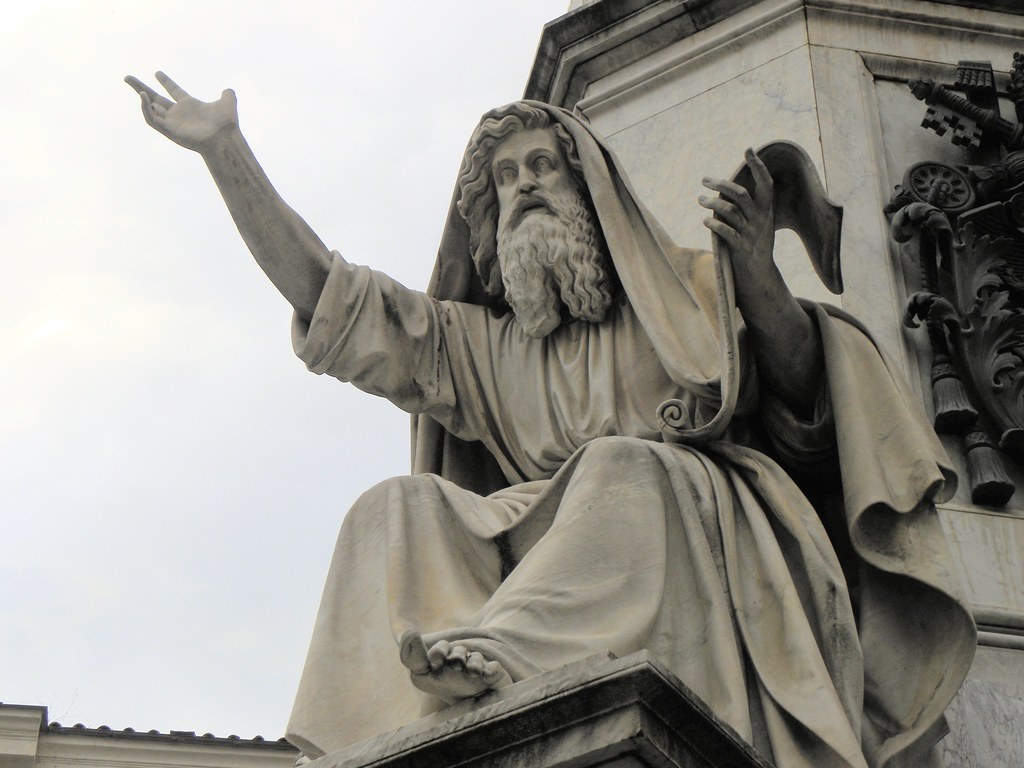
Our readings this weekend will tell us about constancy in more general terms. There is a power that pushes against our attempts to further the divine order. Jeremiah being a good prophet was not going to be pushed off the narrow way that the Holy One had given him to follow, despite the persecutions that came his way – Terror on every side, etc. He laments a little and the word ‘lamentation’ immediately brings dear Jeremiah to mind, but aren’t we given a little to lamenting ourselves sometimes, when life becomes difficult? The great Saints of the Church have also found (along with Jeremiah) the strong arm of God their Hero supporting them in the struggle. S. Paul speaks of this support of God as the free gift of divine grace in the second reading this weekend.
“Wherefore as by one man sin entered into this world, and by sin death; and so death passed upon all men, in whom all have sinned. For until the law sin was in the world; but sin was not imputed, when the law was not. But death reigned from Adam unto Moses, even over them also who have not sinned after the similitude of the transgression of Adam, who is a figure of Him Who was to come. But not as the offence, so also the gift. For if by the offence of one, many died; much more the grace of God, and the gift, by the grace of one Man, Jesus Christ, hath abounded unto many.”
Letter of S. Paul to the Romans, 5: 12-15 [link]
As I’ve said a few times, we are all to be Jeremiahs in this world that we live in, a world that is increasingly hostile to Christianity and to the Church and therefore to the divine order, a world that cannot tolerate our philosophy of the world or what they see as our ‘medieval’ beliefs and morality. But the Lord says in our gospel, Do not fear, do not fear even them who can destroy us from this world, for He Who made us values our lives very highly.
And when we have offered our lives to Him and for Him, with Christ vouching for us, He will restore us and give us eternal life.
“Therefore fear them not. For nothing is covered that shall not be revealed: nor hid, that shall not be known. That which I tell you in the dark, speak ye in the light: and that which you hear in the ear, preach ye upon the housetops. And fear ye not them that kill the body, and are not able to kill the soul: but rather fear Him that can destroy both soul and body in hell. Are not two sparrows sold for a farthing? And not one of them shall fall on the ground without your Father. But the very hairs of your head are all numbered. Fear not therefore: better are you than many sparrows. Every one therefore that shall confess Me before men, I will also confess him before My Father Who is in heaven. But he that shall deny Me before men, I will also deny him before My Father Who is in heaven”
Gospel of S. Matthew, 10: 26-33 [link]

