We continue this Sunday with our journey through the list of the seven deadly sins/vices; we don’t focus on the sins entirely, rather we point towards the corrective virtue that lived by itself ends the sin. We’ve looked at pride and avarice. Today is the turn of envy, or we could call this vice jealousy.
Shall we speak of a sorrow about the good fortune of somebody else, because we think that that somehow affects us or our own more limited fortune? We live in the ruins of a great Christian civilisation, so we have an instinct about this type of behaviour, and we wrinkle our noses at it when we see it. And then we may occasionally discover with horror the sentiment within our own hearts.
Christian charity compels us rather to rejoice in the blessings that other people receive, but we may find ourselves at least a little bitter about the situation. We are only human, of course. But we are called as Christians to be bigger than that, even to be superhuman – that’s what grace is supposed to do to us, it is to build upon our feeble human nature and make us more like God. Another appropriate saying is that the grass is always greener in somebody else’s field.
The envious person torments himself/herself without cause, because we can look away from that greener field and find happiness in what we ourselves have. The lack of charity involved in the vice of envy and the consequent sins of hatred, detraction, and malicious gossip that it engenders can make envy more serious, and even constitute a sin against the Holy Ghost, Who gives good things to all of us, albeit to different degrees, in so far as it benefits us.
I could be inspired by another’s success without begrudging it to him and change my life in order to be as successful, and I could do this without envy, properly described. I have already spoken of envy as being rather the result of a lack of charity. To counter it, we shall therefore be looking once more to the virtue of charity, or rather to characterisations of the charitable heart: goodwill and benevolence. Benevolence is literally wanting/wishing the good of somebody, so we shall not be unduly upset if that person does well. We could talk about beneficence, which is literally doing good for somebody – this is another side of charity.
But I want to end today with the desire for the good of another; as I said last week, this act of charity would be primarily for the sake of God Himself, Who loves the object of our benevolence and would wish us to do the same. Our most valuable prayer and one that we should make every day is that we grow each of us constantly in the virtue of charity.
This weekend, the Bishops have transferred the great feast day of the Assumption to the Sunday, and we rejoice in the great favour that the Holy One showed to this our sister in the flesh, who was privileged to be His Mother, and then by a marvellous act of generosity, was given to us for our own Mother from the height of the cross.
“And the Temple of God was opened in heaven, and the ark of His testament was seen in His Temple, and there were lightnings, and voices, and an earthquake, and great hail. And a great sign appeared in heaven: a woman clothed with the sun, and the moon under her feet, and on her head a crown of twelve stars. And being with child, she cried travailing in birth, and was in pain to be delivered. And there was seen another sign in heaven: and behold a great red dragon, having seven heads, and ten horns: and on his heads seven diadems, and his tail drew the third part of the stars of heaven, and cast them to the earth, and the dragon stood before the woman who was ready to be delivered; that, when she should be delivered, he might devour her son. And she brought forth a man child, who was to rule all nations with an iron rod: and her son was taken up to God, and to his throne. And the woman fled into the wilderness, where she had a place prepared by God, that there they should feed her a thousand two hundred sixty days. And there was a great battle in heaven, Michael and his angels fought with the dragon, and the dragon fought and his angels: and they prevailed not, neither was their place found any more in heaven. And that great dragon was cast out, that old serpent, who is called the devil and Satan, who seduceth the whole world; and he was cast unto the earth, and his angels were thrown down with him. And I heard a loud voice in heaven, saying, ‘Now is come salvation, and strength, and the kingdom of our God, and the power of His Christ: because the accuser of our brethren is cast forth, who accused them before our God day and night.”
Book of the Apocalypse of S. John (aka. Revelation), 11: 19 – 12: 1-10 [link]
Our first reading from the book of Revelation contains (i) a demonstration of OL as the ark of the covenant by immediate comparison, and (ii) a fulfilment of an ancient promise in the book of Genesis. God had cursed the serpent in the garden for drawing our first parents into sin and said that the son of a woman would complete its disgrace by crushing its head, while the serpent would bite back at the heel of this ‘son of man.’
In the reading above, the serpent lies in wait for the Woman, and prepares even to devour her Son with temptation and sin. They are both preserved! This is why the serpent hates the great Lady: her perfect purity and God-centred faith causes humankind to triumph over sin, even before the birth of Christ. From her comes God-made-man, the humiliation of the serpent is complete, and its malice is then turned upon the woman and her spiritual children – upon the Church (the sequel to the above: “And the dragon was angry against the woman: and went to make war with the rest of her seed, who keep the commandments of God, and have the testimony of Jesus Christ.” – Apocalypse 12: 17).
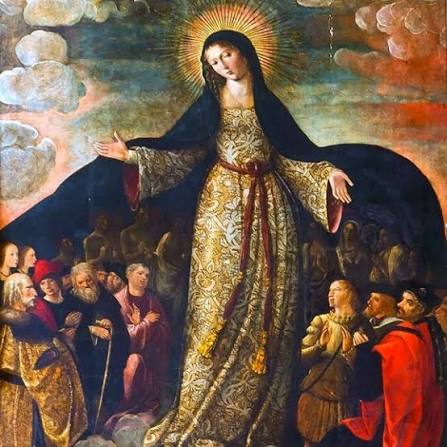
But we needn’t fear, we who keep the commandments of God and have the testimony of the Lord; we are safe under her mantle (see image below), for we look upon her – at once our older sister and our Mother by divine gift – standing on the right of the great King in garments of gold of Ophir (our response to the psalm this weekend) – we look upon her, and she teaches us how to love God, how to keep our faces turned towards Him, how to make our whole lives God-centred. We are the Saint Elizabeths in the gospel story, we are honoured that the Mother of the Lord visits us and stays with us, we declare in our Hail Marys, ‘Blessed art thou among women, and blessed is the Fruit of thy womb,’ and she sings to us of His glory and His victorious love for us all.
“And Mary rising up in those days, went into the hill country with haste into a city of Juda. And she entered into the house of Zachary, and saluted Elizabeth. And it came to pass, that when Elizabeth heard the salutation of Mary, the infant leaped in her womb. And Elizabeth was filled with the Holy Ghost, and she cried out with a loud voice, and said, ‘Blessed art thou among women, and blessed is the Fruit of thy womb. And whence is this to me, that the mother of my Lord should come to me? For behold as soon as the voice of thy salutation sounded in my ears, the infant in my womb leaped for joy. And blessed art thou that hast believed, because those things shall be accomplished that were spoken to thee by the Lord. And Mary said: ‘My soul doth magnify the Lord. And my spirit hath rejoiced in God my Saviour. Because He hath regarded the humility of His handmaid; for behold from henceforth all generations shall call me blessed. Because He That is mighty, hath done great things to me; and holy is His Name. And His mercy is from generation unto generations, to them that fear Him.”
Gospel of S. Luke, 1: 39-50 [link]