“I beseech you therefore, brethren, by the mercy of God, that you present your bodies a living sacrifice, holy, pleasing unto God, your reasonable service. And be not conformed to this world; but be reformed in the newness of your mind, that you may prove what is the good, and the acceptable, and the perfect will of God.”
Letter of S. Paul to the Romans, 12: 1-2 [link]
What a second reading we have this weekend (above) for the theme of Christian virtue that we have carried on with for some weeks. We have three more of these deadly sins to look at, once more with the intention not of focusing on the sin itself but of identifying and cultivating the opposite virtue in our hearts. We must remember once more that virtue is acquired by habitual action: somebody is reckoned to be brave because he has made brave actions a part of his character, and likewise a faithful person has become accustomed to acting faithfully in his life. It is through a life of virtue that we present ourselves to God as a living sacrifice, holy and pleasing to Him.
The deadly vice we are looking at today is lust, which is of course a disordered desire for sexual pleasure, especially beyond the legitimate bounds of wedlock. We don’t talk about this evil very much, do we? It’s far too embarrassing, because it has to do with something so very intimate, because it is an abuse of a great power entrusted to us by God – the power to bring new life into the world. And also because almost all of us today have fallen into this vice to some degree, or feel threatened by it.
It’s the culture we live in, inevitably: a sexualised and sexualising culture that is determined to completely uproot Christian morality in this particular respect. The movement had been underground long before the 1950s and 1960s, when a determined siege was raised against the fortress of Christian morality and the walls came tumbling down quickly, even within the Catholic Church, causing the mass of abuses which have thrown our parishes into some mayhem, with declining families and endless rebellion against the traditions of family and of church. The resulting crimes committed by some priests and Religious have also disfigured the priesthood in the general mind, and diminished the once respected and cherished states of virginity and consecrated life.
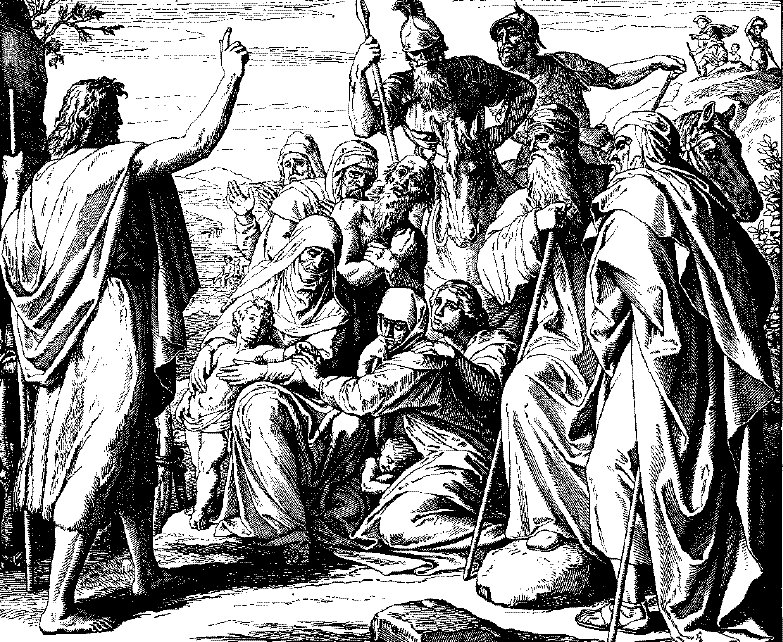
This weekend, we have marked the memorial of the martyrdom of S. John the Baptist, a relation of OLJC, who dared to challenged the want-to-be king Herod Antipas for taking his brother Philip’s wife as a concubine. Herod was afraid of John, who was a moral giant at the time, but the woman Philip’s wife, being thus humiliated by John, arranged for his execution, thus giving the Church one of her first martyrs and a great spiritual warrior against the vice of lust. The great Saint, long respected by the Western Church (there are so many surviving medieval English churches dedicated to his name), becomes for us a tower of strength in our battle against lust.
The opposing virtue which we must chase after and cultivate is chastity. And note carefully that chastity is not the virtue only of priests, monks and nuns, who will have made vows or promises of chastity. It is a virtue of the Christian life, and every one of us must take on chastity, which moderates the indulgence of the sexual appetite in the same way that temperance moderates other appetites.
The strength of sensuality and this sexual appetite within our hearts demands the utmost care in the pursuit of chastity; we cannot expect that the instinct departs with age, our elders may tell us that it does not. Great Saints of the Church like S. Philip Neri, the great apostle of Rome, have advised that when lust presents herself we had better strap on our running shoes and run like the wind in the opposite direction. In our times, when the media has worked overtime to normalise lust and the sins related to it, and when the new media enabled by the internet has worsened the situation further, the advice to run applies also to knowing well when electronic devices need to be turned off, and to understanding one’s own personal limits and erecting strong walls and fences against temptation.
Chastity certainly works within marriage to measure and regulate procreation and family size, for it is generally linked to abstinence and sobriety. But do note that the the Church has firmly condemned as leading to mortal sin technologies which are directed to controlling or ending procreation, like contraception and abortion, because of their serious theological and ethical implications; these technologies have also presented the opportunity for unbridled lust without the inevitable and consequent responsibilities.
In every aspect of sexuality then – in continence, chastity and defence of marriage – the virgin S. John the Baptist stands as a formidable champion. May he pray for us as we fight for God and for the well-being of our families.
Our readings this weekend may help us, as we seek to lead the Christian life in a world that is increasingly both anti-Catholic, and in the last several years anti-Christian. In difficult situations, Christianity becomes a word of prophecy in the mouths of Christians unwilling to preach it, because it will result at least in unpopularity and at most in arrest and fining and imprisonment. So the prophet Jeremiah feels reluctant to bring his woes upon Jerusalem and to correct the corruption of the Judaean king and his nobles and elites, because of the derision and reproach Jeremiah faces daily.
“Thou hast deceived me, O Lord, and I am deceived; Thou hast been stronger than I, and Thou hast prevailed. I am become a laughing-stock all the day, all scoff at me. For I am speaking now this long time, crying out against iniquity, and I often proclaim devastation: and the word of the Lord is made a reproach to me, and a derision all the day. Then I said, I will not make mention of Him, nor speak any more in His Name: and there came in my heart as a burning fire shut up in my bones, and I was wearied, not being able to bear it. For I heard the reproaches of many, and terror on every side, Persecute him, and let us persecute him: from all the men that were my familiars, and continued at my side: if by any means he may be deceived, and we may prevail against him, and be revenged on him.”
Prophecy of Jeremias, 20: 7-10 [link]
Are Christians not also a laughing-stock all the day in the scoffing society they often live in? Jeremiah is a laughing stock because he predicted destruction to be the result of the evil of the priests and nobility, and for a while nothing happened. Everything seemed to carry on as normal. And then the horrible armies of the Babylonian empire appeared on the horizon…
Our Lord Jesus Christ is marching towards a similar fate in the Jerusalem of His own day – worse, as He says, for He is to be tormented by the religious leaders of the people and will suffer death. Surprisingly, here, the spirit of the world speaks through the Apostle S. Peter to say, No, Lord, you had better not, such a grievous thing cannot happen to you, Whom I’ve just seen Transfigured on the mountain with Moses on one hand and Elijah on the other…
But He must go on, up to the Cross. As Jeremiah had to go on, and watch his beloved Jerusalem be razed to the ground by the Babylonians. And we must go on, preaching a message to a people that does not want to hear it. All is well, they say, there is no great impending destruction, no armies on the horizon… We have the mission plan of the Bishop, given us in February, and we shall work hard with it, and work hard for God. For if we make no mention of Him, and speak no more in His Name, His very same Holy Spirit Who possessed the prophet Jeremiah will light those bonfires within our own hearts until we stand up proudly again, marked with the cross of our baptism, taking up our crosses and following after Christ.
“From that time Jesus began to shew to His disciples, that He must go to Jerusalem, and suffer many things from the ancients and scribes and chief priests, and be put to death, and the third day rise again. And Peter taking Him, began to rebuke Him, saying, ‘Lord, be it far from Thee, this shall not be unto Thee.’ Who turning, said to Peter, ‘Go behind Me, Satan, thou art a scandal unto Me, because thou savourest not the things that are of God, but the things that are of men.’ Then Jesus said to His disciples, ‘If any man will come after me, let him deny himself, and take up his cross, and follow Me. For he that will save his life, shall lose it; and he that shall lose his life for My sake, shall find it. For what doth it profit a man, if he gain the whole world, and suffer the loss of his own soul? Or what exchange shall a man give for his soul? For the Son of man shall come in the glory of His Father with His angels, and then will He render to every man according to his works.'”
Gospel of S. Matthew, 16: 21-27 [link]

