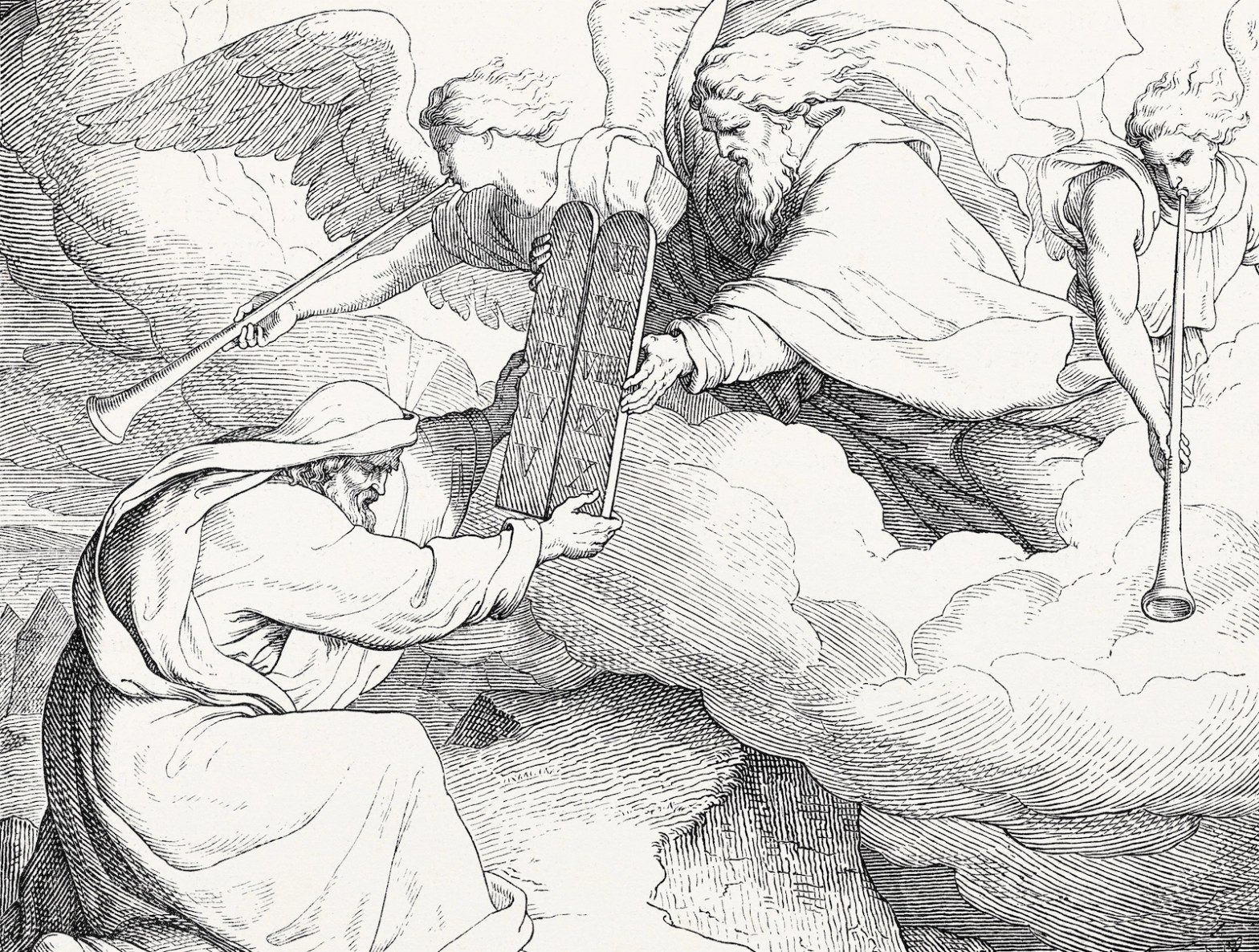
It was Moses who proposed to the people the two ways at the very top of the Bible, in the book of Deuteronomy. I have set before you life and death, blessings and cursings, he had said, but do ye choose life, that you and your children might live.
“I call heaven and earth to witness this day, that I have set before you life and death, blessing and cursing. Choose therefore life, that both thou and thy seed may live. And that thou mayst love the Lord thy God, and obey His voice, and adhere to Him (for He is thy life, and the length of thy days,) that thou mayst dwell in the land, for which the Lord swore to thy fathers Abraham, Isaac, and Jacob that He would give it them.”
Book of Deuteronomy, 30: 19-20 [link]
The Church is still extremely serious about theTen Commandments of Moses, which form the backbone of our catechisms and instructional books. In our times, the general fashion is to ignore the demand of the Gospel and the Commandments of the Hebrews, if we know what these are at all. But some of us are old enough to remember how much more serious the fasts and observances were, how much more dedicated we were as Catholics, how our parents would haul us to Sunday Mass, no excuses, sometimes very, very early, so we could have breakfast afterwards, before we fainted away. We may have thought that by making things easier and accommodating more people, by relaxing the discipline, more people would be interested. Instead, even the fervent very often fell away.
It is very hard to recommend diligence in the devout life of the Christian soul, who these days is torn between long work hours and the desire for leisure and entertainment. The Church may make a demand upon us, and use the authority given by Christ to the Apostles, and we may do what Ezekiel reports that the Hebrews did in our first reading.
“And you have said, ‘The way of the Lord is not right.’ Hear ye, therefore, O house of Israel: Is it My way that is not right, and are not rather your ways perverse? For when the just turneth himself away from his justice, and committeth iniquity, he shall die therein; in the injustice that he hath wrought he shall die. And when the wicked turneth himself away from his wickedness, which he hath wrought, and doeth judgment, and justice, he shall save his soul alive. Because he considereth and turneth away himself from all his iniquities which he hath wrought, he shall surely live, and not die.”
Prophecy of Ezechiel, 18: 25-28 [link]
God had demanded through the prophet a very basic honesty, justice and fair-dealing, together with a religious loyalty to the one true God. The people responded by saying that God’s way is unjust. These days, we would often look at a priest and bishop and perhaps say, as many do, Don’t judge me! Let me live my own life, let me do it my own way. The old ways of our parents and grandparents surely cannot apply anymore. Times are changed. I’m not confessing my most intimate failures to some priest in a box. I’m a good person, I love my family, I do charitable works, surely the most High cannot ask any more of me. There are many ways of protesting against the Will of God, when great Saints have advised docility. But God does ask us for more: he asks us to give everything up and follow after Him.
The human nature of Christ is an extraordinary thing to us, because it is fully human, as we are. And yet, it is bonded firmly to a divine nature. Because it is human although, the humanity of Christ suffers the demands of the Godhead. The human will of Christ conforms perfectly to the divine Will – He will do as the Father commands. And the Godhead demands personal sacrifice. S. Paul notes this carefully in our second reading today, which is all about the humility of Christ, and His subservience to the divine Will.
“If there be therefore any consolation in Christ, if any comfort of charity, if any society of the spirit, if any bowels of commiseration, fulfill ye my joy, that you may be of one mind, having the same charity, being of one accord, agreeing in sentiment. Let nothing be done through contention, neither by vain glory: but in humility, let each esteem others better than themselves, each one not considering the things that are his own, but those that are other men’s. For let this mind be in you, which was also in Christ Jesus: Who being in the form of God, thought it not robbery to be equal with God, but emptied Himself, taking the form of a servant, being made in the likeness of men, and in habit found as a man. He humbled Himself, becoming obedient unto death, even to the death of the cross. For which cause God also hath exalted Him, and hath given Him a Name which is above all names, that in the name of Jesus every knee should bow, of those that are in heaven, on earth, and under the earth, and that every tongue should confess that the Lord Jesus Christ is in the glory of God the Father.”
Letter of S. Paul to the Philippians, 2: 1-11 [link]
Paul applies this humility and servility to every other Christian heart. You too should be like Christ, he says, you must be united together with no rivalries, with an extreme communal charity, each person putting the others first. What a dream that is! If we were to live like that, we should have fewer arguments, bursts of bad temper, etc. It demonstrates the ideal, sacrificial heart of the Christian. If we remember that, after the belonging to Christ that the Sacraments bring about, the most important theme in Catholicism is sacrifice, then we see that we do have to give things up. Following the will of God and the teaching of the Catholic Church is not supposed to be comfortable, because it asks us to give things up. Not only sin, but some good things that we may like, or enjoy even. Not because there may be some benefit from that to our health or something… We shouldn’t be giving up nice things only for Lent. We should be giving up something more for Lent, something more than the usual. And we should tell Him we are doing it for Him. A life of prayer and sacrifice will make us better Catholics.
Our Lord tells us in the gospel reading that great sinners are entering the Kingdom of God before the professionally religious because, having converted to Christ, they are learning to love as the professionally religious may have forgotten to do. They are the son in the parable who said that he wouldn’t do what his father told him to, but went on to do it. The professional religious had the law of Moses and in their profession had said they would obey the commandments, but forgetting to love they had failed their task. Truly, we who say that we love God walk something of a tight rope in our pursuit of the virtuous life, because it’s just as easy for us to fail as it was for those high priests and elders of the people listening probably in a confused fury to Christ. In humility, and with fear and trembling, we each work out our salvation. For He says to His disciples as He once said to Moses, If you love Me, you will keep My commandments.
“Jesus answering, said to them, ‘I also will ask you one word, which if you shall tell me, I will also tell you by what authority I do these things. The baptism of John, whence was it? from heaven or from men?’ But they thought within themselves, saying, ‘If we shall say, from heaven, He will say to us, ‘Why then did you not believe him? But if we shall say, from men, we are afraid of the multitude: for all held John as a prophet.’ And answering Jesus, they said, ‘We know not.’ He also said to them, ‘Neither do I tell you by what authority I do these things. But what think you? A certain man had two sons; and coming to the first, he said, Son, go work today in my vineyard. And he answering, said, I will not. But afterwards, being moved with repentance, he went. And coming to the other, he said in like manner. And he answering, said, I go, Sir; and he went not. Which of the two did the father’s will?’ They say to him, ‘The first.’ Jesus saith to them, ‘Amen I say to you, that the publicans and the harlots shall go into the kingdom of God before you. For John came to you in the way of justice, and you did not believe him. But the publicans and the harlots believed him; but you, seeing it, did not even afterwards repent, that you might believe him.'”
Gospel of S. Matthew, 21: 28-32 [link]

