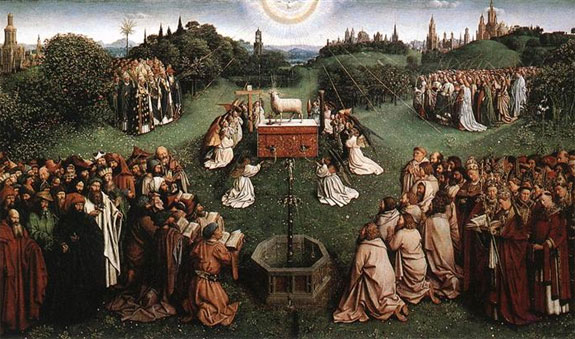
That’s the famous Wedding feast of the Lamb, by Jan van Eyck, part of the Ghent Altarpiece.
Our readings this weekend continue the theme of last week’s, which was about the vineyard being removed from its murderous tenants and given to another people who would bring forth its produce – that is, that the promise of God was to be removed from the ruinous and corrupted priesthood of the second Temple in the time of Christ and given over to a new priesthood established by Christ Himself. This weekend, the murderous tenants of the vineyard have become murderous wedding guests who are not interested in the call of the God of Israel. Always murderous, though.
We shall make mention of one major difference here between the old Hebrew priesthood of the Old Testament, and the new Christian priesthood of the New Testament. The matter is the inclusion of non-Jewish tribes of mankind in the covenant relationship with the God of Israel. This is a running theme in the Bible, and you may have heard me mention it several times before. The old Hebrew priesthood was established to serve the Hebrew tribes and those who associated with them in their commonwealth. As such, it was quite exclusive, although the great prophets among these priests – men like Isaiah and Jeremiah – foretold that the Messiah, the Successor of David, would establish a new situation where all the tribes of mankind would be welcomed into a covenant relationship with the God of Israel. We see one such picture in our first reading today, which is from Isaiah’s prophecy.
“And the Lord of hosts shall make unto all people in this mountain, a feast of fat things, a feast of wine, of fat things full of marrow, of wine purified from the lees. And He shall destroy in this mountain the face of the bond with which all people were tied, and the web that He began over all nations. He shall cast death down headlong for ever, and the Lord God shall wipe away tears from every face, and the reproach of His people He shall take away from off the whole earth, for the Lord hath spoken it. And they shall say in that day, ‘Lo, this is our God, we have waited for Him, and He will save us; this is the Lord, we have patiently waited for Him, we shall rejoice and be joyful in His salvation.’ For the hand of the Lord shall rest in this mountain, and Moab shall be trodden down under Him, as straw is broken in pieces with the wain.”
Prophecy of Isaias, 25: 6-10 [link]
The Christian will at once connect the banquet of the Holy One in this reading with the wedding feast of the Lamb described by the gospels and by the book of Apocalypse/Revelation. Here, in vision, the prophet Isaiah sees not just Hebrew tribes ascending the mountain of God but all people, and the host of the banquet will destroy death and remove a mourning veil and burial shroud off all nations. So, also in the gospel reading, we find in the parable that since the Jews of Christ’s day had overwhelmingly rejected Him as led by their leaders, everybody else is invited in their stead.
“And Jesus answering, spoke again in parables to them, saying, ‘The kingdom of heaven is likened to a king, who made a marriage for his son. And he sent his servants, to call them that were invited to the marriage; and they would not come. Again he sent other servants, saying, Tell them that were invited, Behold, I have prepared my dinner; my calves and fatlings are killed, and all things are ready – come ye to the marriage. But they neglected, and went their own ways, one to his farm, and another to his merchandise. And the rest laid hands on his servants, and having treated them contumeliously, put them to death. But when the king had heard of it, he was angry, and sending his armies, he destroyed those murderers, and burnt their city. Then he saith to his servants, The marriage indeed is ready, but they that were invited were not worthy. Go ye therefore into the highways; and as many as you shall find, call to the marriage. And his servants going forth into the ways, gathered together all that they found, both bad and good; and the marriage was filled with guests.
And the king went in to see the guests, and he saw there a man who had not on a wedding garment. And he saith to him, Friend, how camest thou in hither not having a wedding garment? But he was silent. Then the king said to the waiters, Bind his hands and feet, and cast him into the exterior darkness; there shall be weeping and gnashing of teeth.
For many are called, but few are chosen.'”
Gospel of S. Matthew, 22: 1-14 [link]
Who or what were the tribes of mankind mourning in the Isaiah reading? Why, let us take a trip back to Genesis, and you will remember again the sin of Adam and Eve in the Garden, which caused their separation from God their Lord, and brought about a reign of sin and death. Attempting to escape the reign of God, mankind had fallen under the reign of the serpent, and walked (as the psalm famously says) through the valley of the shadow of death. We all, as mortal beings in this life, walk constantly in the valley of the shadow of death. Hence a shroud and a mourning veil.
But now, declares the prophet, the Holy One God our Lord lifts the reproach at last, puts an end to the curses that were laid upon us as we left the Garden of Eden. How does He do that? The answer hangs above our heads in church and in our homes upon a cross – the Lamb of God, Whose wedding feast we have here in both our first reading and gospel reading. There is a rejoicing in the horror of the Cross, even if the lifeless Body hangs over our heads, for there is in the hearts of each one of us here who is baptised a spark of the Life that returned to that Body on Easter Sunday, and with that spark came a promise that we too would share that eternal Life that is His. As we responded to the psalm this weekend, In the Lord’s own house shall we dwell, forever and ever. Because of the Cross.
But let us be very, very careful about this. The promise of Christ does come with conditions. He says in the Gospel that we must love Him, and that we must show that we love Him by obeying His commandments, that many false prophets and false shepherds would attempt to draw us away from Him, but that we should nonetheless persevere through many sufferings and many difficulties. And speaking of suffering and perseverance, we might as well let S. Paul have a say from our second reading this weekend…
“I know both how to be brought low, and I know how to abound: (everywhere, and in all things I am instructed) both to be full, and to be hungry; both to abound, and to suffer need. I can do all these things in Him Who strengtheneth me. Nevertheless you have done well in communicating to my tribulation. And you also know, O Philippians, that in the beginning of the gospel, when I departed from Macedonia, no church communicated with me as concerning giving and receiving, but you only, for unto Thessalonica also you sent once and again for my use. Not that I seek the gift, but I seek the fruit that may abound to your account. But I have all, and abound; I am filled, having received from Epaphroditus the things you sent, an odour of sweetness, an acceptable sacrifice, pleasing to God. And may my God supply all your want, according to His riches in glory in Christ Jesus. Now to God and our Father be glory world without end. Amen.”
Letter of S. Paul to the Philippians, 4: 12: 20 [link]
The false prophets that Christ predicted have been with us for centuries, they are among us today, and the whisper of the serpent is always in our ears. It is the work of false prophets to create gospels and utopias of their own, as political movements have done in the last few centuries, to replace the God of Israel with other gods, either individuals or governments and cultural movements, and also to create situations of distress in order to subject the hearts of men and women to these new gods – to steal the hearts of Christians from Christ. As the gospel parable says, to make them give up their ‘wedding garments.’
All of us in baptism were given a white garment, and were told either ourselves or via our parents and godparents to maintain that white garment unstained until the end, when we shall stand before the High King. Now, I do not mean to say that this baptismal garment is the wedding garment of the parable. Rather, the wedding garment of the parable is a symbol of our perseverance in the Catholic Faith and in our attachment to Christ. It should be embarrassing if we get up to the pearly gates and have not the right disposition of heart, that is, the right clothing for the circumstance. So, let us stand firm, Christian souls, declare our allegiance to Christ and persevere in our devotions, no matter what life may bring us.

