
In times past, this whole part of the calendar year, from Trinity Sunday until the first Sunday of Advent, was called the time ‘after Pentecost.’ These days, we count down the Sundays to Advent in an ordered way and call it Ordered Time, or Ordinary Time. I wanted to in this small post call attention to an old page I copied onto this website, about the so-called Athanasian Creed. It was of old attributed to S. Athanasius, but that association is usually thought to be contrived. It remains that the Athanasian Creed, also called Quicumque-vult, after its first words in the Latin, is a concise statement of the faith, with a greater content about the Holy Trinity than the other popular creeds that we know – the Apostles creed and the Nicaeno-Constantinopolitan creed (both of which we use at Mass). Click the link in this paragraph for more.
Confessions at Louth
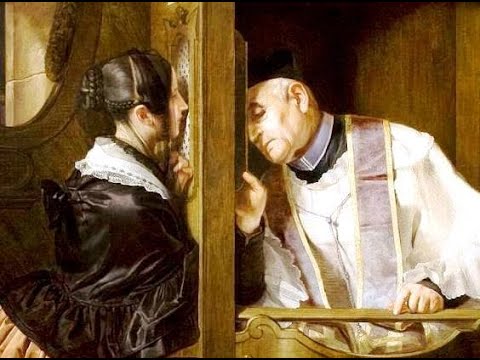
I thought that I would repeat what I had begun at Derby – an hour of Confessions heard on Saturday mornings and about a half hour before every Sunday Mass. We began that today. I shall eventually establish an hour of Confessions at Mablethorpe also.
Sacred Heart month
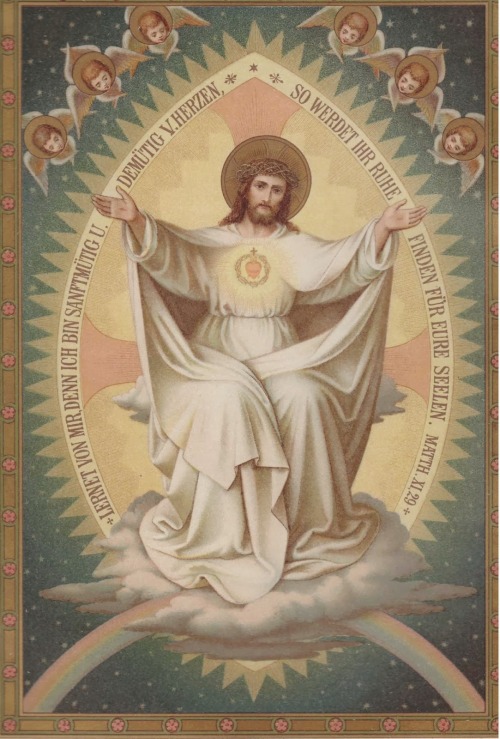
I’ve noticed that, once more, Catholic social media accounts are calling out about June being dedicated to the Sacred Heart. It’s been some time since I read Sister Margaret Mary’s reluctant autobiography about her visions of Christ. I say reluctant because, like so many other Catholic visionary Saints, she sought to be a recluse and to not receive publicity for herself. But messages like the one she received cannot be detached from the prophetic figures that bring them to the people. And Sister MM was a prophet. Here’s a short essay on her experiences:
She entered a community of the Visitation Sisters at Paray-le-Monial on the 25the of May, 1671, greatly gifted with humility and a generous spirit that drove her to choose duties for herself that made life particularly intolerable for herself. She found refuge from this in the Sacred Heart, and Christ acted personally as her spiritual director, confiding to her the mission to spread abroad devotion to His Sacred Heart. Religious superiors don’t generally look kindly on reports of spiritual excesses bestowed on their subordinates, and MM was called to obedience and to continue to lead the common life of the Sisters, despite the extraordinary favours shown her by the Most High. Suffering was His gift to her and she established the Holy Hour and the Holy Communion on the first Friday of every month. Christ called upon men and women in general to return to love of Him, and so to receive from the treasury of His Sacred Heart the love and mercy that was His gift, the sanctification and so the salvation that He had designed for the race of men. The Friday after the octave (eight days) of the feast of Corpus Christi was named by Christ Himself as the feast day of His Sacred Heart. He called Sister MM His beloved disciple of the Sacred Heart. She died with the Holy Name of Jesus upon her lips.
Here are the several promises made by Christ to those who would take up devotion to His Sacred Heart:
“I will give them all the graces necessary in their state of life.
“I will establish peace in their homes.
“I will comfort them in all their afflictions.
“I will be their secure Refuge during life, and above all in death.
“I will bestow abundant blessings upon all their undertakings.
“Sinners will find in My Heart the source and infinite ocean of mercy.
“Lukewarm souls shall become fervent.
“Fervent souls shall quickly mount to high perfection.
“I will bless every place in which an image of My Heart is exposed and honoured.
“I will give to priests the gift of touching the most hardened hearts.
“Those who shall promote this devotion shall have their names written in My Heart.
“I promise you in the excessive mercy of My Heart that My all powerful love will grant to all those who receive Holy Communion on the First Fridays in nine consecutive months the grace of final perseverance; they shall not die in My disgrace, nor without receiving their sacraments. My divine Heart shall be their safe refuge in this last moment.”
Masses and Services at the Louth
I have promised to begin very slowly with establishing new and regular Mass timings at both Louth and Mablethorpe. This means that we shall continue for now with the present Sunday Masses and the existing Wednesday and Thursday weekday Masses at Louth, but standardising the 9.30 timing.
I am also establishing from this weekend the Saturday morning Mass at Louth, also at 9.30, followed by the exposition of the Blessed Sacrament and an hour of Adoration and Confessions heard, followed by Benediction with the Blessed Sacrament. At the beginning of the hour of Adoration, parishioners will also be leading the Holy Rosary. I shall shortly establish an hour of Confessions at Mablethorpe also.
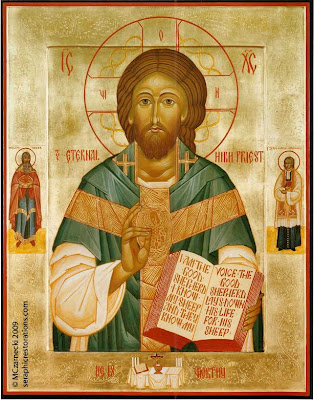
Today, we honour the Lord as the Eternal High Priest, both fully God and fully Man. Being fully Man enables Him to function as High Priest for the Elect of God.
Arrived at the parish house
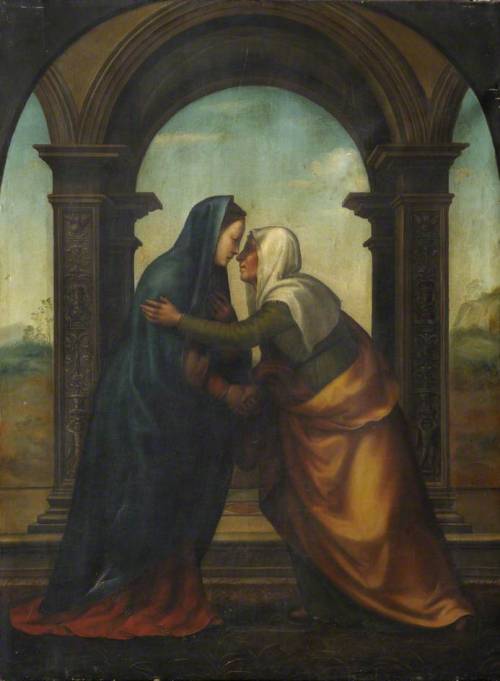
Late last night, we arrived with the misty rain. Just had a nice walk through town on market day. I hadn’t expected the great variety of shops the town has, or the number of people/cars that would be passing through. Father Thacker was in this morning again, to say Mass for the Visitation, and my father and I attended at the back of the church. My father has been helping me with the move over and is a devoted son of our Lady. He would not miss Visitation Mass, even after a long evening of packing and moving and a short night, and especially when our church is dedicated to her.
We are currently taking things out of boxes, and calming the animals down; they are excitedly examining their new habitat. My first Mass at the parish church will be tomorrow morning at 9.30, when we shall honour our Lord as the Eternal High Priest. Here’s a small extract from the letter of S. Paul to the Hebrews:
“The purpose for which any high priest is chosen from among his fellow men, and made a representative of men in their dealings with God, is to offer gifts and sacrifices in expiation of their sins. He is qualified for this by being able to feel for them when they are ignorant and make mistakes, since he, too, is all beset with humiliations, and, for that reason, must needs present sin-offerings for himself, just as he does for the people. His vocation comes from God, as Aaron’s did; nobody can take on himself such a privilege as this. So it is with Christ. He did not raise Himself to the dignity of the high priesthood; it was God that raised Him to it, when He said, ‘Thou art My Son, I have begotten thee this day,’ and so, elsewhere, ‘Thou art a Priest for ever, in the line of Melchisedech.’ Christ, during His earthly life, offered prayer and entreaty to the God Who could save Him from death, not without a piercing cry, not without tears; yet with such piety as won Him a hearing. Son of God though He was, He learned obedience in the school of suffering, and now, His full achievement reached, He wins eternal salvation for all those who render obedience to Him. A High Priest in the line of Melchisedech, so God has called Him.”
Letter to the Hebrews, 5: 1-10
Short commentary on the Gospel of S. Matthew
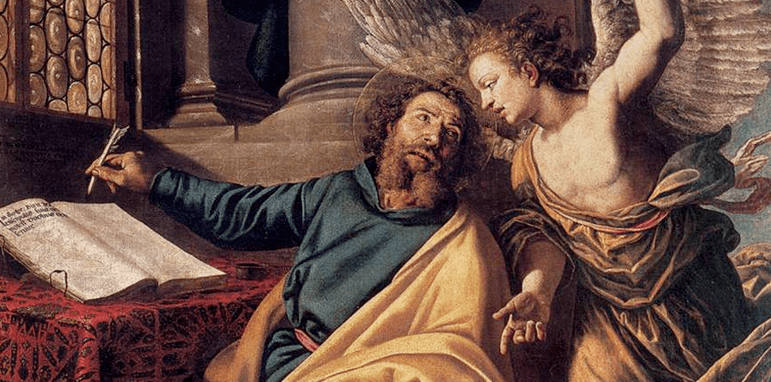
I had begun to read the Bible in a year about two years ago; it seemed something of a fashion during the long months of the lockdown. And I simultaneously scribbled some little notes. I shall use those to populate this blog until I can get some new content in. That will happen when I have completed the relocation to Louth. But here’re my ramblings about the Gospel of S. Matthew.
It’s still safe to consider S. Matthew’s Gospel as being written the first, which is the traditional story, although a large portion of modern scholarship has succumbed to the idea that Saint Mark’s Gospel is prior, because of its smaller size. The idea seems to be that the shortest comes first, like a skeleton, which is later fleshed out into newer versions. There’s also this reasonable if entirely un-evidenced idea that there was a common body of ‘Jesus sayings’ that the scholars call Q, from which the evangelists (except Saint John) drew upon to construct their several essays. It’s all way up there: clever ideas thought up by clever people, you see. I’ve always thought, in my own reading, that these modern scholars picture the Apostles and Evangelists as scholars sitting in writing rooms to write, with bookshelves of reference books behind them. When you consider that many of these same scholars think that the Gospels were all written decades after the Ascension of Christ, and not by the Apostles and their disciples but later Christians, you can see why this whole idea of assembling by reference to other traditions fits in. I may refer to this theory as the priority of Saint Mark’s Gospel…
But, the older idea, as I said, may still be held. The Apostles had a mission and needed to leave the Holy Land at some point, possibly at some time in the late 50s. They required a working text of the Gospel to carry on to the countries they would visit. They must have generally used Matthew’s Gospel, the only one written at the time. He was one of the Apostles, of course. I know that at least the Apostle Bartholomew’s copy was left behind in India and found later (according to Eusebius’ history); and, of course, the Apostle Barnabas was buried with his copy. The mission of the Apostles, as also of Christ, was to the Jewish people, and the Gospel of Saint Matthew is full of references to the Hebrew Bible, what we call the Old Testament. Mark’s Gospel, written later, when the Apostle Saint Peter had arrived in Rome and Mark had joined Peter’s disciples there, is shorter and has some particular reference to Saint Peter, as it naturally would. It’s similarity to Saint Matthew’s Gospel may simply be explained by the fact that that was available in Rome and regularly heard, alongside the Holy Father Saint Peter’s own reminiscences. Saint Luke’s Gospel contains new information, such as in the infancy stories, and must have required further input from local Christians in the Holy Land (such as the Blessed Virgin) and is certainly from later on. Saint John’s Gospel is generally considered to be the last of the four, although it contains some very early, first-hand-witness information.
Flipping through Matthew’s Gospel right now, it’s surprising how short it feels, how abbreviated. The Gospels were not meant to be biographies of Christ, although they provide biographical information. They were concerned rather with presenting Christ as the fulfilment of the Promise. Matthew therefore provides an adjusted genealogy at the very beginning, to demonstrate that Christ’s arrival was carefully planned. Saint John the Baptist is introduced and surpassed. The Apostles are appointed, the inner circle first – Peter (along with his brother Andrew), James and John – and then the rest. There is the great Sermon on the Mount, between chapters five and seven, a first catechism, we might say. Then come the long stream of miraculous works, interspersed with confused Jewish leaders – pharisees, mostly, but increasing numbers of scribes and Sadducees (Jerusalem priests and their associates) – asking why such an orthodox Jew doesn’t observe all the various purity laws of the people. The disciples are then sent on the mission. John the Baptist is soon killed by Herod, the ethnarch of Galilee, and Christ takes Himself away from Galilee. In the midst of new attention from the Pharisees and the Sadducees, Christ prepares for His sacrifice with the Transfiguration on the mountain and the procession to Jerusalem. The controversies with the Jerusalem authorities climax with the terrible parables of the vineyard owner whose servants and son are killed by the vineyard keepers and of the king whose son’s wedding feast is not attended by those invited. The implied abandonment of Jerusalem by God brings a new fury into the hearts of the Jerusalem authorities, who arrange for Christ’s arrest. He establishes the new covenant, is tried, tortured, killed and returns from the dead. The Church then receives the command to go forth on the mission.
It’s the greatest story ever told, a romance and a love story. Read the whole thing here.
Moving to Louth S. Mary
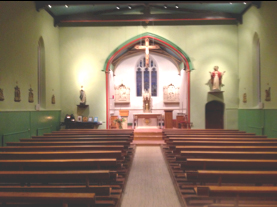
As it says at the bottom of the front page, there’s something of a countdown to my move across the country to the parish in Louth, which has recently had her parish priest retire. This will be an exciting, new thing, for I have never before remained for longer than a few hours in any part of Lincolnshire, having only briefly visited Lincoln city, Scunthorpe, Grimsby and lately Louth itself. With only a few, last minute duties at my present location in Derby, I should begin the move at month-end.
I’ve hijacked the image from the parish website, but I shall soon have my own pictures…
 Catholic Louth and Mablethorpe